
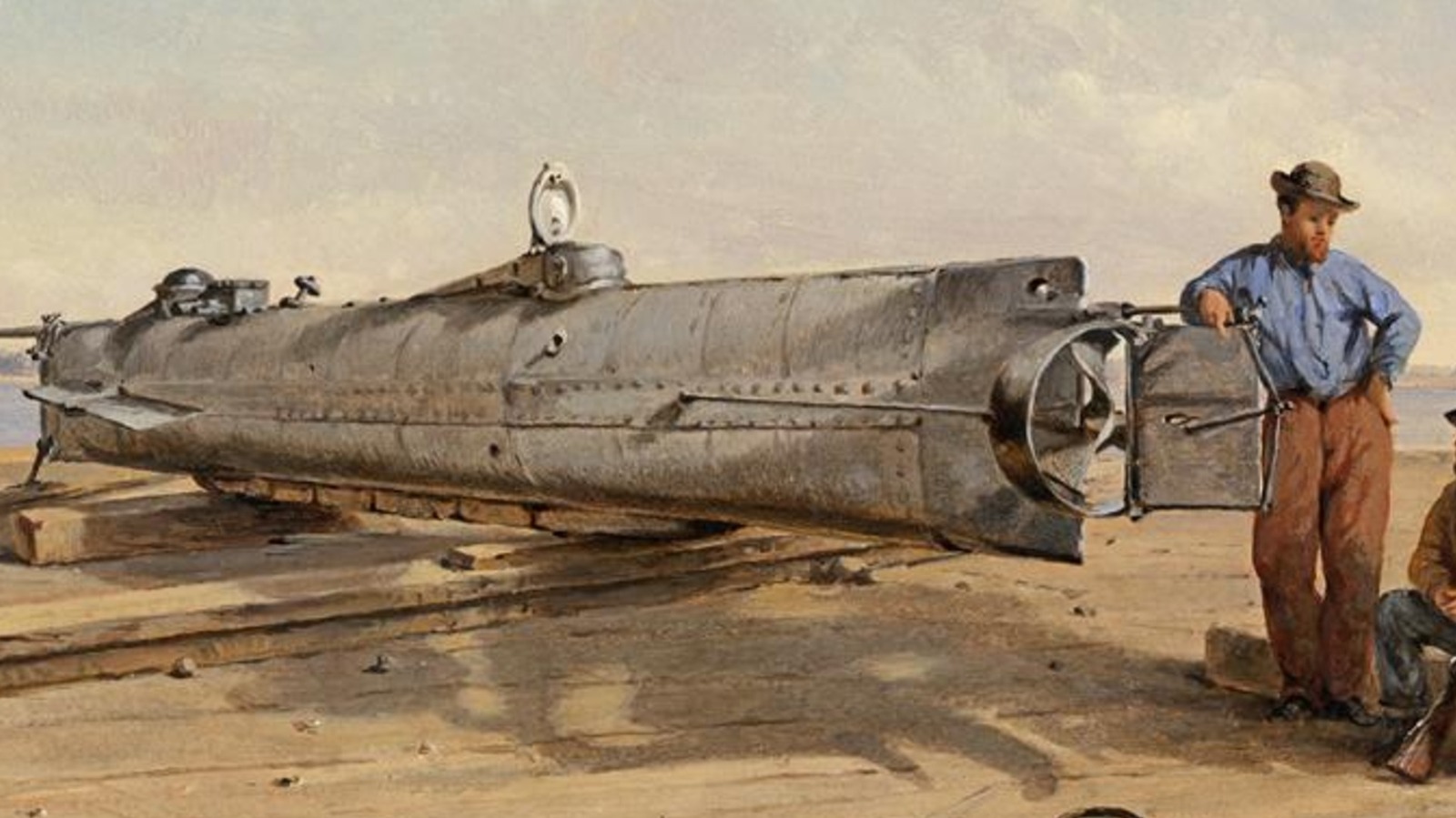
For over a century, the depths of the Atlantic Ocean held a secret that defied naval logic. The H.L. Hunley, a Confederate submersible from the American Civil War, had achieved a feat of military history by becoming the first submarine to sink an enemy warship in combat. Yet, the victory was short-lived. Shortly after its successful strike, the vessel vanished, taking its eight-man crew into a watery grave that remained undisturbed for 136 years.
The discovery of the wreck in 2001 did more than just locate a missing ship; it opened a forensic cold case that challenged historians and scientists alike. When the vessel was finally raised from the seabed, researchers found the crew still at their stations, frozen in a haunting tableau of their final moments. The real mystery was not where they were, but why they hadn’t tried to escape.
As a technology editor, I find the Hunley’s story particularly compelling because it represents the bleeding edge of 19th-century engineering. It was a prototype of undersea warfare, built with a level of desperation and innovation that mirrored the chaos of the American Civil War. The intersection of early mechanical engineering and modern forensic science has finally begun to peel back the layers of what happened on that fateful night in February 1864.
The Mission and the First Combat Sinking
The H.L. Hunley was not a government project at its inception. It was privately funded and developed by Horace Lawson Hunley, an entrepreneur and innovator, and built by Park and Lyons of Mobile, Alabama, in 1863 according to the Naval History and Heritage Command. The vessel was essentially a modified iron cylinder, roughly 40 feet long, designed to be hand-cranked by its crew.
On February 17, 1864, the Hunley executed its most famous mission. It targeted the USS Housatonic, a Union blockader guarding Charleston Harbor. The Hunley utilized a “spar torpedo”—an explosive charge mounted on a long pole protruding from the bow. The attack was successful; the Housatonic sank, marking the first time in history that a submarine had sunk an enemy warship during wartime as documented by the U.S. Navy.
However, the triumph was fleeting. The Hunley never returned to port. For over a century, theories ranged from a catastrophic mechanical failure to a sudden ambush by Union forces. The vessel remained lost until 2001, when a joint effort by the U.S. Navy and archaeologists located the wreck off the coast of South Carolina.
The Forensic Mystery: Why Didn’t They Escape?
When the Hunley was recovered and carefully opened, the discovery shocked the archaeological community. The remains of the eight crew members were found largely in their original positions. There was no evidence of a struggle, no signs of panic, and no indication that the men had attempted to scramble toward the hatch.
This lack of movement created a scientific paradox. If the submarine had slowly leaked or run out of air, the crew would have likely moved around the cabin in a desperate search for oxygen or a way out. The fact that they remained at their stations suggested a sudden, incapacitating event.
For years, researchers debated the cause of death. Some hypothesized carbon monoxide poisoning from the engine or a sudden influx of water. However, recent multidisciplinary research has pointed toward a more violent, yet invisible, cause. A study published in PLOS One
suggests that the crew may have been killed by air blast injuries resulting from the detonation of their own torpedo according to forensic analysis.
The theory posits that because the Hunley was so close to the USS Housatonic during the attack—less than 16 feet away—the resulting explosion created a shockwave that traveled through the water and the iron hull. This “blast overpressure” could have caused immediate internal injuries, such as lung collapse or brain trauma, rendering the crew unconscious or dead instantly, explaining why they remained in their seats.
Engineering a Death Trap: The Risks of Early Submersibles
From a technical perspective, the H.L. Hunley was an incredibly dangerous environment. The crew operated in a cramped, iron tube with minimal ventilation and a primitive propulsion system. The physical toll of hand-cranking a vessel through the Atlantic currents was immense, and the risk of asphyxiation was a constant threat.
The vessel’s design reflected the experimental nature of the era. It lacked the sophisticated ballast and diving systems of modern submarines. Instead, it relied on the physical strength of the crew and a rudimentary understanding of buoyancy. The very features that made it a stealthy weapon—its small size and iron skin—also made it a potential coffin if anything went wrong.
Key Technical Specifications of the H.L. Hunley
| Feature | Detail |
|---|---|
| Length | Approximately 40 feet |
| Hull Material | Iron |
| Propulsion | Manual hand-crank |
| Weaponry | Spar Torpedo (Black Powder) |
| Crew Capacity | 8 Members |
What So for Naval History
The recovery and analysis of the H.L. Hunley serve as a pivotal case study in both naval architecture and forensic archaeology. It proves that the “success” of a military operation is not always measured by the damage dealt to the enemy, but by the survivability of the platform. The Hunley was a tactical success but a systemic failure.

The mystery of the crew’s silence underscores the volatility of early explosives and the physics of underwater pressure. By combining historical records with modern CT scans and blast-wave simulations, scientists have been able to reconstruct a scene from 1864 with a level of precision that was previously impossible.
The story of the Hunley is a reminder of the human cost of innovation. The eight men who sailed in that iron cylinder were pioneers in a new form of warfare, venturing into an environment where the slightest miscalculation meant certain death. Their final positions, preserved for over a century, stand as a silent testament to the dangers of the early industrial age.
Frequently Asked Questions
When was the H.L. Hunley found?
The wreck was located in 2001 and subsequently raised for conservation and study.
Who was Horace Lawson Hunley?
He was the inventor and financial backer of the submarine, though he died during an earlier trial run of the vessel.
Did the crew die of suffocation?
While early theories suggested suffocation or carbon monoxide poisoning, more recent forensic evidence suggests that blast injuries from the torpedo detonation were the likely cause of death.
Where is the H.L. Hunley now?
The submarine is preserved and on display at the Warren Lasch Conservation Center
in North Charleston, South Carolina.
The ongoing study of the H.L. Hunley continues as researchers utilize new imaging technologies to further analyze the remains and the vessel’s structure. The next phase of research involves deeper isotopic analysis of the crew’s remains to better understand their origins and health prior to the mission.
Do you consider the risks taken by the Hunley crew were justified by the tactical gain? Share your thoughts in the comments below and share this article with other history and tech enthusiasts.