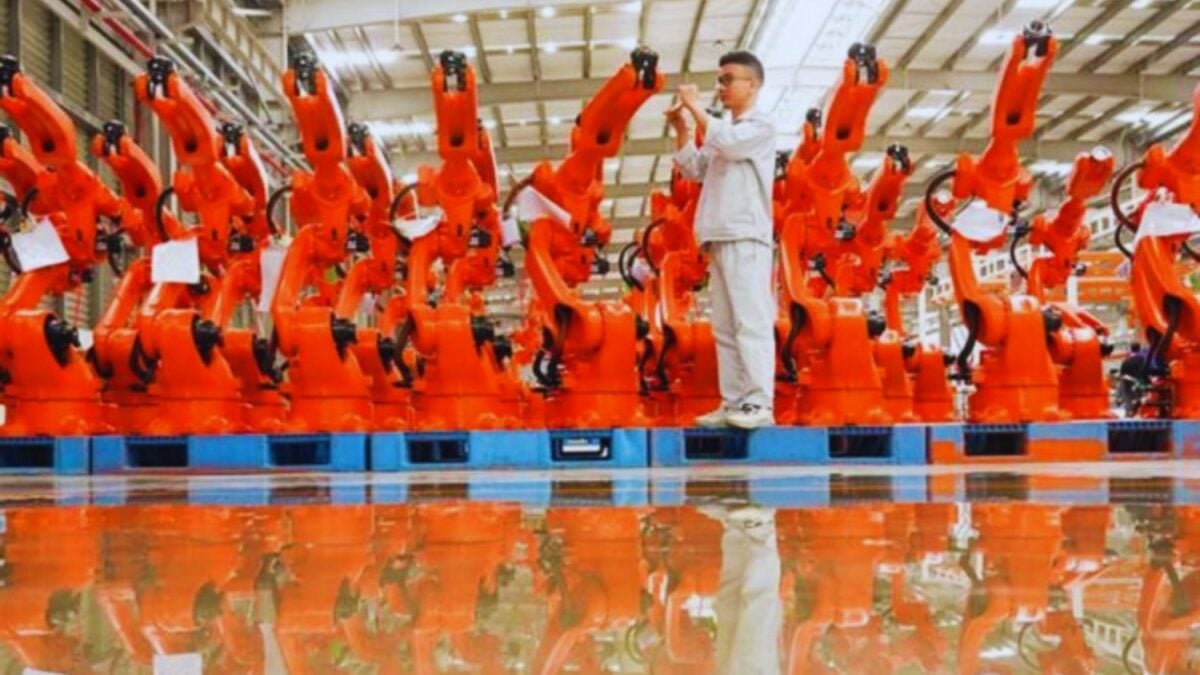
For decades, the global perception of the Made in China
label was inextricably linked to a vast, low-cost labor force. However, a fundamental structural shift is currently underway. Beijing is pivoting away from human-centric productivity toward a model where industrial dominance is measured not by the number of workers on a floor, but by the number of robots coordinated by a central artificial intelligence.
This transition is manifesting in the rise of dark factories
—production facilities so automated they require no internal lighting because no humans are present to see them—and the deployment of massive autonomous fleets in the harshest environments. From the freezing plains of Inner Mongolia to the critical nodes of the national power grid, China is integrating embodied AI to insulate its economy from demographic decline and rising labor costs.
The scale of this ambition is evidenced by recent state-level investments. In April 2026, reports emerged that the State Grid Corp. Of China plans to invest approximately 6.8 billion yuan (roughly $994.7 million) this year to procure about 8,500 AI-powered robots for the inspection and maintenance of vital infrastructure according to Caixin Global. This move marks one of the first large-scale industrial deployments of embodied AI, utilizing humanoid robots and robotic dogs to navigate hazardous environments and ensure grid reliability.
The Era of the ‘Dark Factory’ and Autonomous Logistics
The concept of the dark factory
is moving from theoretical prototype to commercial reality. In northeast China, the manufacturer Zeekr has implemented robotic production lines where vehicles are assembled and rolled off the line without human intervention. These facilities represent a departure from the traditional assembly line, replacing human choreography with algorithmic precision.
Beyond the factory walls, the automation of logistics is scaling rapidly. In May 2025, China deployed what is currently the world’s largest fleet of autonomous electric mining trucks at the Yimin coal mine in Inner Mongolia. The fleet consists of 100 AI-driven vehicles developed by Huaneng Mengdong Company, a subsidiary of the state-owned China Huaneng Group, utilizing Huawei’s autonomous driving technology as reported by Shanghai Metals Market. These trucks are designed to operate in extreme temperatures as low as -48.5°C, proving that AI coordination can maintain productivity where human labor is physically unsustainable.
The logistics sector is further being transformed by startups like Robotera. The company has secured significant strategic backing, including a funding round led by Geely Capital, and has entered a deep partnership with SF Technology to deploy embodied AI solutions in express delivery and warehousing. By focusing on factory-floor stability
rather than speculative hype, these firms are integrating bipedal humanoid robots into active supply chain roles.
Strategic Policy: The 15th Five-Year Plan
This industrial pivot is not accidental but is the result of a coordinated national strategy. The Ministry of Industry and Information Technology (MIIT) has integrated AI, humanoid robots, and 6G technology as primary growth drivers in the country’s latest strategic blueprints. On March 24, 2026, the MIIT publicly solicited opinions on the High-Quality Development Action Plan for Intelligent Manufacturing Equipment Industry (2026–2030)
, a document designed to fast-track the adoption of intelligent machinery across the factory floor according to official policy filings.

The 15th Five-Year Plan emphasizes the creation of new quality productive forces
, a term used by the Chinese government to describe economic growth driven by technological breakthrough rather than traditional capital or labor expansion. By prioritizing embodied AI—AI that exists in a physical body capable of interacting with the real world—Beijing aims to maintain its global manufacturing edge even as its working-age population shrinks.
Key Pillars of China’s Autonomous Industrial Strategy
| Sector | Key Technology | Recent Milestone | Primary Objective |
|---|---|---|---|
| Energy Grid | Humanoid Robots / Robot Dogs | $1B investment for 8,500 robots | Hazardous environment maintenance |
| Mining | 5G-A Autonomous Trucks | 100-truck fleet in Inner Mongolia | Productivity in extreme climates |
| Manufacturing | Dark Factory Robotics | Zeekr unmanned production lines | Elimination of human-centric downtime |
| Logistics | Embodied AI / Bipedals | Robotera & SF Tech partnership | Flexible warehousing and delivery |
Economic Implications and Global Competition
From an economic perspective, this shift represents a hedge against the middle-income trap
. As wages in China have risen, the country has lost its competitive advantage in low-end assembly. By transitioning to AI-coordinated robotics, China is attempting to leapfrog the traditional industrial evolution, moving directly into a high-efficiency, autonomous era.
However, this transition creates a new set of risks. The reliance on centralized algorithms for industrial decision-making introduces vulnerabilities to systemic software failures and cybersecurity threats. The rapid displacement of manual labor in sectors like logistics and mining poses significant social challenges regarding workforce transition.
For global markets, the implication is clear: the competition is no longer about who has the most workers, but who has the most efficient coordination between AI and hardware. The ability to deploy 8,500 robots to manage a power grid or 100 autonomous trucks in a sub-zero mine suggests a level of industrial scaling that few other nations have currently matched.
The next critical milestone for the sector will be the formalization of the High-Quality Development Action Plan for Intelligent Manufacturing Equipment Industry (2026–2030)
following the MIIT’s current consultation period. This document will likely provide the specific benchmarks and subsidies that will dictate the pace of robotic adoption through the end of the decade.
World Today Journal encourages readers to share their thoughts on the rise of dark factories and the future of global labor in the comments below.