
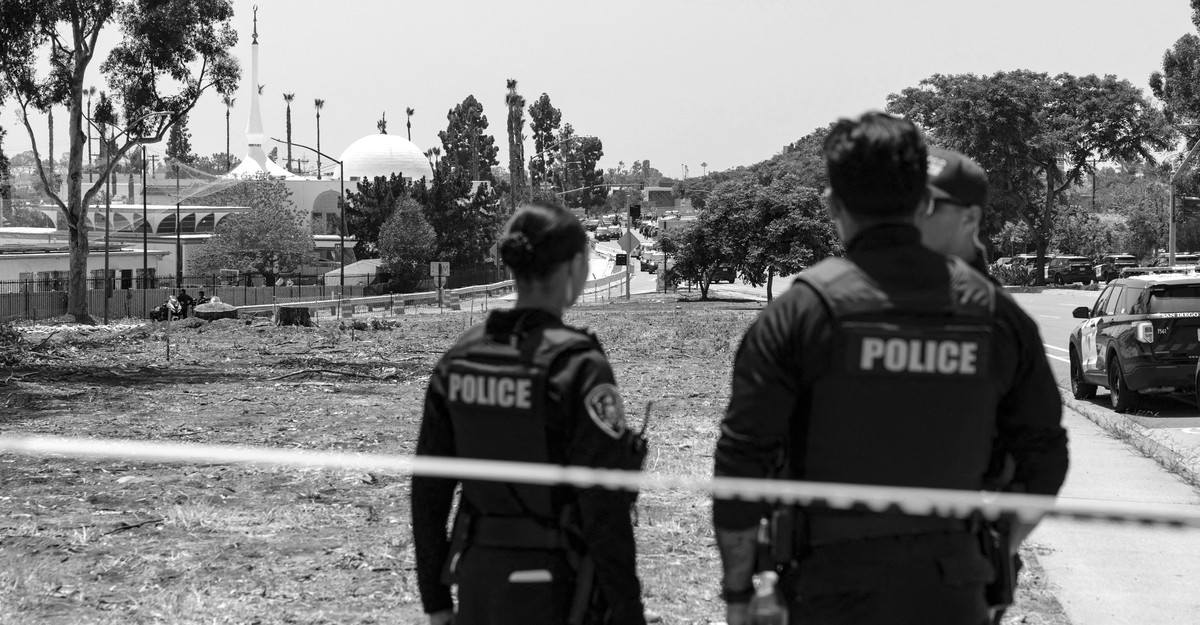
The recent reported tragedy at the Islamic Center of San Diego has sent shockwaves through the international community, highlighting a terrifying evolution in how extremist ideologies are consumed and broadcast. As investigators work to piece together the motivations behind the attack, which reportedly left three people dead, a darker pattern is emerging—one that moves beyond simple political grievance into a digital realm where the glorification of mass murder is treated as a form of online performance.
Authorities are currently scrutinizing a purported 75-page manifesto and video recordings that appear to show the suspects, identified as teenagers Caleb Vazquez and Cain Clark, livestreaming their assault. The incident, which culminated in a fatal encounter between the two suspects in a stolen vehicle, is being viewed by experts not as an isolated act of violence, but as a calculated attempt to engage with a globalized, digital subculture of extremism.
This intersection of high-tech connectivity and ancient hatreds marks a significant shift in the landscape of domestic terrorism. It suggests that the modern extremist is no longer a solitary figure operating on the fringes of society, but a participant in a highly networked, “fandom-like” ecosystem designed to reward violence through digital engagement.
The Mechanics of Memetic Radicalization
Central to this new era of violence is what researchers call “memetic radicalization.” According to the Global Network on Extremism and Technology, this process involves the use of internet culture—memes, specific aesthetics, and shared digital “vibes”—to normalize and attract individuals to violent ideologies. In the case of the San Diego suspects, the use of body cameras to livestream the attack suggests a desire to create content for specific online communities, such as those found on the messaging platform Discord.

This method of radicalization transforms heinous acts into a form of digital currency. By recording their crimes, perpetrators aim to achieve a level of infamy that resonates within extremist echo chambers. This “online vibe” can act as a low-barrier entry point for young people, drawing them into radical circles through shared interests in gaming or internet subcultures before introducing them to more virulent forms of hate.
Researchers note that this phenomenon can even cross racial and cultural lines. The digital architecture of modern extremism allows for a “nihilistic violence” that is less about traditional political goals and more about the spectacle of destruction itself. This was evidenced by recent reports of a 17-year-old student in Jakarta, Indonesia, who allegedly utilized neo-Nazi imagery in a school bombing attempt, demonstrating how these digital subcultures can influence even those far removed from the traditional geographic strongholds of white supremacy.
Accelerationism and the Pursuit of Societal Collapse
The ideology driving the San Diego attack appears to be rooted in “militant accelerationism.” This white supremacist doctrine posits that modern society is beyond repair and that only through targeted, extreme acts of violence can the existing social order be collapsed, eventually paving the way for the creation of a white “ethnostate.”
The symbolism associated with this movement is pervasive and highly recognizable to security agencies. Investigators noted that the suspects reportedly wore patches displaying the “Black Sun”—a neo-Nazi iteration of the swastika—and had inscribed various hateful symbols on their weapons. This visual language serves two purposes: it signals allegiance to a specific, violent movement and provides a recognizable brand for the “content” they produce for their online followers.
The purported manifesto linked to the San Diego attack contains intense vitriol directed at a wide array of identity groups, including Muslims, Jewish people, Black people, and the LGBTQ community. By framing their violence as a necessary step toward societal downfall, these actors attempt to lend a sense of “purpose” to what is essentially senseless slaughter, turning mass murder into a perceived tool of political and social engineering.
From Fringes to Fandoms: A New Era of Extremism
Historically, extremist communities were often geographically isolated, operating in hard-to-reach regions such as the American South or the Idaho panhandle. In those eras, recruitment and indoctrination were slow, face-to-face processes. Today, the digital landscape has removed these barriers, allowing extremist ideologies to flourish in the open through “fandom-style” engagement.

Cody Zoschak of the Institute for Strategic Dialogue has suggested that some modern extremists may not fully embrace the traditional tenets of historical movements like the Third Reich, but instead treat far-right extremism as a “fandom.” This shift is particularly evident in the rise of “nihilistic violence” circles, which include the “True Crime Community” (TCC). While the TCC is often associated with mainstream non-fiction, certain internet subcultures have co-opted the genre to valorize mass shooters, treating them as dark celebrities rather than criminals.
This “fandom” approach creates a dangerous feedback loop:
- Consumption: Users engage with content related to mass casualty events.
- Validation: Extremist platforms reward this engagement with social status.
- Action: The desire for “infamy” drives individuals to commit acts of violence that can be recorded and shared.
- Amplification: The recorded acts are then used to recruit and radicalize the next wave of participants.
As digital extremism continues to evolve, the challenge for global security forces is no longer just monitoring physical gatherings, but understanding the complex, memetic ways in which violence is being gamified and glorified across the internet.
Authorities are currently continuing their forensic review of the digital evidence and the authenticity of the suspects’ writings. Further updates regarding the investigation and the authentication of the manifesto are expected as law enforcement completes its assessment.
What are your thoughts on the impact of digital subcultures on modern radicalization? Share this article and join the conversation in the comments below.