
Public school educators across the United States are increasingly struggling to meet basic financial obligations as stagnant wages fail to keep pace with inflation and the rising cost of living. Data from the National Education Association (NEA) indicates that in terms of purchasing power, the average teacher’s salary has declined over the past decade, leaving many professionals to rely on second jobs or personal debt to cover essential expenses like housing and healthcare. This financial instability has intensified calls for legislative reform regarding school funding and the protection of collective bargaining rights.
The financial pressure on classroom teachers is systemic, according to recent reports from the National Education Association, which found that when adjusted for inflation, teacher pay has actually fallen over the last ten years. While nominal salaries have seen incremental increases, these gains have been largely neutralized by the rising costs of fuel, groceries, and housing. As reported by the NEA, the average starting salary for a teacher has increased by only 0.7% in recent years, a figure that significantly trails the broader inflationary trends affecting the U.S. economy. National Education Association: Rankings and Estimates Report
The Growing Teacher Pay Penalty
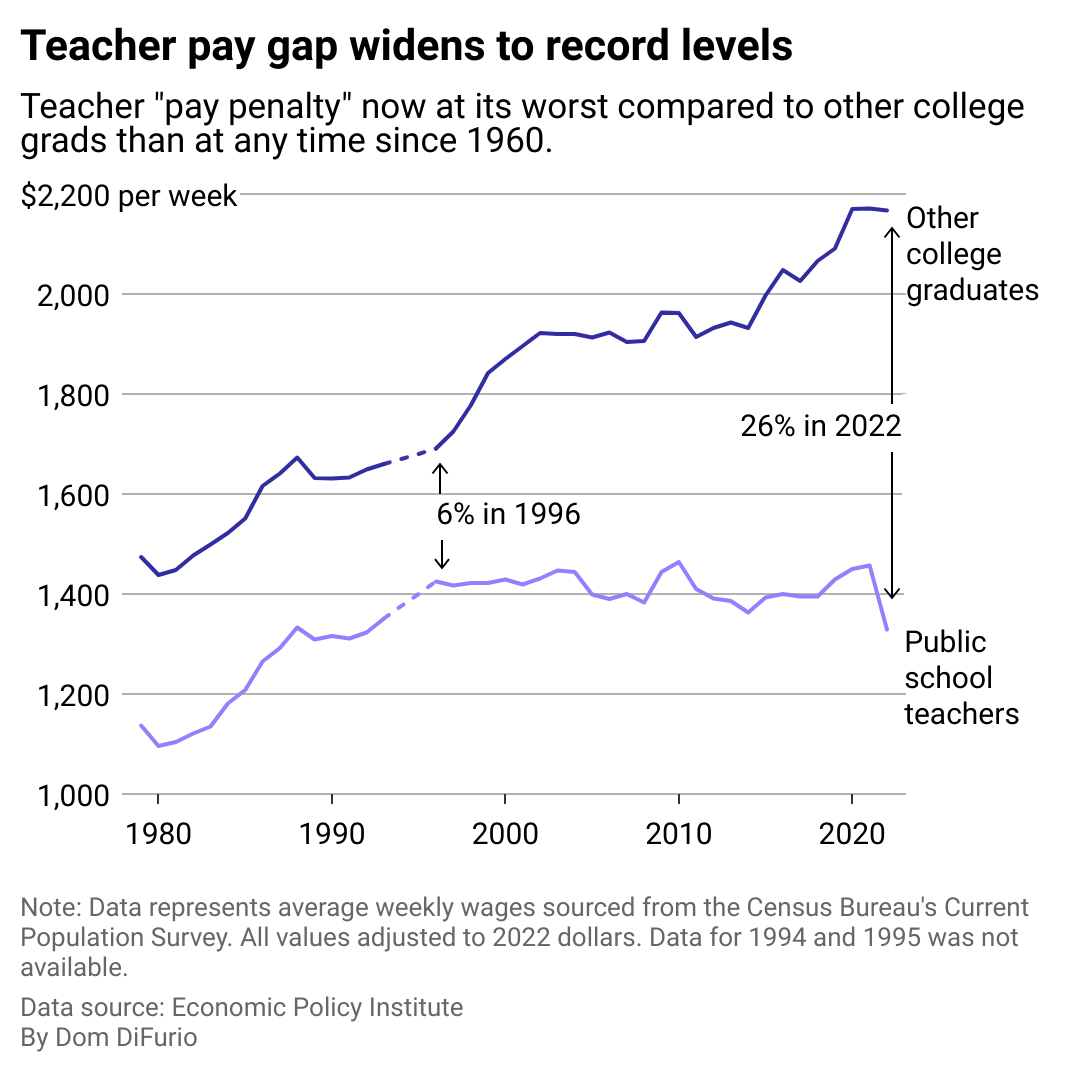
A primary driver of the current crisis is the widening gap between educator compensation and the earnings of other professionals with comparable levels of education. The Economic Policy Institute (EPI) defines this as the “teacher pay penalty,” noting that the disparity has reached approximately 27%. This calculation compares the weekly wages of public school teachers to those of other college-educated workers. The persistence of this gap serves as a significant barrier to both recruiting new talent into the profession and retaining experienced educators who may find more lucrative opportunities in the private sector. Economic Policy Institute: The Teacher Pay Penalty
The impact of these low wages is evident in the workforce participation data. Surveys conducted by the American Federation of Teachers (AFT) suggest that a substantial majority of their members report living paycheck to paycheck. To bridge the gap, many educators have turned to secondary employment. According to data analyzed by the NEA, approximately 70% of teachers report working more than one job to maintain their standard of living, with many taking on roles in the gig economy, retail, or service industries during their off-hours. American Federation of Teachers: Educator Financial Survey
Collective Bargaining as a Financial Lever
Collective bargaining remains a central point of contention in the debate over teacher compensation. Educators in states that permit collective bargaining generally command higher wages and better working conditions than those in states where such rights are limited or prohibited. Research from the Economic Policy Institute indicates that teachers in states with strong collective bargaining laws earn approximately 24% more than their counterparts in states without these protections. For many educators, union contracts are the primary mechanism for negotiating not only salary schedules but also critical school-level conditions such as class size, access to support staff like school nurses and counselors, and professional development resources. Economic Policy Institute: Collective Bargaining and Teacher Pay

The strategic focus of major union affiliates, such as the United Teachers Los Angeles (UTLA) and the Chicago Teachers Union (CTU), has expanded beyond base salary. By bargaining for the “common good,” these unions often push for comprehensive school services. This approach includes advocating for the hiring of additional librarians, the expansion of mental health services for students, and the creation of parent resource centers. When legislative bodies move to restrict or eliminate bargaining rights, they effectively remove these tools for local educators to advocate for the resources necessary to support student achievement.
Legislative Action and Future Implications
The crisis of teacher affordability is increasingly viewed as a matter of public policy rather than individual financial management. Lawmakers at the state level face ongoing pressure to address school funding formulas, which are often tied to local property taxes and can lead to significant funding disparities between districts. As of the current legislative cycle, several states are reviewing teacher compensation bills aimed at increasing base pay floors. However, the effectiveness of these measures often depends on whether they provide recurring funding or one-time bonuses that do not address long-term inflation.

The next major checkpoint for these issues will occur during the upcoming state budget sessions, where school funding allocations are finalized. Educators and union representatives are expected to testify at committee hearings, citing the rising cost of living as a direct threat to the stability of the public education system. Readers interested in following these developments can monitor their state department of education websites or the legislative tracking databases provided by the National Conference of State Legislatures (NCSL). National Conference of State Legislatures: Teacher Compensation Policy
The sustainability of the teaching profession depends on whether school districts and state governments can align compensation with the professional requirements of the role. For many educators, the current situation is not merely a question of wages, but a reflection of the priority placed on public education within the national budget. As discussions continue, the focus will likely remain on whether legislative bodies choose to view school funding as a mandatory public obligation or as a flexible line item subject to political negotiation.
We welcome your thoughts on this critical issue. How has the cost of living impacted the educators in your community? Please leave a comment or share this article to join the conversation.
Keep reading