
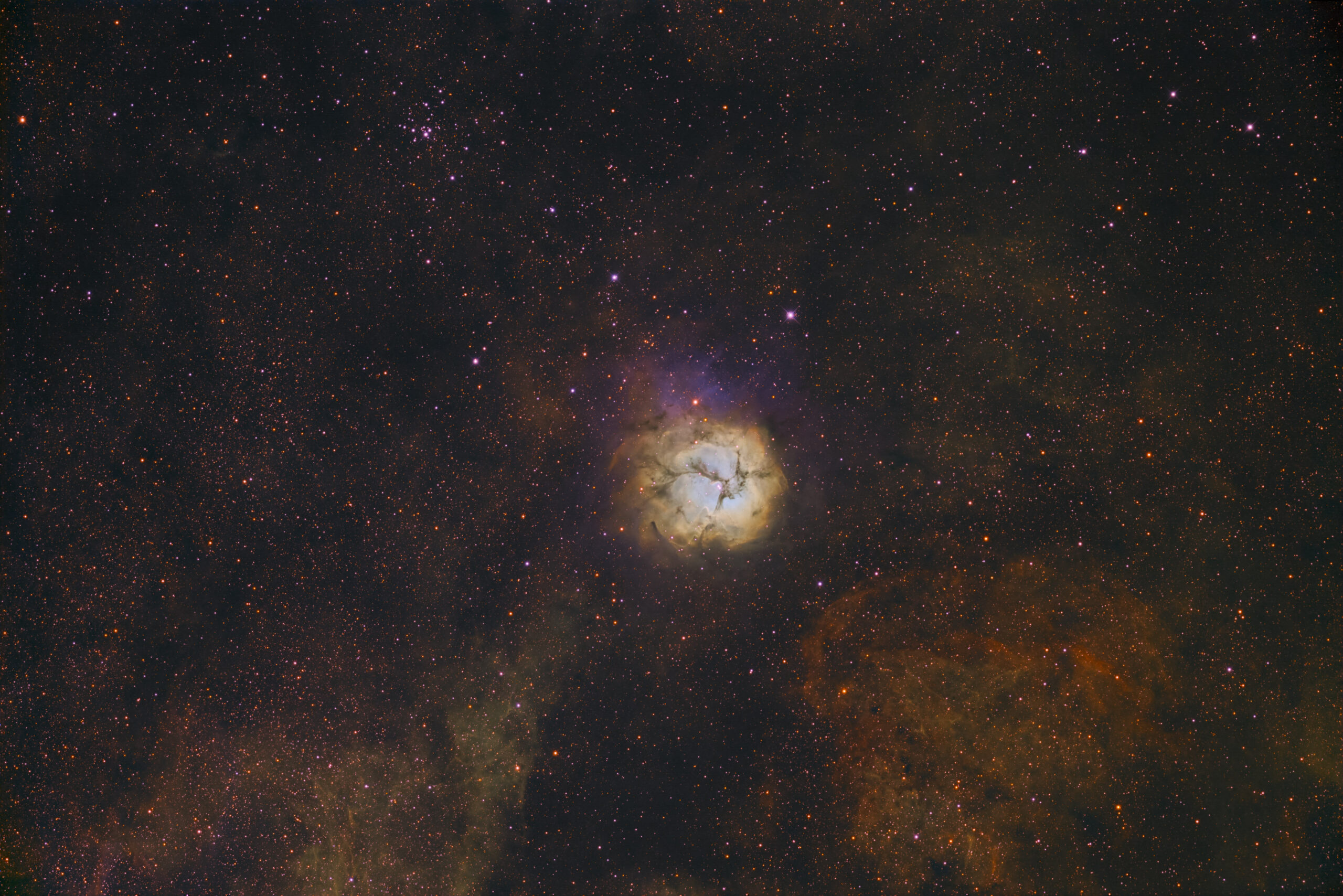
On April 25, 2026, the Hubble Space Telescope marked its 36th year in orbit with a stunning new image of the Trifid Nebula, officially known as Messier 20 or M20. Located in the constellation Sagittarius, this celestial object continues to captivate astronomers and the public alike with its vivid colors and complex structure. The nebula’s name derives from its appearance in visible light, where dark dust lanes seem to divide it into three distinct lobes.
The Trifid Nebula is a rare combination of three types of nebulae: an emission nebula glowing red from ionized hydrogen, a reflection nebula scattering blue starlight, and a dark nebula composed of obscuring dust. This unique blend makes it one of the most studied star-forming regions in the Milky Way. Situated approximately 9,000 light-years from Earth, M20 lies within the Sagittarius Arm of our galaxy, a region rich in stellar nurseries.
Hubble’s latest observation, released to commemorate its launch anniversary, builds on decades of scrutiny into how stars are born within dense clouds of gas and dust. The telescope’s high-resolution imaging has allowed scientists to peer into the nebula’s core, where young, hot stars emit intense ultraviolet radiation that shapes the surrounding material. These stellar winds and radiation erode the nebula over time, sculpting the pillars and jets visible in detailed images.
According to the European Space Agency, which collaborates with NASA on Hubble operations, the 36th-anniversary image highlights the dynamic interplay between newborn stars and their natal environment. The radiation from these stars not only illuminates the nebula but also triggers further star formation in nearby compressed gas — a process known as triggered star formation. This cycle illustrates how stellar lifecycles drive the evolution of interstellar matter.
First discovered by French astronomer Charles Messier in 1764, M20 was cataloged as the 20th object in his famous list of nebulous entities to help comet hunters avoid confusion. Though Messier described it as a faint, fuzzy patch, modern technology reveals a far more intricate structure. Infrared observations from telescopes like Spitzer and ground-based observatories have penetrated the dust to reveal dozens of embryonic stars still embedded in their natal cocoons.
The Trifid Nebula’s location in Sagittarius places it near the galactic center, where star formation is particularly active. It shares the sky with other notable objects such as the Lagoon Nebula (M8) and the Omega Nebula (M17), all part of a vast complex of gas and dust spanning hundreds of light-years. Together, these regions form part of the Sagittarius OB1 association, a group of hot, massive stars that have formed within the last few million years.
Studying M20 provides insights into the early stages of stellar development, particularly how massive stars influence their surroundings. O-type stars, the hottest and most luminous known, are present within the nebula and emit enough energy to ionize hydrogen across significant distances. Their short lifespans — often just a few million years — signify they live swift and die young, ultimately enriching the interstellar medium with heavy elements when they explode as supernovae.
Hubble’s role in observing such objects has been transformative since its launch aboard the Space Shuttle Discovery on April 24, 1990. Despite an initial flaw in its primary mirror, a servicing mission in 1993 corrected the optics, enabling the telescope to deliver unprecedented clarity. Over its operational lifetime, Hubble has contributed to breakthroughs in cosmology, exoplanet atmospheres, and galactic evolution, with nebulae like M20 serving as key laboratories for understanding star birth.
Data from Hubble’s instruments, including the Wide Field Camera 3 and the Advanced Camera for Surveys, allow scientists to map the nebula’s composition, temperature, and motion. Spectroscopic analysis reveals the presence of complex molecules and ionized gases, helping researchers model the physical conditions within star-forming regions. These findings are essential for refining theories about how our own solar system may have formed 4.6 billion years ago in a similar stellar nursery.
While professional observatories continue to monitor M20, the nebula is also a popular target for amateur astronomers. Under dark skies, it can be seen with binoculars as a faint, fuzzy patch near the “spout” of the Sagittarius teapot asterism. Modest telescopes begin to reveal its tripartite appearance, while larger instruments and long-exposure photography capture the full contrast between its glowing gas and obscuring dust.
As Hubble enters its fourth decade of operation, its observations of objects like the Trifid Nebula remain vital to NASA and ESA’s astrophysics goals. The telescope continues to operate alongside newer observatories such as the James Webb Space Telescope, which observes in infrared wavelengths ideal for peering through dust. Together, these instruments provide a multi-wavelength view of cosmic phenomena, combining Hubble’s sharp visible-light vision with Webb’s ability to see the cold, hidden depths of star formation.
No single image can capture the full story of a nebula as dynamic as M20, but each observation adds a layer to our understanding. The 36th-anniversary portrait serves not only as a celebration of Hubble’s endurance but also as a reminder of the ongoing quest to comprehend the universe’s most beautiful and energetic processes. For readers interested in following Hubble’s ongoing mission, official updates are available through NASA’s Hubble Space Telescope website and the ESA’s Hubble portal.
To stay informed about the latest discoveries from Hubble and other space observatories, readers are encouraged to explore trusted sources such as NASA.gov and ESA.int. Sharing knowledge about wonders like the Trifid Nebula helps inspire curiosity about our place in the cosmos — a goal at the heart of both scientific exploration and science journalism.