
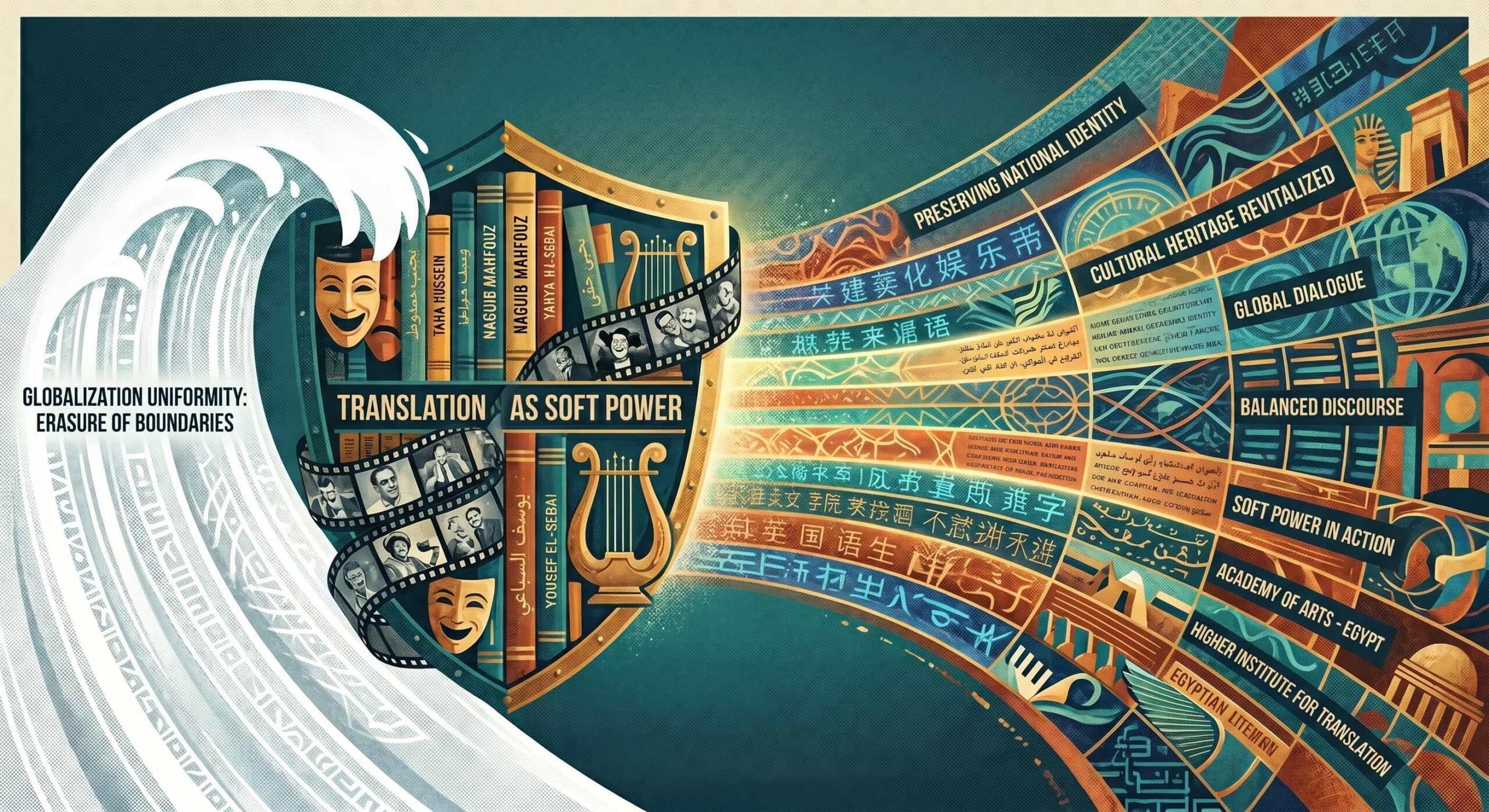
In an era where globalization often manifests as a relentless tide of cultural homogenization, the boundaries that define national identity are increasingly blurred. For many nations, the challenge is no longer simply about participating in the global exchange of ideas, but about doing so without losing the distinct essence of their own heritage. In Egypt, this struggle has evolved into a sophisticated strategic effort, where the act of translation is being repositioned not as a mere linguistic service, but as a vital instrument of soft power.
Rather than viewing translation as a technical exercise in swapping words from one language to another, Egyptian cultural institutions are treating it as a conscious cultural practice. The goal is to navigate the delicate tension between remaining open to international cooperation and defending a unique national identity. By shifting the focus from literal transfer to the “re-creation” of aesthetic experiences, Egypt aims to present its arts and literature as dynamic, living entities capable of interacting with the world without being reduced or distorted.
This institutional shift is most evident in the strategic vision of the Egyptian Ministry of Culture. The Ministry is increasingly leveraging translation to enhance Egypt’s global presence, utilizing exchange programs, grants, and specialized seminars to build international knowledge partnerships. By treating cultural heritage as an active asset rather than a static inheritance, the state is attempting to reshape how the world perceives Egyptian identity, ensuring that the nation’s contribution to the global discourse is both accurate and influential.
Central to this mission is the Academy of Arts, which has established the Higher Institute for the Translation of Arts, Literature, and Artistic Media. Under the leadership of Dean Prof. Inas Abd-ElKhaleq, the institute has adopted a philosophy that treats artistic texts as intricate semantic systems. These systems encompass more than just language; they integrate culture, customs, traditions, imagery, sound, and performance. The institute’s objective is to train a new generation of specialists who can translate the “spirit” of a work, ensuring that the universal messages within Egyptian art are accessible to global audiences while preserving their local authenticity.
Beyond Literalism: Translation as Aesthetic Re-creation
The traditional approach to translation often prioritizes the “correct” word, which can lead to a sterile version of the original work that lacks emotional resonance. The Higher Institute for the Translation of Arts, Literature, and Artistic Media argues that translating a work of art requires a “re-creation” of the aesthetic experience. This process demands a dual awareness: a deep understanding of the original identity and a keen sense of how that identity will be received by a global audience.

This distinction is critical when dealing with Egypt’s literary giants. Writers such as the Nobel laureate Naguib Mahfouz, the influential Taha Hussein, Yahya Haqqi, and Youssef El-Sebai did not merely write stories; they produced penetrating insights into the human psyche and the complexities of social structures. Their works are inherently local in setting but universal in theme. When these texts are translated with a focus on “re-creation,” they cease to be foreign curiosities and instead turn into mirrors through which readers of any culture can understand the shared human experience.
For the translator, the task is to identify these universal messages—themes of justice, love, struggle, and identity—and convey them in a way that inspires a broader understanding. This approach prevents the “reduction” of culture, where a complex national identity is simplified into a few stereotypes for the sake of easy consumption by a foreign audience.
Cinematic Heritage and the Language of Defiance
The push for conscious translation extends beyond the written page and into the realm of audio-visual media. Egypt’s cinematic and theatrical heritage is one of the most influential in the Arab world and beyond, yet much of it remains trapped by outdated or overly literal translations that focus on dialogue rather than cultural content.
There is a growing movement to retranslate Egypt’s timeless cinematic works to better reflect their original socio-political context. For instance, the comedic films of the 1940s and 1950s were often more than mere entertainment; they frequently served as weapons of political defiance against colonial occupation. When these films are translated solely for the “joke,” the underlying political courage and social commentary are lost. A culturally conscious translation restores this layer, allowing global audiences to see how comedy was used as a tool for national liberation.
Similarly, the realistic cinema of the 1990s provides a crucial window into the early effects of globalization. These films captured the anxiety and transformation of Egyptian society as it began to interface more deeply with global capitalist structures. By re-evaluating these works through the lens of cultural translation, Egyptian institutions can highlight how their artists engaged with the world’s changes in real-time, offering an artistic perspective that is both specific to Cairo and relevant to any city experiencing rapid modernization.
The Geopolitics of Soft Power
In the field of international relations, “soft power”—a term coined by Joseph Nye—refers to the ability of a country to persuade others to do what it wants without force or coercion, primarily through the appeal of its culture, political ideals, and policies. For Egypt, translation is the primary vehicle for this appeal.

By investing in the accurate and conscious presentation of its arts, Egypt is not just preserving the past; it is actively competing in the global marketplace of ideas. The challenge lies in ensuring that this presence is not merely a “export” of products, but a genuine dialogue. When a work of art is translated with integrity, it invites the world to engage with Egypt on its own terms, fostering a pluralistic global discourse that celebrates difference rather than obliterating it.
This strategic orientation suggests that translation has moved from being a cultural choice to a tactical necessity. In a world where digital platforms can flatten cultural nuances in seconds, the deliberate, academic, and artistic approach to translation serves as a bulwark against the erasure of national identity.
Key Takeaways for Cultural Preservation
- Shift from Technical to Cultural: Translation is now viewed as a strategic tool of soft power rather than a simple linguistic service.
- Aesthetic Re-creation: The goal is to re-create the emotional and cultural experience of a work, moving beyond literal word-for-word transfer.
- Institutional Support: The Egyptian Ministry of Culture and the Academy of Arts are professionalizing this process through specialized institutes and grants.
- Universalism through Particularity: By faithfully presenting the distinctiveness of Egyptian identity, the nation can communicate universal human truths more effectively.
- Cinematic Reclamation: Retranslating heritage films allows for the recovery of political and social meanings that were previously lost in translation.
As Egypt continues to expand its international cultural cooperation, the role of the translator will only become more central. The ability to reshape a national image for the world—without sacrificing the essence of that image—is perhaps the most sophisticated form of diplomacy available in the 21st century.
The next phase of this initiative will likely involve deeper integration of digital media and AI-assisted translation, provided these tools can be steered by the “conscious cultural practice” championed by the Higher Institute. The objective remains clear: to participate in a global conversation where Egypt’s voice is heard clearly, accurately, and with its full cultural richness intact.
World Today Journal encourages readers to share their perspectives on the role of translation in preserving national identity in the comments below.