
The Superhighway Solution: Can an Interregional Transmission Overlay Save the U.S. Grid?
The American power grid is currently facing a perfect storm of aging infrastructure, shifting generation sources, and a sudden, massive surge in electricity demand. For decades, the U.S. Transmission system has operated as a patchwork of regional networks, largely optimized for local needs and predictable, centralized power plants. But the era of predictable growth is over. As we transition toward a decarbonized economy and witness the explosive rise of energy-intensive technologies like generative AI, the limitations of our current regional structure are becoming dangerously apparent.
To bridge the gap between where energy is produced and where it is consumed, industry experts and regulators are increasingly looking toward a concept known as an Interregional Transmission Overlay (ITO). Much like a high-capacity superhighway built above existing local roads, an ITO would function as a high-voltage backbone designed specifically to move massive amounts of electricity across vast distances and through complex regional boundaries. By creating a more interconnected national architecture, this overlay aims to bolster U.S. Power grid resilience and ensure that the transition to renewable energy does not lead to instability or skyrocketing costs.
This is not merely a technical upgrade; it is a fundamental rethinking of how electrons move across the continent. As we navigate the complexities of grid modernization, the success of such an overlay will depend on our ability to harmonize technology, policy, and massive capital investment.
A Grid Under Siege: The Convergence of Demand and Decay
The pressure on the current U.S. Transmission system is coming from three distinct directions: the retirement of legacy plants, the integration of variable renewables, and an unprecedented spike in load growth. For much of the 20th century, the grid was anchored by steady, coal-fired generation. However, as these plants retire, they leave behind gaps in the reliability of the regional structures they once supported. This transition is further complicated by the rapid deployment of wind and solar energy, which are often located in resource-rich but remote regions, far from the major metropolitan centers that require the power.
The current regional grid structure is approaching its physical and economic limits. Because many regions operate as semi-autonomous islands, they often struggle to import power from neighbors when local generation fails or when weather patterns shift. This is particularly evident at the “seams”—the points where different regional transmission organizations (RTOs) or independent system operators (ISOs) meet. These seams are often the weakest links in the chain, acting as bottlenecks that prevent the efficient flow of energy between regions.
Perhaps the most significant new variable is the “exponential” growth in large-load demand. We are no longer just talking about residential air conditioning or industrial manufacturing; we are talking about the massive energy requirements of hyperscale data centers powering the AI revolution and the reshoring of semiconductor and battery manufacturing. This concentrated, high-intensity demand is placing a strain on local substations and transmission lines that were never designed for such rapid, large-scale expansion. Without a way to pull power from across the country, these localized demand surges could lead to frequent congestion and increased volatility in electricity prices.
Engineering Connectivity: The Architecture of an Overlay
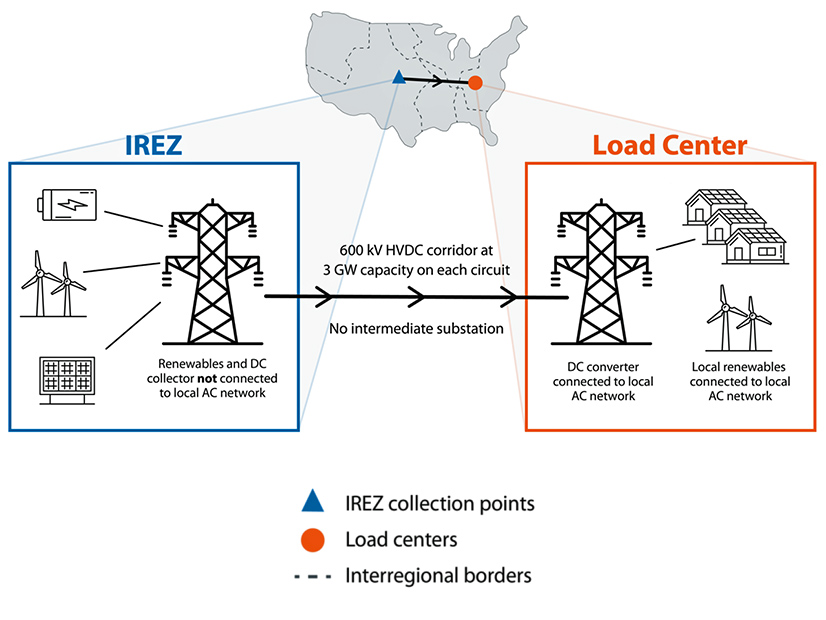
How does one actually build a “superhighway” for electricity? An Interregional Transmission Overlay relies on two primary technological pillars: High Voltage Direct Current (HVDC) and 765 kV Extra High Voltage Alternating Current (EHVAC) technology. While alternating current (AC) is the standard for local distribution, HVDC is the gold standard for long-distance transmission. HVDC lines experience significantly lower energy losses over long distances and offer superior control over the direction and magnitude of power flow, making them ideal for connecting distant wind farms in the Great Plains to the demand centers of the coasts.
Complementing this is the use of 765 kV EHVAC, which provides the massive capacity needed to move bulk power across interstate lines. By deploying these technologies in a coordinated overlay, the system can effectively bridge the critical gaps between the East, West, and ERCOT (the Texas interconnection) seams. This interconnection is vital; it allows the grid to act as a unified whole, leveraging the strengths of one region to compensate for the weaknesses of another.
The potential economic benefits of this architecture are substantial. By optimizing the way we move energy and reducing the need for redundant, localized generation, an integrated overlay could potentially reduce overall electric system costs by hundreds of billions of dollars through 2050. This is achieved by minimizing “congestion costs”—the extra money utilities must pay to move power when the most efficient routes are full—and by allowing the grid to fully utilize the lowest-cost renewable resources available across the nation.
Navigating the Regulatory Maze: FERC Order 1920 and Beyond
Technological capability is only half the battle; the other half is regulatory and political. Historically, transmission planning has been a fragmented, state-by-state, or region-by-region process. This has led to a “siloed” approach where critical corridors are overlooked because no single entity has the authority or the incentive to plan across vast distances. To address this, the Federal Energy Regulatory Commission (FERC) has taken decisive action.

A landmark development in this space is FERC Order 1920, issued in May 2024. This order is designed to revolutionize long-term transmission planning by requiring grid operators to consider regional needs over a multi-decade horizon. Crucially, it addresses the “cost allocation” problem—one of the most contentious issues in grid expansion. Under Order 1920, planners must develop frameworks to ensure that the costs of building large-scale, interregional lines are shared equitably among the stakeholders who benefit from them, whether they are located directly on the line or simply benefit from the increased reliability and lower prices it provides.
Beyond FERC, the Department of Energy (DOE) is also playing a pivotal role through various programs aimed at accelerating grid deployment. However, even with federal mandates, the path to an ITO remains fraught with complexity. Energy market harmonization is a major hurdle; different regions have different rules for how electricity is bought and sold, and reconciling these rules to allow for seamless interregional trade is a monumental task. The “permitting” process remains a significant bottleneck. A single interregional line may cross dozens of jurisdictions, each with its own environmental regulations, land-use laws, and political interests.
The Obstacles to Implementation
Even with the momentum of FERC Order 1920, several critical challenges could stall the development of an Interregional Transmission Overlay. These obstacles are not just technical, but structural and economic.
- Cross-State Planning Coordination: Coordinating between multiple state utility commissions and regional grid operators requires a level of transparency and data sharing that currently does not exist at scale.
- Investment and Permitting Barriers: The sheer scale of capital required for HVDC projects is immense. Securing private investment is difficult when the regulatory and permitting timelines can stretch into a decade or more.
- Supply Chain Limitations: There is a growing global shortage of specialized equipment, such as high-voltage transformers and specialized conductors, which are essential for EHVAC and HVDC projects. This scarcity drives up costs and extends project timelines.
- Political and Regulatory Uncertainty: Changes in administration or shifts in state-level energy policies can create a “wait-and-see” atmosphere that discourages long-term infrastructure investment.
Key Takeaways: The Path to a Resilient Grid
| Core Challenge | The ITO Solution | Primary Driver |
|---|---|---|
| Aging, fragmented regional grids | High-capacity HVDC/EHVAC overlay | Renewable integration & reliability |
| Skyrocketing demand (AI/Data Centers) | Efficient long-distance energy transport | Load growth & economic reshoring |
| Inefficient cost allocation | FERC Order 1920 mandates | Regulatory modernization |
| Interconnection bottlenecks (Seams) | Bridging East/West/ERCOT seams | System-wide stability |
Building an Interregional Transmission Overlay is perhaps the most significant engineering and policy challenge of the 21st century. It requires a shift from a mindset of “local reliability” to one of “continental resilience.” While the hurdles—from supply chain constraints to political friction—are formidable, the cost of inaction is far higher. Without a modernized, interconnected backbone, the U.S. Risks a future of energy instability, higher costs, and an inability to meet its climate and economic goals.
The roadmap is beginning to take shape through federal mandates and technological advancements, but the transition from vision to implementation will require unprecedented cooperation between utilities, developers, and policymakers. As the demand for electricity continues to accelerate, the clock is ticking on the construction of the American energy superhighway.
Next Checkpoint: Keep a close eye on upcoming FERC implementation hearings and state-level filings regarding the regional transmission planning requirements mandated by Order 1920. These proceedings will signal how quickly the regulatory framework moves from theory to practice.
What do you think is the biggest hurdle to grid modernization: technology, politics, or cost? Share your thoughts in the comments below and share this article with your network to join the conversation.