
As U.S. Re-arms during Iran ceasefire, long-term concerns emerge about advanced munitions supplies
Days after the United States opened its military campaign against Iran, President Donald Trump sought to project confidence in the nation’s war footing, declaring that America possessed a “virtually unlimited supply” of key munitions and could fight wars “forever” using them. The remark conveyed a familiar image of American military power, a projection of being technologically unmatched, logistically dominant and capable of sustaining operations indefinitely. But recent congressional testimony from Pentagon officials and an analysis of the U.S. Arsenal point to a more constrained reality, where the U.S. Advantage lies less in limitless supply than in highly advanced, but finite, systems.
Of particular concern are supplies of advanced long-range missiles capable of striking targets hundreds of miles away, as well as interceptor munitions used to defend U.S. Forces against incoming attacks. Mr. Trump’s announcement of an indefinite ceasefire extension with Iran earlier this week prolonged a window for the U.S. To re-arm assets in the Middle East with existing stocks after a five-week bombing campaign. The president told reporters Thursday the U.S. Isn’t under any pressure to wrap up the conflict, saying, “we’ve never had so much ammunition.” Long-term supply questions remain.
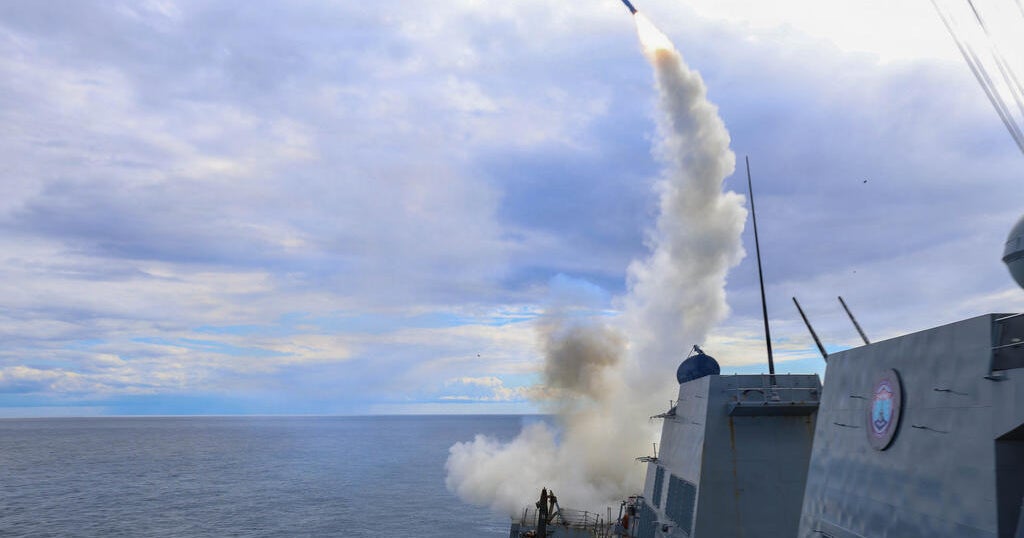
This image provided by U.S. Central Command shows the Arleigh Burke-class guided-missile destroyer USS Thomas Hudner firing a Tomahawk Land Attack Missile in support of Operation Epic Fury, on March 1, 2026.
The Center for Strategic and International Studies analyzed U.S. Munitions stocks and concluded that the U.S. “may have expended more than half of the prewar inventory” of at least four key munitions, including Tomahawk missiles. The report said the “United States has enough missiles to continue fighting this war under any plausible scenario. The risk — which will persist for many years — lies in future wars.”
Depletion of critical weapons stockpiles raises readiness concerns
The United States has significantly depleted key missile stockpiles during its recent conflict with Iran, raising concerns about military readiness in other regions. Officials say the scale and speed of munitions expenditure has outpaced domestic production capacity, creating potential vulnerabilities for future contingencies.

The conflict has already cost the United States more than $25 billion, according to a study conducted in April by the American Enterprise Institute. In the first two days of the conflict alone, the military burned through around $5.6 billion worth of munitions, a congressional source told The Hill in March.
The Pentagon has used more than 1,200 Patriot interceptor missiles, each costing more than $4 million. The military has also used up around 1,100 of its long-range stealth cruise missiles stockpiled for a potential war with China, according to congressional officials and internal Defense Department estimates obtained by the New York Times. More than 1,000 Tomahawk cruise missiles have been fired, too, which is around 10 times the amount currently bought by the U.S. Military each year.
Internal Pentagon estimates also suggested that around 1,100 JASSM-ER missiles, which cost around $1.1 million each, have been used. That has left just 1,500 of the projectiles in the military’s inventory. “At current production rates, reconstituting what we have expended could capture years,” Senator Jack Reed, the top Democrat on the Armed Services Committee, said this week.
Impact on regional deterrence and alliance commitments
The drawdown of advanced munitions has implications beyond the immediate theater of operations. U.S. Officials privately acknowledge that the current pace of expenditure could complicate contingency plans to defend Taiwan, as some have warned that critical stocks needed for a potential conflict in the Indo-Pacific are being diverted to the Middle East.
Allies in Europe and Asia have expressed concern about the sustainability of U.S. Military support if high-intensity conflicts were to erupt simultaneously in multiple regions. NATO defense planners have begun reviewing stockpile levels and logistics chains to assess potential shortfalls in air defense and precision-guided munitions.
Defense industry analysts note that while the U.S. Maintains a technological edge in missile guidance and stealth capabilities, the industrial base for producing advanced munitions has not scaled up to match wartime demand. Lead times for new production of systems like the Tomahawk and JASSM-ER remain measured in months, limiting the speed of replenishment.
Path forward: Reassessing production and stockpile strategy
In response to the depletion, the Biden administration has initiated a review of munitions production requirements and is considering incentives to expand domestic manufacturing capacity. The Defense Department is also evaluating adjustments to wartime consumption models to better align with peacetime production rates.

Congressional oversight committees have scheduled hearings for May 2026 to examine the long-term implications of the Iran conflict on military readiness. The Armed Services Committee plans to hear from service chiefs, acquisition officials, and independent experts on whether current stockpile levels are sufficient to meet the objectives of the National Defense Strategy.
As the ceasefire holds, the window for re-arming remains open, but officials caution that the opportunity to rebuild stocks should not be mistaken for a return to abundance. The experience has prompted a broader discussion about the balance between maintaining a ready force and sustaining the industrial capacity needed to regenerate it after prolonged use.
For ongoing updates on defense readiness and munitions stockpile levels, readers can consult the monthly reports published by the Defense Security Cooperation Agency and the quarterly assessments from the Congressional Budget Office.
What are your thoughts on the U.S. Approach to munitions management during extended conflicts? Share your perspective in the comments below and support inform the conversation.