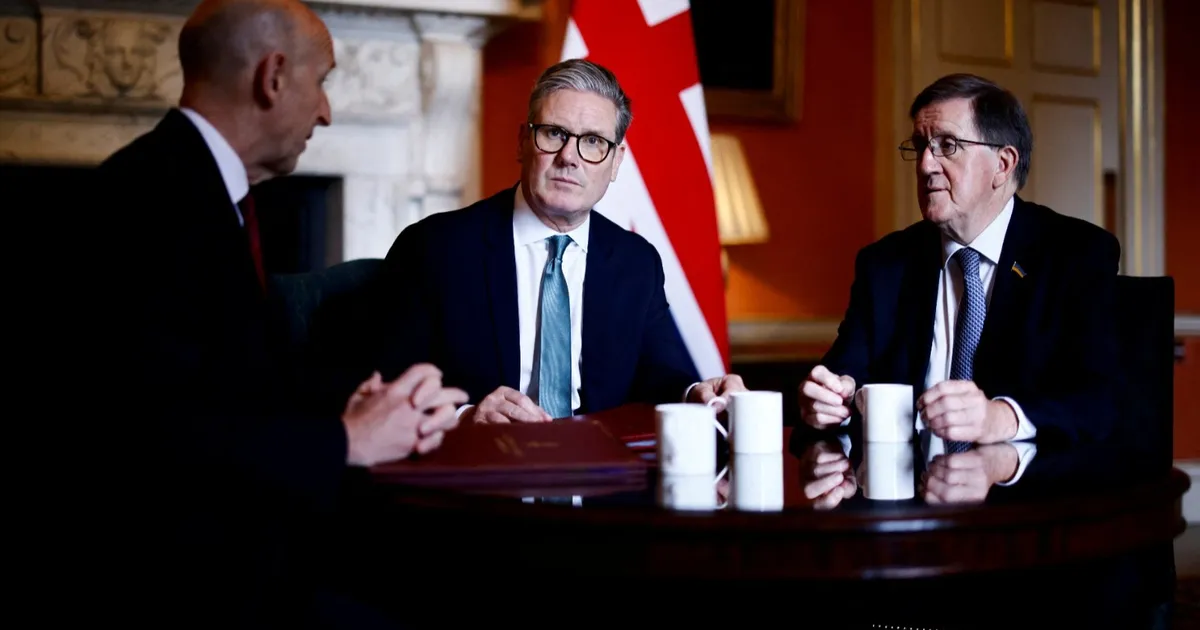
A high-ranking government adviser and former head of NATO has issued a stark warning that the United Kingdom is facing severe UK national security risks due to what he describes as a “corrosive complacency” within the current political leadership. George Robertson, who served as NATO Secretary General from 1999 to 2003, has accused Prime Minister Keir Starmer of failing to align his public rhetoric with the actual financial commitments required to keep the country safe.
Speaking on Tuesday, April 14, 2026, Robertson argued that the British government is currently operating under a dangerous delusion regarding its military readiness. The former NATO chief suggested that the Prime Minister is unwilling to create the necessary investments in defense, choosing instead to prioritize an “ever expanding welfare budget” over the strategic requirements of national security. This internal rift is coming to a head as the UK navigates an increasingly volatile global security environment, characterized by escalating conflicts and shifting alliances.
The criticism is not limited to internal government circles. Robertson’s warnings mirror public criticisms from US President Donald Trump, who has also characterized the British prime minister as being weak on defense according to CNN. The convergence of criticism from both a key domestic adviser and a primary international ally underscores a growing perception that the UK’s military capabilities are deteriorating at a critical moment in geopolitical history.
The Gap Between Rhetoric and Military Investment
At the heart of Robertson’s critique is the perceived disconnect between Keir Starmer’s stated commitment to security and the actual allocation of resources. Robertson, who was commissioned by Starmer to lead a strategic review of UK defense after the transition from 14 years of Conservative rule, claims that the Prime Minister’s actions do not match his words. He asserts that the current approach puts the United Kingdom “in peril” by failing to address systemic funding gaps.
Robertson’s concerns are echoed by other high-level military figures. General Richard Barrons, the former head of the Joint Forces Command and a co-author of the strategic defense review, has supported these warnings. Speaking to BBC Radio 4’s Today program, Barrons noted the gravity of the situation, emphasizing that it is a significant indicator of the crisis when a lifelong Labour Party member and former NATO Secretary General feels compelled to speak so bluntly about the government’s failures as reported by Youm7.
The tension is further complicated by a clash between military necessity and fiscal policy. Robertson has specifically targeted non-military experts within the UK Treasury, accusing them of “sabotage” by restricting the funds necessary to modernize and maintain the armed forces. This struggle suggests a deep-seated conflict within the British cabinet between the Ministry of Defence and the Treasury over how to balance social spending with the costs of deterrence and defense.
A Legacy of Underinvestment and Unpreparedness
The current crisis is not merely a result of recent policy shifts but is the culmination of decades of decline. The strategic review conducted by Robertson, General Barrons and Fiona Hill—a former senior director at the US National Security Council—was released last year. The findings of this review were unequivocal: decades of budget cuts and systemic underinvestment have left the United Kingdom “dangerously unprepared for a conflict” via CNN.
This lack of preparedness manifests in several critical areas of military readiness:
- Equipment Obsolescence: A failure to modernize hardware at a pace that keeps up with adversarial technological leaps.
- Personnel Shortages: The long-term impact of cuts on recruitment and retention within the armed forces.
- Strategic Depth: A reduced capacity to sustain long-term operations or respond to multi-theater conflicts.
Robertson argues that the “corrosive complacency” he observes is a refusal to acknowledge that the security environment has fundamentally changed. By treating defense as a secondary concern to domestic welfare spending, he contends that the government is ignoring the basic reality that social stability is impossible without a secure national foundation.
The Iran Conflict as a “Harsh Wake-Up Call”
The urgency of these warnings is tied to current global events, specifically the ongoing war involving Iran. During a lecture delivered in Salisbury on Tuesday, Robertson described the conflict in Iran as a “harsh wake-up call” for the British government. He argued that the volatility of the Middle East serves as a real-time demonstration of why the UK cannot afford to be under-equipped or strategically hesitant.
The war in Iran has raised critical questions about the British Army’s defensive capabilities and its ability to project power or protect interests in a high-intensity conflict zone. For Robertson, the conflict is not a distant event but a signal that the window for correcting the UK’s military deficiencies is closing rapidly. He maintains that the government must treat the current geopolitical instability as a catalyst for immediate and substantial investment in the defense sector.
Key Takeaways on the UK Defense Crisis
| Issue | Robertson’s Perspective | Stated Impact |
|---|---|---|
| Political Leadership | “Corrosive complacency” | Puts the UK “in peril” |
| Budgetary Focus | Prioritizing welfare over defense | Insufficient investment for safety |
| Institutional Conflict | Treasury “sabotage” | Blocking necessary military funding |
| Global Context | War in Iran as a “wake-up call” | Highlights dangerous unpreparedness |
What This Means for the UK’s Global Standing
The public nature of this dispute—involving a former NATO chief and a sitting Prime Minister—signals a potential crisis of confidence in the UK’s role as a leading security partner. When a country’s own strategic advisers warn that it is “dangerously unprepared,” it sends a signal to both allies and adversaries about the limits of British power.
The pressure on Keir Starmer is now twofold: he must manage a domestic electorate that expects the maintenance of the welfare state, while simultaneously addressing the demands of the military establishment and the expectations of the United States. The accusation that non-military Treasury officials are undermining national security suggests that the battle for the UK’s defense budget is being fought not just in parliament, but within the administrative corridors of the civil service.
As the UK continues to navigate its post-Conservative strategic landscape, the tension between “rhetoric and action” will likely remain a central theme of Starmer’s premiership. The ability of the government to pivot from a posture of complacency to one of active readiness will determine whether the UK remains a viable security pillar in the North Atlantic and beyond.
The next critical development will be the official government response to George Robertson’s Salisbury lecture and the potential for an emergency reallocation of funds within the Treasury to address the gaps identified in the strategic review. We will continue to monitor official statements from 10 Downing Street and the Ministry of Defence.
Do you believe the UK is balancing its social and defense budgets correctly in the current global climate? Share your thoughts in the comments below.
Keep reading