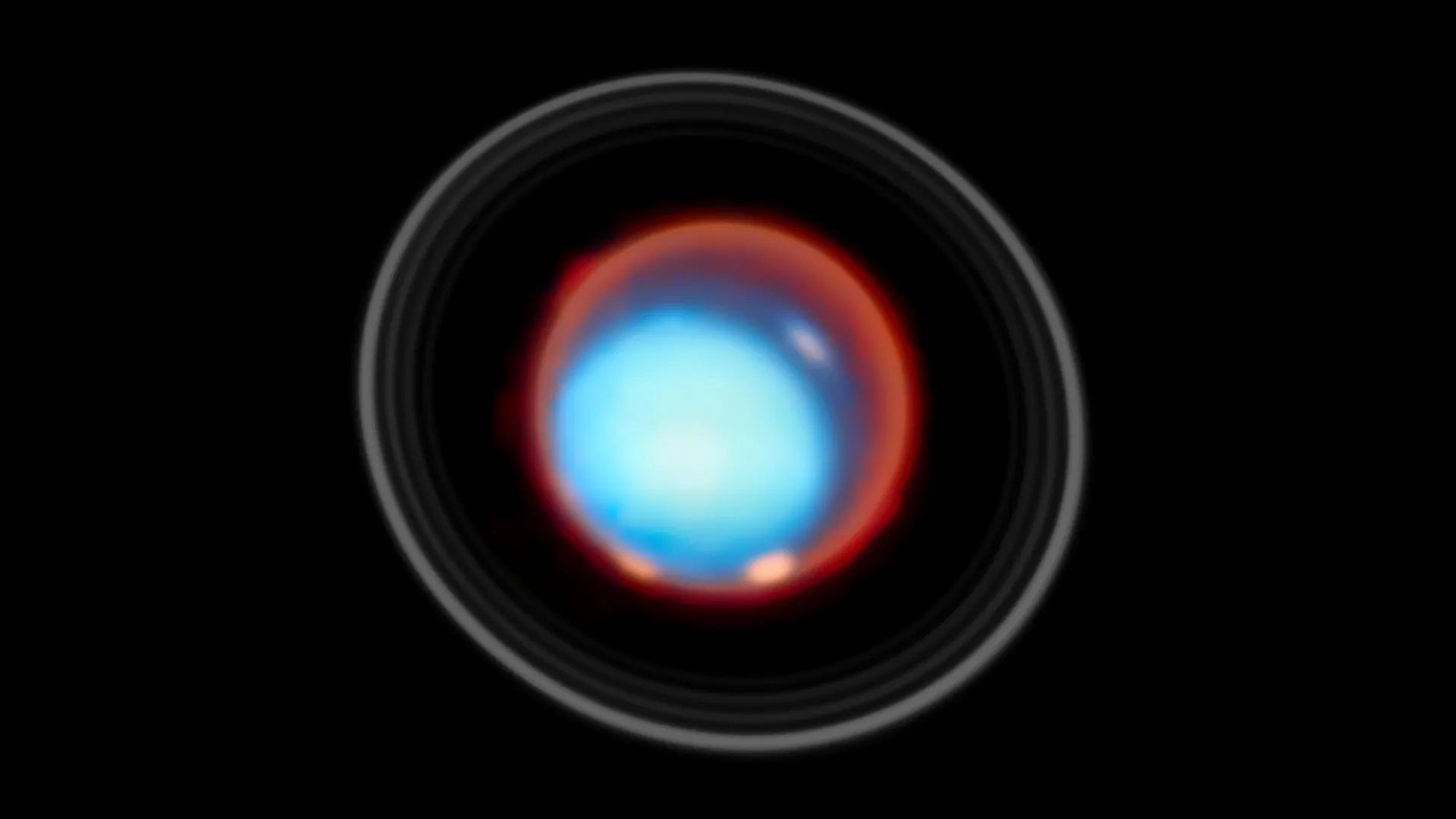
James Webb Telescope Reveals Unprecedented Details of Uranus’s Atmosphere and Magnetic Field
In a groundbreaking series of observations, the James Webb Space Telescope (JWST) has provided the most detailed three-dimensional map yet of Uranus’s upper atmosphere, shedding light on the planet’s auroras, temperature variations, and the complex interplay between its atmosphere and strangely tilted magnetic field. The findings, published in the journal Geophysical Research Letters, represent a significant leap forward in our understanding of ice giants and their energy balance, offering valuable insights applicable to exoplanet research. This research builds on decades of study, with initial observations of Uranus’s cooling atmosphere dating back to the early 1990s.
The research team, led by Paola Tiranti of Northumbria University in the United Kingdom, utilized JWST’s Near-Infrared Spectrograph (NIRSpec) to monitor Uranus for nearly a full rotation – approximately 15 hours – on January 19, 2025. By analyzing faint molecular emissions high above the planet’s cloud tops, scientists were able to probe the region known as the ionosphere, where the atmosphere becomes ionized and strongly influenced by the planet’s magnetic field. This allowed for measurements of temperatures and ion densities up to 5,000 kilometers above the visible clouds, a feat previously unattainable with ground-based observatories or earlier spacecraft missions.
The data collected by JWST confirms that Uranus’s upper atmosphere continues to cool, a phenomenon first identified over three decades ago. Researchers calculated an average temperature of approximately 426 kelvins (around 150 degrees Celsius), which is lower than previous measurements. This cooling trend, coupled with the unique characteristics of Uranus’s magnetic field, presents a compelling puzzle for planetary scientists. The European Space Agency (ESA) played a crucial role in the mission, providing the launch service using the Ariane 5 rocket and supplying the NIRSpec instrument.
Unraveling the Mysteries of Uranus’s Magnetic Field and Auroras
One of the most striking aspects of Uranus is its unusually tilted and offset magnetic field. Unlike Earth’s relatively aligned magnetic field, Uranus’s is tilted nearly 60 degrees from its rotational axis and is offset from the planet’s center. This peculiar configuration results in complex auroral displays that sweep across the planet’s surface in unpredictable ways. JWST’s observations have now revealed how deeply these magnetic field effects reach into the atmosphere, providing a clearer picture of where the planet’s auroras originate and how they are shaped.
The telescope detected two bright auroral bands near Uranus’s magnetic poles. Interestingly, between these bands, the team identified an area with reduced emissions and fewer ions, a feature believed to be linked to transitions in the magnetic field lines. Similar darker regions have been observed on Jupiter, where the shape of the magnetic field guides the movement of charged particles in the upper atmosphere. Understanding these dynamics is crucial for deciphering the energy transfer processes within Uranus’s magnetosphere, which is considered one of the strangest in the Solar System.
“Uranus’s magnetosphere is one of the strangest in the Solar System,” explained Tiranti. “It’s tilted and offset from the planet’s rotation axis, which means its auroras sweep across the surface in complex ways. Webb has now shown us how deeply those effects reach into the atmosphere. By revealing Uranus’s vertical structure in such detail, Webb is helping us understand the energy balance of the ice giants.”
Vertical Structure and Atmospheric Dynamics
For the first time, astronomers have been able to map the vertical structure of Uranus’s upper atmosphere in three dimensions. JWST’s sensitivity allowed the team to trace how energy moves upward through the planet’s atmosphere and to observe the influence of its lopsided magnetic field. The data reveal that temperatures reach their highest levels between 3,000 and 4,000 kilometers above the clouds, while ion densities peak closer to 1,000 kilometers. The observations show clear differences in atmospheric conditions based on longitude, which are tied to the complex structure of the magnetic field.
This detailed mapping of the ionosphere provides crucial insights into the planet’s energy budget and how it manages heat. Ice giants like Uranus radiate more heat into space than they receive from the Sun, a phenomenon that has long puzzled scientists. Understanding the processes that govern energy transport within the atmosphere is essential for resolving this mystery. The James Webb Space Telescope is a joint mission of NASA, ESA, and the Canadian Space Agency (CSA).
The Role of the James Webb Space Telescope
The James Webb Space Telescope, the most powerful space telescope ever launched, has proven to be an invaluable tool for studying the outer solar system. Its advanced infrared capabilities allow it to penetrate the haze and observe faint emissions that are invisible to other telescopes. The JWST General Observer program 5073, led by H. Melin of Northumbria University, provided the opportunity for these groundbreaking observations of Uranus. The program utilized NIRSpec’s Integral Field Unit to gather data over a continuous 15-hour period.
The development and operation of JWST are a testament to international collaboration. In addition to NASA and CSA, the European Space Agency (ESA) contributed significantly to the mission, providing the launch service and the NIRSpec instrument. ESA similarly contributed 50 percent of the mid-infrared instrument (MIRI), developed by a consortium of European Institutes in partnership with the Jet Propulsion Laboratory (JPL) and the University of Arizona. Arianespace secured the launch services for the mission.
Implications for Exoplanet Research
The findings from the JWST observations of Uranus have broader implications for the study of exoplanets – planets orbiting stars other than our Sun. Ice giants are thought to be common throughout the galaxy, and understanding their atmospheric dynamics and energy balance is crucial for characterizing these distant worlds. By studying Uranus, scientists can develop models and techniques that can be applied to the analysis of exoplanet atmospheres, potentially revealing clues about their composition, temperature, and habitability.
“By revealing Uranus’s vertical structure in such detail, Webb is helping us understand the energy balance of the ice giants. This is a crucial step towards characterizing giant planets beyond our Solar System,” Tiranti emphasized. The data collected by JWST will undoubtedly fuel further research into the mysteries of Uranus and other ice giants, both within our solar system, and beyond.
Key Takeaways
- The James Webb Space Telescope has created the first three-dimensional map of Uranus’s upper atmosphere.
- Observations confirm that Uranus’s upper atmosphere continues to cool, a trend identified decades ago.
- The planet’s unusually tilted magnetic field significantly influences its auroral displays and atmospheric dynamics.
- These findings provide valuable insights for understanding ice giants and characterizing exoplanets.
Researchers will continue to analyze the data collected by JWST, seeking to further unravel the complexities of Uranus’s atmosphere and magnetic field. Future observations are planned to monitor changes in the planet’s atmosphere over time and to investigate other aspects of its unique environment. The next major data release from the JWST program 5073 is anticipated in late 2026, promising even more detailed insights into this enigmatic ice giant. What are your thoughts on these new discoveries? Share your comments below and let us know what questions you have about Uranus and the James Webb Space Telescope.
Worth a look