
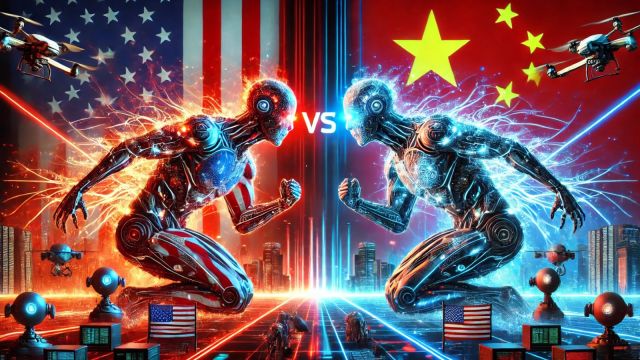
The intensifying competition for technological supremacy has reached a new flashpoint as the United States and China prepare for high-stakes diplomatic engagements. At the center of this friction is the control and distribution of cutting-edge artificial intelligence, highlighted by a recent decision by the AI safety and research company Anthropic to deny Chinese requests for access to its latest models.
This refusal comes at a critical juncture in the US China AI rivalry, as the two superpowers race to develop systems capable of transforming national security, economic productivity and cybersecurity. The tension is expected to dominate the agenda during President Donald Trump’s upcoming visit to China, where he is scheduled to meet with Chinese leader Xi Jinping to discuss the global trajectory of AI development.
The current landscape reveals a divide in how “success” is measured in the AI race. While the United States maintains a significant lead in the raw performance and capability of its top-tier models, China is increasingly viewed as a formidable competitor in the practical integration of these technologies into the broader economy and public services.
The Strategic Denial of AI Access
The decision by Anthropic to block Chinese access to its newest AI tools underscores the growing perception of large language models (LLMs) as critical national security assets. The pursuit of these models by Chinese entities reflects a broader effort to close the gap with U.S.-based developers like OpenAI and Google DeepMind.
Industry analysts suggest that the most advanced models are not merely commercial products but are essential tools for high-level strategic advantages. These include the ability to handle complex coding tasks and the capacity to both launch and prevent sophisticated cyberattacks. By restricting access, U.S. Firms are effectively maintaining a technological “moat” that prevents adversaries from leveraging American innovation to undermine U.S. Security.
The ‘Mythos’ Model and Cybersecurity Risks
The risks associated with high-performance AI have become so acute that some developers are choosing not to release their most powerful tools to the general public, let alone foreign governments. Anthropic recently determined that its AI model, known as Mythos, was too dangerous to be released due to severe cybersecurity concerns.
The internal assessment of Mythos highlights a recurring dilemma for AI labs: the “capability-safety” trade-off. As models become more proficient at reasoning and coding, they may inadvertently provide users—including malicious actors—with the tools necessary to develop autonomous malware or exploit vulnerabilities in critical infrastructure. The decision to withhold Mythos suggests that the potential for misuse currently outweighs the benefits of public or international deployment.
Performance vs. Integration: The Global AI Race
While the U.S. Currently holds the edge in raw model intelligence, the definition of leadership in the AI sector is evolving. According to Kyle Chan, a fellow at the Brookings think tank, the U.S. Is leading if the metric is the “sheer performance of the top models.” Models developed by OpenAI, Anthropic, and Google DeepMind are widely regarded as the most capable in the world.
However, Chan notes that performance is only one half of the equation. He argues that the ability to integrate these models into various sectors of the economy and into essential services is equally critical. The data suggests that China may be outpacing the United States, prioritizing the rapid adoption and application of AI across its industrial and governmental frameworks.
This divergence creates a complex strategic environment: the U.S. Possesses the most powerful “engines” of AI, but China may be building a more efficient “vehicle” for deploying that power across its society.
Key Dimensions of the AI Rivalry
| Metric | United States Focus | China Focus |
|---|---|---|
| Model Performance | Leading in raw intelligence, complex coding, and frontier research. | Closing the gap. seeking access to frontier models. |
| Economic Integration | Market-driven adoption; varying levels of sectoral integration. | State-driven, rapid integration into economy and services. |
| Security Approach | Focus on safety guardrails and restricting adversary access. | Rapid deployment to achieve strategic parity. |
Diplomatic Stakes at the Trump-Xi Summit
The upcoming meeting between President Donald Trump and President Xi Jinping is expected to address these technological disparities directly. With AI now viewed as a cornerstone of global influence, the discussions will likely touch upon export controls, the ethics of AI deployment, and the prevention of an AI-driven arms race.

The U.S. Administration has emphasized that maintaining a lead in AI is vital for national security. The ability to develop superior AI for cyber-defense and intelligence gathering is seen as a primary deterrent against geopolitical instability. Conversely, the Chinese leadership views access to these technologies as essential for its continued economic growth and modernization.
The refusal of access by companies like Anthropic adds a layer of corporate diplomacy to the official state relations. As private companies become the primary gatekeepers of the world’s most powerful technology, their internal safety and security policies now have direct implications for international relations.
The next confirmed checkpoint in this developing story will be the official readout and joint statements following the meeting between President Trump and President Xi Jinping this week.
Do you believe the restriction of AI access is a necessary security measure or a hindrance to global safety? Share your thoughts in the comments below.