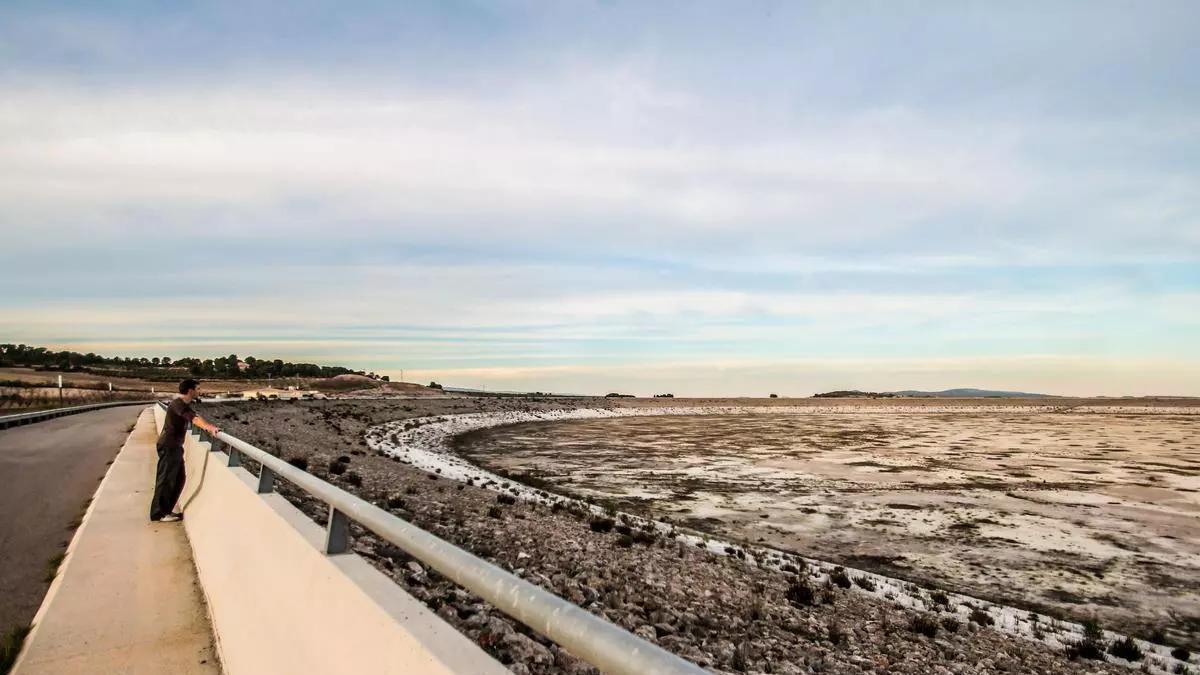
The San Diego reservoir in Villena, designed as the critical terminus for the Júcar-Vinalopó water transfer, has remained a symbol of infrastructural failure and administrative delay for over a decade. Intended to regulate the flow of water from the Júcar river to the arid regions of the Vinalopó valley, the facility has spent years largely empty and dysfunctional due to severe structural leakages that undermined its primary purpose.
The project, which saw initial filling phases begin around 2010, was meant to provide a strategic reserve for agriculture and urban consumption in the Alto Vinalopó region. Yet, the discovery of significant seepage—where water filtered through the reservoir’s base rather than being contained—effectively halted the facility’s utility. This failure turned a multi-million euro investment into a dormant basin, leaving thousands of hectares of farmland without the promised water security.
For the local communities in Villena and surrounding municipalities, the San Diego reservoir was presented as a hydraulic milestone. The facility was engineered to store more than 20 million cubic meters of water, a volume capable of irrigating 10,000 hectares of crops according to reports from May 2010. Despite these ambitions, the reality has been a protracted cycle of detection, neglect, and belated attempts at remediation.
A History of Structural Failure and Delay
The operational timeline of the San Diego reservoir is marked by a stark contrast between early optimism and long-term dysfunction. In February 2010, the Spanish government initiated the filling of the basin, and by May 2011, reports indicated the reservoir had reached half its capacity, storing 12 cubic hectometers of water as documented by Las Provincias. These early milestones suggested that the Júcar-Vinalopó transfer was finally becoming a reality for the region.
However, the triumph was short-lived. It soon became evident that the reservoir suffered from critical impermeability issues. Instead of holding the water for regulation and distribution, the basin acted as a sieve, with water leaking into the surrounding soil. These leakages were not merely technical glitches but fundamental failures in the construction or the geological assessment of the site. The result was a facility that could not be safely or efficiently used for its intended purpose, rendering the entire transfer infrastructure incomplete at its most vital point.

The impact of these leaks extended beyond the loss of water. Since the San Diego reservoir serves as the regulation point for the transfer, its inability to hold water meant that the distribution network—managed by the regional government (Conselleria)—could not operate at full capacity. The water from the Júcar river could reach the Vinalopó, but without the storage capacity of San Diego, the system lacked the stability needed to guarantee a steady supply during periods of drought.
The Long Road to Remediation
The gap between the detection of the leaks and the government’s action to fix them has been a point of significant local frustration. For years, the reservoir remained a “ghost” facility—constructed, filled, and then abandoned to the elements. The administrative response was characterized by a slow bureaucratic process that failed to match the urgency of the region’s water needs.
It was not until March 2020 that the Ministry for the Ecological Transition began formally processing the construction project required to waterproof the reservoir. This move came eight years after the leaks had been identified and documented, representing a decade of lost opportunity for the farmers of the Alto Vinalopó according to reports by Información. The project focused on the “impermeabilización” (waterproofing) of the basin, a necessary step to ensure that the reservoir could actually retain the millions of cubic meters of water it was designed to hold.
Key Technical and Social Impacts
- Agricultural Instability: The inability to use the reservoir meant that 10,000 hectares of potential irrigation remained precarious, dependent on erratic rainfall and limited transfer flows.
- Economic Waste: The construction of a reservoir that cannot hold water represents a significant loss of public funds, compounded by the cost of the eventual repairs.
- Environmental Stress: The lack of a regulation basin increases the vulnerability of the Vinalopó valley to climate-driven droughts, which have intensified in southeastern Spain.
Why the San Diego Reservoir Matters Globally
Although the San Diego reservoir is a local infrastructure project, it serves as a case study in the challenges of water management in the Mediterranean basin. Spain is one of the most water-stressed countries in Europe, and the reliance on “trasvases” (water transfers) is often a point of intense political and social conflict. The failure of the San Diego basin highlights the risks associated with large-scale hydraulic engineering when geological surveys are flawed or construction quality is compromised.
The Júcar-Vinalopó transfer is part of a broader strategy to move water from areas of abundance to areas of scarcity. When the “complete point” of such a system fails, it creates a bottleneck that renders the entire upstream investment less effective. The San Diego case illustrates the “last mile” problem in infrastructure: you can build the canals and the pumps, but if the final storage vessel leaks, the system fails.
the delay in repairing the facility underscores a common issue in public works: the “sunk cost” fallacy and administrative inertia. Once a project is completed and declared “finished,” admitting a fundamental flaw requires a political and financial admission of failure that often leads to years of delay in corrective action.
Current Status and Future Outlook
The process of waterproofing the San Diego reservoir is the only viable path toward making the Júcar-Vinalopó transfer fully operational. Without a functional regulation basin, the transfer remains a partial success—capable of moving water but incapable of managing it for long-term security. The technical challenge involves applying modern geomembranes or sealing layers to the basin floor to prevent further seepage into the subsoil.
For the residents of Villena and the wider Alto Vinalopó region, the completion of these repairs is not merely a technical requirement but a necessity for economic survival. The agricultural sector in this region is the backbone of the local economy, and the promise of 20 million cubic meters of stored water remains the primary goal for regional water authorities.
| Year | Event/Status | Impact |
|---|---|---|
| 2010 | Initial filling begins | Infrastructure declared as the “final point” of the transfer. |
| 2011 | Reaches 50% capacity | Temporary optimism as 12 cubic hectometers are stored. |
| 2012 | Leaks detected | Reservoir becomes unusable; water seeps through the base. |
| 2012-2020 | Period of Inactivity | Facility remains empty; administrative delays in repair. |
| 2020 | Repair project processed | Ministry begins drafting the waterproofing construction plan. |
The next critical milestone for the region is the full implementation and verification of the waterproofing works. Once the basin is sealed and tested, the Ministry and the regional government must coordinate the filling process to ensure that the water reaches the distribution networks of the Conselleria without further loss.
World Today Journal will continue to monitor the progress of the Júcar-Vinalopó transfer and the restoration of the San Diego basin. We invite our readers to share their perspectives on water management and infrastructure in the comments section below.