The United States will mark its 250th anniversary on July 4, 2026, an event known as the Semiquincentennial. Managed by the U.S. Semiquincentennial Commission, the celebration aims to evaluate the nation’s progress since 1776, while acknowledging the enduring contradictions between the country’s founding ideals of liberty and its historical realities of inequality.
This milestone arrives at a time of significant political and social division within the U.S. The federal government has established a formal framework to coordinate celebrations across all 50 states, territories, and the District of Columbia. However, historians and policymakers suggest that the 2026 anniversary will be defined less by simple celebration and more by a confrontation with the “American paradox”—the gap between the democratic rhetoric of the founding documents and the lived experience of marginalized groups.
The U.S. Semiquincentennial Commission, created by Congress, is tasked with ensuring the anniversary is inclusive. According to the commission’s official mandate, the goal is to create a “shared” national story that recognizes both the achievements and the failures of the American experiment. This approach marks a departure from previous centennial celebrations, which often focused on a sanitized version of national progress.
The tension inherent in the 250-year mark centers on the Declaration of Independence. While the document asserts that “all men are created equal,” the authors of that text held enslaved people and excluded women and Indigenous populations from the political process. This fundamental contradiction has shaped U.S. law, conflict, and social movements for two and a half centuries.
What is the United States Semiquincentennial?
The United States Semiquincentennial is the official 250th anniversary of the signing of the Declaration of Independence. The term “semiquincentennial” derives from the Latin semi (half) and quincentennial (500 years). The primary event will occur on July 4, 2026, but the celebrations are designed as a multi-year effort involving educational programs, community service, and national commemorations.

To manage the scale of the event, the U.S. government established the U.S. Semiquincentennial Commission. This body is responsible for coordinating with state and local governments to ensure the anniversary is not centralized solely in Washington, D.C. The commission’s objective is to encourage “grassroots” participation, prompting citizens to reflect on what the United States means to them in a modern context.
Unlike the 1976 Bicentennial, which focused heavily on patriotism and a recovery of national spirit after the Vietnam War and Watergate, the 2026 event is being framed around the concept of “America’s story.” This framing allows for a broader interpretation of history, including the perspectives of those who were oppressed by the very systems the nation sought to build. The commission has emphasized that the anniversary should be a time for “honest reflection” rather than just a party.
Which founding paradoxes define the American experience?
The “American paradox” refers to the coexistence of contradictory values or realities within the United States. The most prominent of these is the conflict between the ideal of universal liberty and the institution of chattel slavery. According to records from the National Archives, the Declaration of Independence established the philosophical basis for human rights, yet the legal structure of the early Republic protected the ownership of human beings.
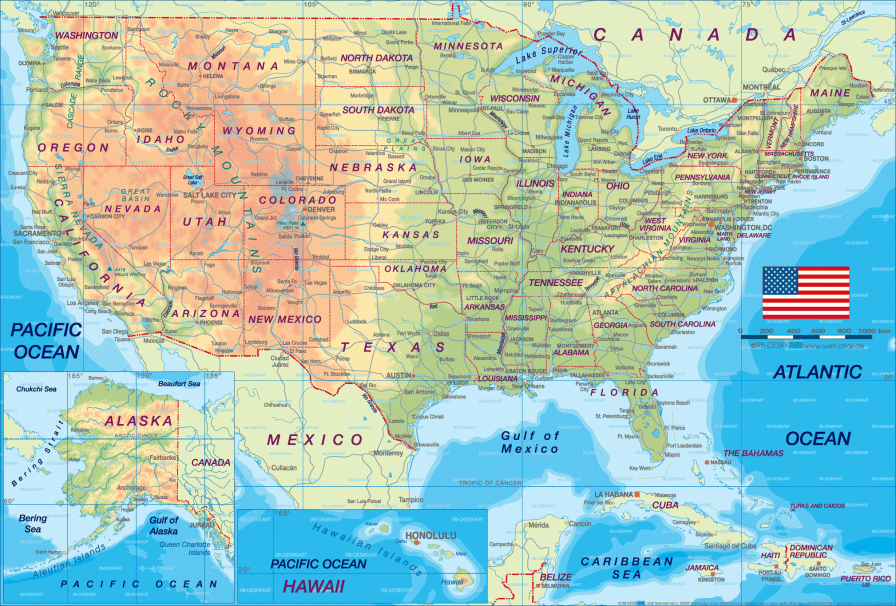
This paradox extended beyond slavery to the treatment of Indigenous peoples. While the U.S. expanded its territory under the banner of “Manifest Destiny,” this growth required the systemic removal and genocide of Native American tribes. The tension between the desire for land and the stated value of justice created a legal and moral contradiction that the U.S. government continues to address through tribal sovereignty disputes and land claims today.
Another enduring paradox is the tension between rugged individualism and the need for collective social stability. The U.S. identity is heavily tied to the “self-made man” and a distrust of centralized government. However, the nation’s survival and economic dominance have relied on massive collective efforts, including federal infrastructure projects, public education, and wartime mobilizations. This conflict manifests in modern debates over healthcare, climate change, and social safety nets.
Economic disparity represents a contemporary version of this paradox. The United States maintains the world’s largest economy by GDP, yet it experiences levels of income inequality that are higher than those in many other developed democracies. The “American Dream”—the idea that any citizen can achieve prosperity through hard work—is frequently contrasted with systemic barriers to wealth accumulation for minority groups and the working class.
How is the U.S. Semiquincentennial Commission planning the event?
The U.S. Semiquincentennial Commission is utilizing a decentralized model to organize the 2026 festivities. Instead of a single, government-mandated program, the commission provides resources and guidance for states to develop their own local commemorations. This strategy is intended to reflect the diversity of the American experience across different regions.
Key pillars of the planning process include:
- Educational Initiatives: The commission is partnering with historians and educators to update curricula, ensuring that students learn about both the triumphs and the tragedies of the last 250 years.
- Community Service: There is a push to link the anniversary with “acts of service,” encouraging citizens to improve their local communities as a way of honoring the national legacy.
- Inclusive Narratives: The commission has stated that the 2026 celebrations must include the voices of immigrants, LGBTQ+ individuals, and people of color to provide a complete picture of the U.S. evolution.
The commission’s approach is designed to avoid the political polarization that has characterized recent U.S. elections. By focusing on “local stories” and “shared values,” the organizers hope to find common ground. However, some critics argue that any attempt to create a “unified” narrative may inadvertently gloss over the deep-seated grievances that still divide the country.
What impact will the anniversary have on national unity?
The Semiquincentennial occurs during a period of intense political volatility. The success of the event as a tool for national unity depends on whether the U.S. can successfully navigate its internal contradictions. If the celebrations are viewed as mere propaganda, they may further alienate populations that feel excluded from the “American story.”

Sociologists note that national milestones often serve as a mirror. For some, July 4, 2026, will be a celebration of the resilience of democracy and the ability of the U.S. to reform itself over time. They point to the 13th, 14th, and 15th Amendments—which abolished slavery and granted citizenship and voting rights—as evidence that the U.S. can resolve its paradoxes through legal and social struggle.
For others, the anniversary will highlight the unfinished nature of the American project. The ongoing debates over voting rights, systemic racism, and the role of the judiciary suggest that the “founding paradoxes” are not merely historical footnotes but active conflicts. The way the U.S. handles these discussions in 2026 could signal whether the country is moving toward a more inclusive identity or deeper fragmentation.
Globally, the Semiquincentennial will be watched as a litmus test for the “democratic model.” As the U.S. promotes democracy abroad, its internal stability and its ability to reconcile its history will influence its diplomatic authority. A celebration that acknowledges failure and strives for improvement may carry more weight internationally than one that ignores the paradoxes of its past.
The next major confirmed checkpoint for the celebrations will be the release of the detailed state-by-state event calendars, expected to be finalized as the commission enters the final planning phase leading up to July 4, 2026.
Do you believe the U.S. can reconcile its founding paradoxes by 2026? Share your thoughts in the comments below.