
Republican Representative Rich McCormick of Georgia has introduced legislation aimed at reversing a historical boundary change that transferred land from the District of Columbia to Virginia in the mid-19th century. The proposed “Make DC Square Again Act” seeks to return Arlington County and the City of Alexandria to federal jurisdiction, restoring the district to its original 100-square-mile footprint as established when the national capital was first laid out.
The bill directly addresses the 1846 retrocession act, in which Congress returned the Virginia portion of the District of Columbia to the Commonwealth of Virginia. At that time, the area now known as Arlington and Alexandria was referred to as Alexandria County. McCormick argues that this transfer violated the Constitution’s Enclave Clause, which grants Congress exclusive legislative authority over a federal district “not exceeding ten miles square,” and maintains that the lawmaker lacks constitutional power to cede territory back to a state.
According to McCormick’s office, the legislation would formally transfer jurisdiction at the start of the first fiscal year following enactment. The spokesperson emphasized that property rights for residents would remain unaffected and that any ongoing criminal or civil proceedings in Virginia courts could continue to their conclusion without disruption.
The current District of Columbia spans approximately 68 square miles, a significant reduction from its original boundaries. Reintegrating Arlington and Alexandria would expand the district’s area and reshape its geography into a form closer to a square, inspiring the bill’s titular reference. This geographic change would too alter the political landscape, as both jurisdictions are predominantly Democratic-leaning and currently represented in Congress by Democratic members.
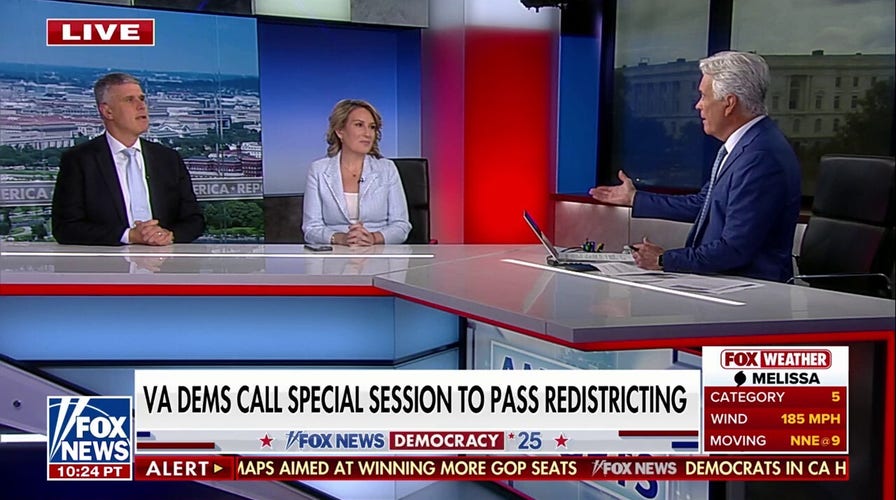
The proposal emerges amid heightened political activity in Virginia following voter approval of a mid-decade redistricting plan. Analysts suggest the revised congressional map could enhance Democratic prospects in upcoming House elections by creating additional competitive or favorable districts. Republicans, including McCormick, have framed the DC expansion effort as a response to these electoral developments, though the bill’s constitutional basis remains central to its presentation.
Opposition to the legislation has been voiced by Virginia’s Democratic congressional delegation. Representative Don Beyer, whose district includes parts of Northern Virginia, has publicly challenged the bill’s constitutionality, arguing that Congress cannot unilaterally reverse a retrocession approved by both the federal government and the Commonwealth of Virginia in the 1840s. Beyer maintains that such a move would overstep federal authority and disregard established legal precedents governing territorial changes.
Historical context shows that the original District of Columbia, established by the Residence Act of 1790, was a 100-square-mile diamond-shaped territory straddling the Potomac River, with land contributed by both Maryland, and Virginia. The Virginia portion was returned via retrocession in 1846, effective in 1847, leaving the current district composed solely of the former Maryland cession. Any attempt to alter the district’s boundaries would require congressional approval and likely face legal challenges regarding the permanence of the 1846 agreement.
The bill has been referred to the House Committee on Oversight and Reform, which holds jurisdiction over matters related to the District of Columbia. No committee hearing or markup has been scheduled as of this reporting. Observers note that the legislation faces steep odds in the closely divided House, where bipartisan support would be necessary for advancement, and similar proposals in past Congresses have not progressed beyond introduction.
For updates on the legislative status of the Make DC Square Again Act, readers can consult the official Congress.gov database, which tracks all introduced bills, committee actions, and voting records. The site provides real-time information on legislative proceedings and is maintained by the Library of Congress as a nonpartisan resource for public access to federal lawmaking processes.
As the debate over federal district boundaries continues, the proposal highlights ongoing tensions between local governance, congressional authority, and historical interpretations of constitutional provisions. Whether the bill gains traction will depend on legislative priorities, legal assessments, and the broader political climate surrounding voting rights and representation in the national capital.
We encourage readers to share their perspectives on this developing story in the comments section below and to follow World Today Journal for ongoing coverage of legislative and political developments affecting communities across the United States and beyond.