
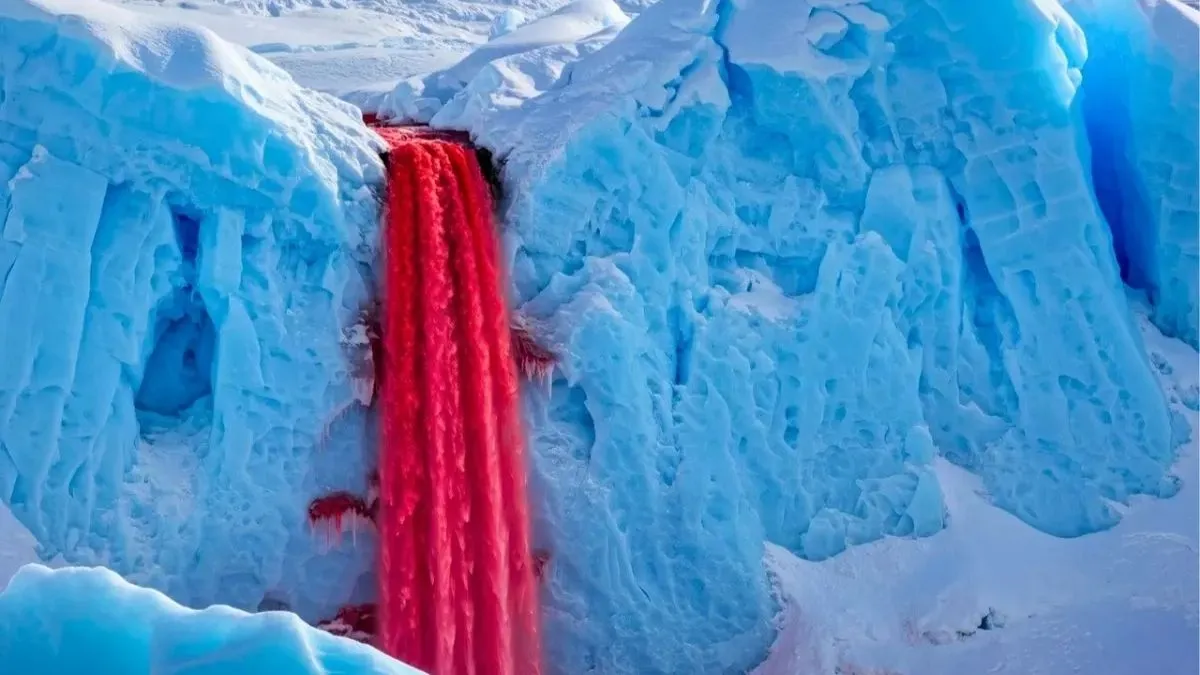
Antarctica’s Blood Falls, a crimson waterfall flowing from Taylor Glacier into Lake Bonney, was finally explained by researchers who discovered that extremely salty, iron-rich brine travels through pressurized channels before oxidizing on the surface. First found in 1911, the site provides a rare, sealed subglacial ecosystem.
For more than a century, a striking crimson stream pouring from the edge of Antarctica’s Taylor Glacier into Lake Bonney has captivated scientists and explorers alike. Known widely as Blood Falls, the feature resembles a horror film set against the stark white terrain of the McMurdo Dry Valleys. Early explorers, led by Australian geologist Thomas Griffith Taylor, could only guess at what caused the eerie red flow. Over the decades, hypotheses ranged from exotic red algae to ancient battles, but modern science has dismantled those guesses in favor of a complex underground plumbing system.
Unlocking an Ancient Subglacial Reservoir Beneath Taylor Glacier
The source of the crimson liquid lies deep beneath the ice. According to data cited by the National Science Foundation (NSF), the water originates in a subglacial pool trapped 400 meters
beneath the surface. Researchers believe this ancient body of water was sealed off approximately 1.5 million years ago when seawater became enclosed under the advancing glacier and grew progressively saltier over millennia.
For a long time, the puzzle was not just why the water was red, but how it managed to escape a frozen desert. A study published in the Antarctic Science journal mapped tiny cracks and fractures within the glacier that provide natural pathways for the liquid to move upward. Scans revealed a network of pressurized channels carrying brine nearly 300 meters inside the ice before it finally breaks through to the air.
Why the Hypersaline Brine Refuses to Freeze in Sub-Zero Cold
Liquid water in a polar desert defies standard intuition. The mechanism keeping the brine fluid involves a combination of high salt concentration and thermodynamics. Reporting notes that the brine is roughly three times saltier than standard seawater, which depresses its freezing point significantly. Furthermore, researchers explain that water releases heat during the freezing process, which helps keep the salty water flowing beneath the glacier.
When this pressurized brine reaches the surface in the McMurdo Dry Valleys—where temperatures sit around -7 °C—it comes into contact with atmospheric oxygen. As Factcrescendo notes from visitor and researcher descriptions, the water emerges clear but then quickly turns crimson
through rapid oxidation.
Microscopic Iron Nanospheres Replace Traditional Rust Theories
The exact chemical composition responsible for the intense coloration has also been refined by recent technology. While mid-century studies attributed the stain to general ferric hydroxide or iron compounds, a study published in the Journal of Glaciology in 2023–2024 utilized advanced microscopy to uncover a more specific culprit. Researchers analyzing soil and water samples with a Transmission Electron Microscope found that the liquid is packed with tiny, iron-rich nanospheres roughly 100 times smaller than a human red blood cell.
This microscopic structure explains why earlier, less powerful testing methods failed to identify crystalline iron minerals in significant quantities. Instead, the water acts as a concentrated suspension of nanospheres that instantly take on a rusty, vivid hue the moment they hit the open air.
Real-Time Glacial Shifts Captured During Active Drainage Pulses
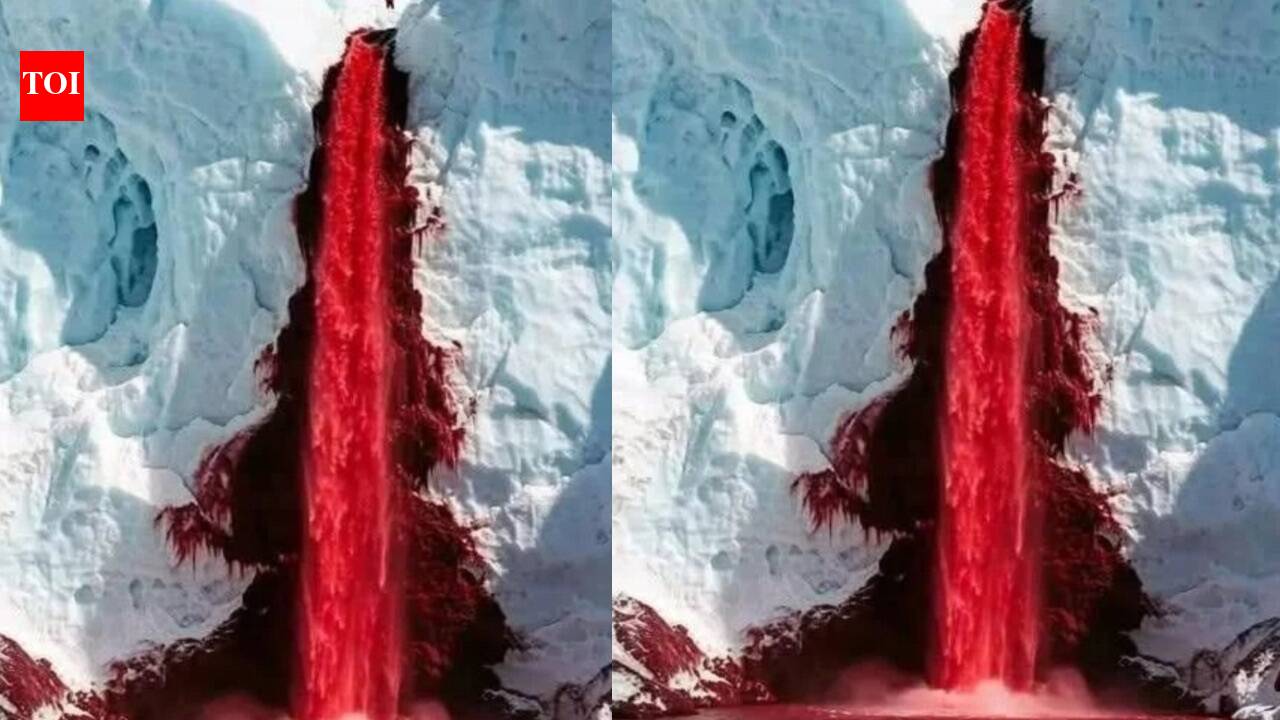
Rather than flowing as a constant, steady stream, recent data from 2025 confirms that the brine’s flow is sporadic but constant, proving that liquid water systems can exist deep inside cold-based glaciers previously thought to be frozen solid.
Implications for Extremophile Life and Astrobiology Searches
Beyond its striking visual appearance, Blood Falls serves as a vital natural laboratory for astrobiologists studying how life might persist in extreme, dark, oxygen-deprived environments elsewhere in the solar system. Researchers recovered samples containing a unique community of microbes surviving entirely without sunlight.
These extremophile bacteria rely on iron and sulfur respiration in total darkness, offering a compelling analog for conditions expected beneath the icy crusts of Jupiter’s moon Europa or Saturn’s moon Enceladus. Data gathered from Taylor Glacier continues to reshape scientific understanding of cold-based glaciers, proving they can harbor active, liquid hydrological systems rather than existing as entirely frozen blocks of ice.
Worth a look
- Why Minnesota’s AI Nudification Ban Is Unconstitutional (And Why Elon Musk Is Right to Sue)
- Warhammer 40,000: Dawn of War IV Focuses on Necrons in Latest Preview
- Causes and Prevention of Leg Edema and Blood Stasis (world-today-news.com)
- New Ultrasound Technique Breaches Blood-Brain Barrier to Treat Gliomas (newsdirectory3.com)