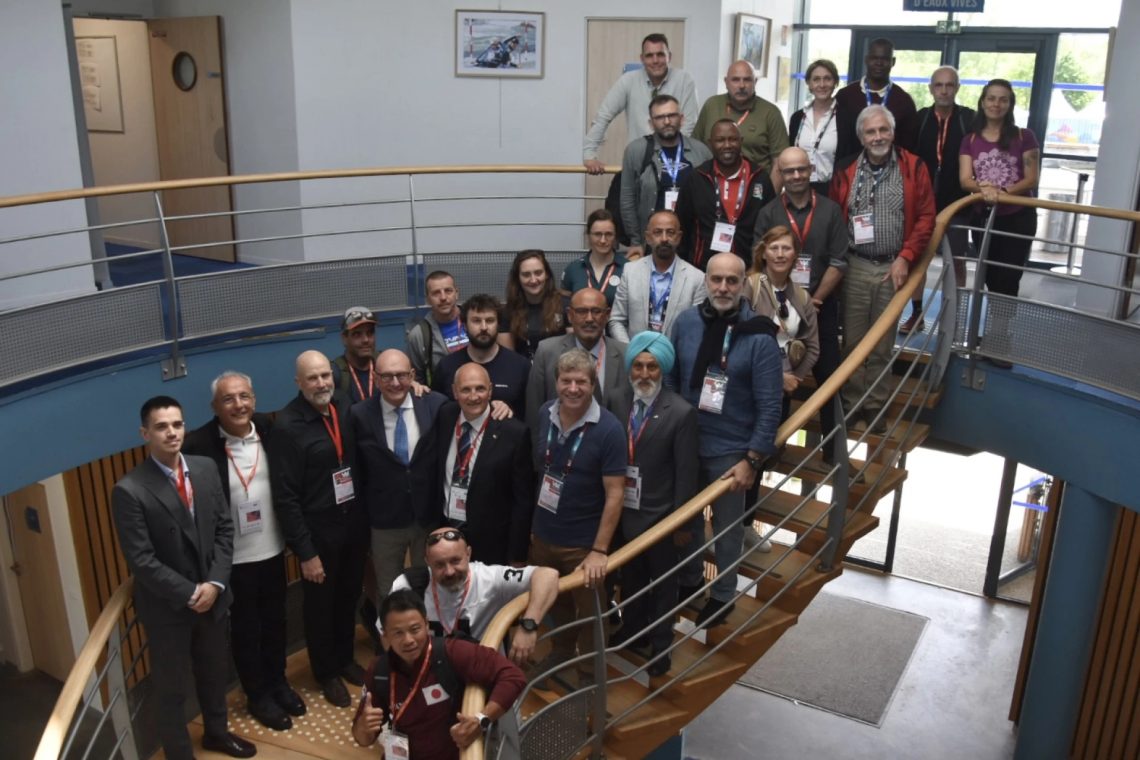
Danilo Barmaz has been elected as the first president of United Rafting, the newly formed global governing body for the sport of rafting. The election took place during the inaugural Elective Congress held in Pau, France, on April 21–22, 2026, marking the formal unification of the World Rafting Federation (WRF) and the International Rafting Federation (IRF) into a single international organization. This development represents a significant milestone for the global rafting community, aiming to streamline governance and strengthen the sport’s international presence.
The congress brought together representatives from 56 national federations entitled to vote, as confirmed in the official proceedings of the Elective Congress. Barmaz, who previously served as president of the WRF, was elected to lead the new General Board of United Rafting. His leadership role comes at a pivotal moment as the organization seeks to establish unified rules, competition calendars, and sustainable practices for rivers worldwide, building on the foundation laid by the 2024 declaration of intent to unite the two federations.
The formation of United Rafting follows a joint declaration signed on May 24, 2024, in Lausanne, Switzerland, by Barmaz and Joseph Willis Jones, then-president of the IRF. That agreement outlined shared goals to promote rafting as a unified sport, support athletes and technical officials, organize high-level competitions, and advance environmental stewardship of rivers. The Elective Congress in Pau served as the constitutional step to bring that vision into effect, electing not only the president but likewise treasurer and board members representing Africa, the Americas, Asia, and Europe.
Alongside Barmaz, the General Board includes Blerina Ago of Albania as treasurer, and board members William Kariuki Mwangi (Kenya), Hadi Seyed Ghaziasgar (Iran), Gurkan Kose (Türkiye), and Boris Purjakov (Serbia). Continental councils were also established to ensure regional representation, with elected delegates from national federations across Asia, Europe, the Americas, and Africa. This structure reflects the organization’s commitment to inclusivity and balanced global governance.
The unification effort has been framed as a response to long-standing fragmentation in the sport, where competing international bodies sometimes led to duplicated events, inconsistent rules, and limited recognition by major sports institutions. By creating a single federation, United Rafting aims to improve coordination with the International Canoe Federation (ICF), pursue recognition from the International Olympic Committee (IOC), and expand access to funding and development programs for emerging rafting nations.
ICF President Thomas Konietzko acknowledged the significance of the merger during the congress, sending a video message that emphasized collaboration within the wider paddlesport community. His remarks highlighted the potential for joint initiatives in athlete development, safety standards, and event scheduling, particularly as rafting continues to grow in popularity across both competitive and recreational sectors.
Looking ahead, United Rafting has stated its initial priorities include finalizing a unified sport rulebook and competition calendar effective January 1, 2025, as previously agreed upon in the 2024 declaration. The organization also plans to engage with national federations to align local governance structures with the new international framework, ensuring that clubs, guides, and athletes benefit from clearer pathways for participation and advancement.
For the global rafting community, the election of Danilo Barmaz and the establishment of United Rafting signal a move toward greater stability and shared purpose. Athletes may benefit from standardized competition opportunities, while event organizers could see reduced scheduling conflicts and improved access to international sanctioning. National federations, particularly those in developing regions, stand to gain from centralized resources and technical support aimed at growing the sport at the grassroots level.
As the sport moves forward under this new governance model, transparency and democratic participation will be key to maintaining trust among stakeholders. The next major checkpoint for United Rafting is the anticipated release of its first official sport calendar and rulebook, expected before the end of 2024, which will provide concrete guidance for the 2025 competition season. These documents will be critical in determining how successfully the unification translates into practical improvements on the water.
Readers interested in following the development of United Rafting can monitor official updates through the organization’s website and communications from member national federations. The success of this initiative will depend on sustained collaboration across continents, a shared commitment to safety and sustainability, and the ability to deliver tangible benefits to rafting enthusiasts of all levels.
Stay informed about the latest developments in global rafting governance by visiting trusted sports news sources and official federation channels. Share your thoughts on what this unification means for the future of the sport in the comments below, and help spread awareness by sharing this article with fellow paddling enthusiasts.