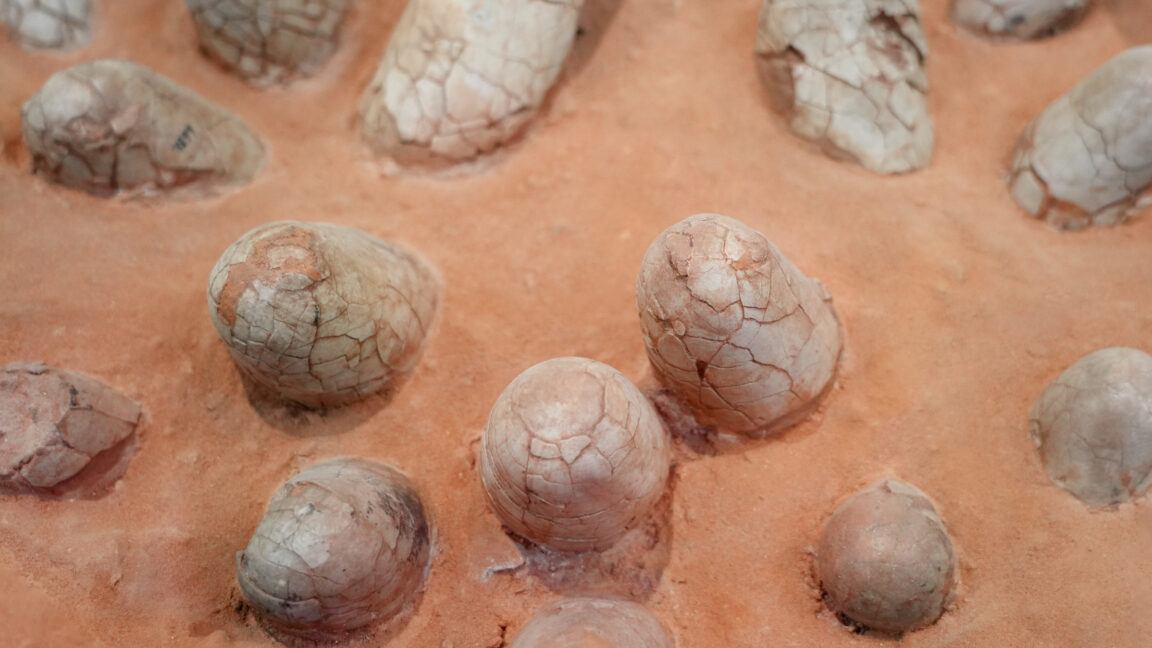
Dinosaur Eggshells Offer New Clues to Fossil Dating
For paleontologists, determining the age of dinosaur fossils has long been a complex challenge. While sedimentary rock layers provide a relative timeline, pinpointing the exact age of the fossils embedded within them has often been frustratingly imprecise. Traditional methods of dating fossilized bones and teeth are inconsistent, as the fossilization process itself can alter the material and compromise accuracy. Now, a groundbreaking new approach focusing on dinosaur eggshells is offering a potential solution, promising to refine our understanding of prehistoric life and the environments in which dinosaurs thrived. This method could unlock a more precise timeline for fossils found alongside the eggshells, offering a new window into the Mesozoic Era.
The difficulty in dating fossils stems from the limitations of existing techniques. Uranium-lead dating, while widely used for geological materials, is still an emerging technology when applied directly to fossils. Fossilization and the transformation of sediment into rock can significantly alter the chemical composition of bone, introducing errors into the dating process. This new technique, however, sidesteps these issues by focusing on the unique properties of dinosaur eggshells, offering a more reliable and consistent method for establishing age.
A team of researchers, led by paleontologist Ryan Tucker of Stellenbosch University in South Africa, has developed a method to date dinosaur eggshells, revealing when they were buried by sediment. This information, crucially, can then be used to determine the burial age of other fossils found within the same rock layer. The research, recently published in Nature Communications Earth & Environment, suggests a significant advancement in the field of paleontological dating.
“If validated, this approach could greatly expand the range of continental sedimentary successions amenable to radioisotopic dating,” Tucker said in the published study. This means the technique could be applied to a wider variety of fossil sites, particularly those where traditional dating methods have proven unreliable.
The Unique Microstructure of Dinosaur Eggshells
Vertebrates have been laying eggs for hundreds of millions of years, though early dinosaur eggs differed from those of modern reptiles, initially possessing soft shells. National Geographic reports on the evolution of dinosaur eggs, noting the transition to harder, calcified shells over time. What makes fossil eggshells particularly useful for dating purposes is their unique microstructure, specifically the arrangement of calcium carbonate crystals within them. This structure records diagenetic changes – the physical and chemical alterations that occur during fossilization – including water damage and fractures caused by the pressure of overlying sediment.
These changes aren’t detrimental to the dating process; rather, they provide a record of the eggshell’s history after burial. By analyzing these microstructural features, researchers can determine how long ago the eggshell was covered by sediment, and how old the surrounding fossils are likely to be. This is a significant improvement over attempting to date the fossils themselves, which are more susceptible to alteration, and contamination.
How the New Dating Method Works
The process involves a detailed analysis of the calcium carbonate crystals within the eggshell. Researchers examine the arrangement and composition of these crystals, looking for evidence of diagenetic changes. These changes act as a kind of “fossilized fingerprint,” revealing the conditions the eggshell experienced after burial. By comparing these changes to known rates of diagenetic processes, scientists can estimate the time elapsed since the eggshell was covered in sediment.
This method isn’t simply about identifying the presence of changes; it’s about quantifying them. The team developed a sophisticated analytical technique to measure the extent of these changes with precision. This allows for a more accurate and reliable age estimate than previous methods. The technique relies on radioisotopic dating, but applied to the eggshell material itself, rather than attempting to directly date the bone material of other fossils.
The implications of this research extend beyond simply refining the ages of known fossils. It also opens up the possibility of dating fossils from sites where traditional dating methods have been unsuccessful. Many continental sedimentary formations lack the volcanic layers needed for radiometric dating, making it difficult to establish a precise timeline. This new method offers a way to overcome this limitation, potentially unlocking a wealth of new information about dinosaur evolution and the ancient environments they inhabited.
The Significance for Paleontological Research
The ability to accurately date fossils is fundamental to understanding the history of life on Earth. It allows paleontologists to reconstruct evolutionary relationships, track changes in biodiversity, and investigate the causes of extinction events. Accurate dating is also crucial for understanding the paleoenvironment – the climate, geography, and ecosystems of the past. By knowing when a fossil lived, scientists can infer what the world was like at that time.
Fossil Butte National Monument in Wyoming, for example, is renowned for its exceptionally well-preserved fossil fish. Britannica details the site’s significance, highlighting its Eocene Epoch fossils. Precise dating of the surrounding rock layers, facilitated by techniques like the one developed by Tucker’s team, would provide a more accurate understanding of the conditions that led to the exceptional preservation of these fossils.
the technique has the potential to resolve long-standing debates about the timing of dinosaur evolution. For instance, the exact timing of the Cretaceous-Paleogene extinction event – the event that wiped out the non-avian dinosaurs – is still a subject of ongoing research. More precise dating of fossils from this period could help to refine our understanding of this pivotal moment in Earth’s history.
Looking Ahead: Validation and Wider Application
While the initial results are promising, the researchers emphasize that the method still needs to be validated on a larger scale. Further studies are needed to test the technique on eggshells from different geological formations and to compare the results with existing dating methods. The team is also working to refine the analytical techniques and to develop standardized protocols for applying the method.
The potential applications of this new dating method are vast. It could be used to date fossils from sites all over the world, providing a more complete and accurate picture of dinosaur evolution. It could also be applied to other types of fossils, such as those of early mammals and birds. The research represents a significant step forward in the field of paleontological dating, offering a new tool for unraveling the mysteries of the past.
The success of this method hinges on the availability of well-preserved dinosaur eggshells. Fortunately, these fossils are relatively common in many parts of the world, suggesting that the technique could be widely applicable. As researchers continue to refine and validate the method, We see likely to become an increasingly critical tool for paleontologists seeking to understand the history of life on Earth.
The next step for the research team involves applying the technique to a wider range of fossil sites and comparing the results with existing dating methods. The team plans to publish further findings in the coming years, as they continue to refine and validate the method. Readers interested in following the progress of this research can find updates on the Nature website and through Stellenbosch University’s press releases.
What are your thoughts on this new dating method? Share your comments below, and don’t forget to share this article with your friends and colleagues!