
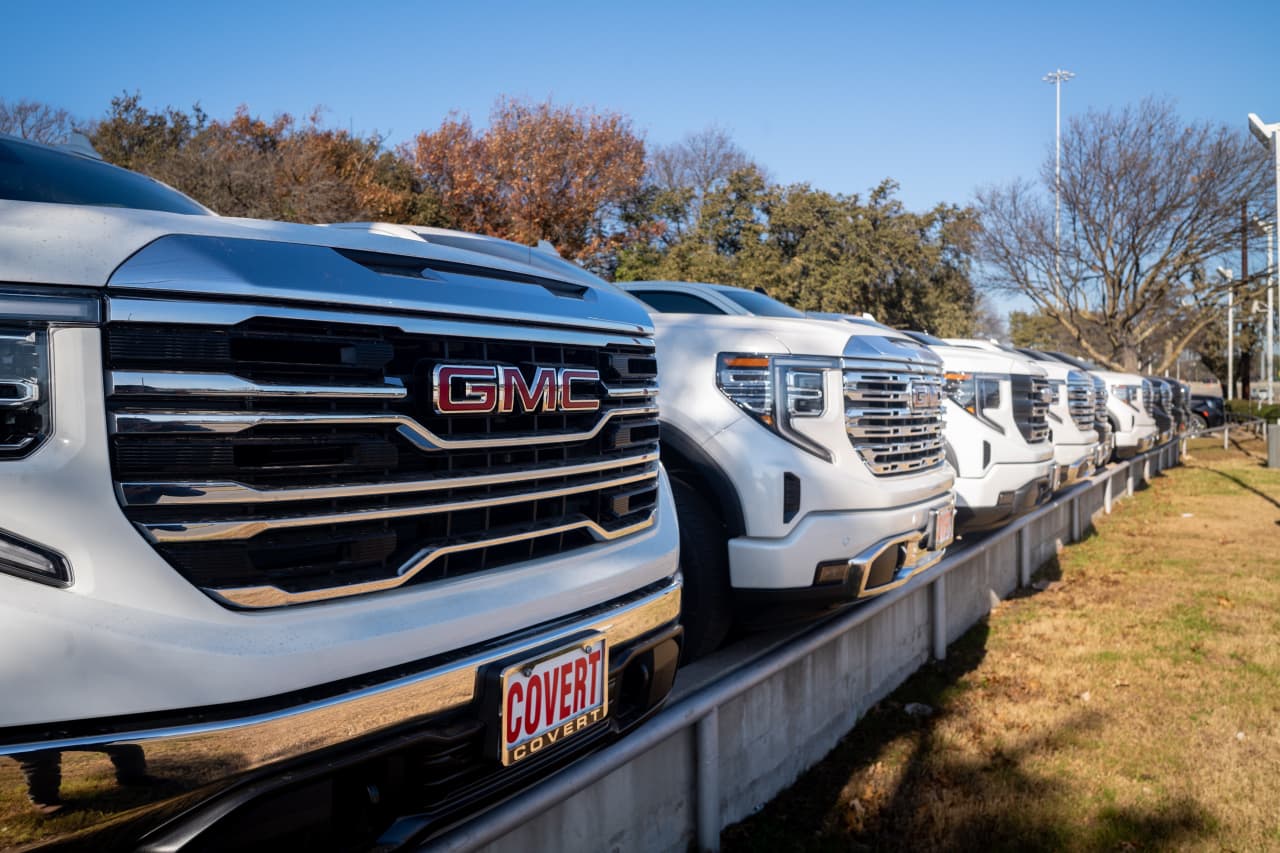
GM Weathering Higher Gas Prices—For Now—As EV Demand Holds Steady
As global oil markets remain volatile amid escalating tensions in the Middle East, General Motors (GM) is navigating a complex landscape where higher gas prices have yet to significantly shift consumer behavior toward electric vehicles (EVs). While industry analysts warn that a prolonged conflict involving Iran could accelerate the transition to EVs, GM’s latest financial performance suggests the automaker is holding its ground—at least for the moment.
In its most recent earnings report, GM reported a 3.9% year-over-year increase in revenue for the first quarter of 2026, reaching $43.99 billion, though net income dipped slightly to $2.94 billion from $3.01 billion in the same period last year. The company’s traditional internal combustion engine (ICE) vehicles, including trucks and SUVs, continue to dominate sales, but its EV division, led by the Chevrolet Bolt and upcoming Silverado EV, is showing signs of resilience. GM CEO Mary Barra emphasized in a recent earnings call that the company remains “focused on balancing profitability with our long-term vision for an all-electric future,” a strategy that appears to be paying off as gas prices fluctuate.
Yet, the broader automotive industry is bracing for potential shifts. Edmunds, a leading automotive research firm, reported a 12% increase in online searches for EVs in the U.S. During the first quarter of 2026 compared to the same period last year, a trend analysts attribute to rising fuel costs and geopolitical uncertainty. “Consumers are starting to consider EVs more seriously as gas prices climb, but the transition isn’t happening overnight,” said Jessica Caldwell, Edmunds’ executive director of insights. “There’s still a lag between interest and actual purchases, especially when it comes to higher-priced models.”
Gas Prices and the EV Tipping Point
The relationship between gas prices and EV adoption is well-documented, but the timeline for consumer behavior to shift remains unpredictable. According to data from the U.S. Energy Information Administration (EIA), the national average price for regular gasoline reached $3.89 per gallon in April 2026, up from $3.52 a year earlier. While this marks a notable increase, it has yet to trigger the kind of mass migration to EVs seen during previous oil crises, such as the 2022 surge following Russia’s invasion of Ukraine.
One key factor is the current state of EV infrastructure. The U.S. Department of Energy reports that as of April 2026, there are approximately 187,000 public charging stations across the country, a 45% increase from 2023. However, charging deserts—areas with little to no access to public chargers—remain a significant barrier, particularly in rural and underserved communities. GM has invested heavily in expanding its Ultium Charge 360 network, which now includes over 12,000 fast-charging ports in the U.S., but industry experts argue that more federal and private investment is needed to meet growing demand.
Another hurdle is the price gap between EVs and traditional vehicles. While the average cost of a new EV in the U.S. Has declined slightly to around $52,000 in 2026, according to Kelley Blue Book, it remains roughly 20% higher than the average price of a new ICE vehicle. Federal tax credits, including the $7,500 Clean Vehicle Credit under the Inflation Reduction Act, have helped narrow the gap, but eligibility restrictions—such as income limits and battery sourcing requirements—have limited their impact. GM’s Chevrolet Bolt, one of the most affordable EVs on the market at around $26,500, has seen steady sales, but the company’s higher-end models, like the GMC Hummer EV, remain out of reach for many consumers.
GM’s EV Strategy: Balancing Short-Term Profits and Long-Term Goals
GM’s approach to EVs has been cautious but deliberate. Unlike Tesla, which has bet heavily on an all-electric future, GM is maintaining a dual focus on both ICE and EV production. This strategy has drawn criticism from environmental groups, who argue that the automaker should accelerate its transition to zero-emission vehicles. However, GM’s leadership insists that profitability must arrive first. “We’re not going to sacrifice our bottom line for the sake of speed,” Barra said in a March 2026 interview with The Wall Street Journal. “Our goal is to lead in EVs, but we’re going to do it in a way that makes sense for our shareholders and our customers.”

The company’s EV sales have grown modestly, with deliveries of the Chevrolet Bolt increasing by 8% in the first quarter of 2026 compared to the same period last year. However, GM’s overall EV market share in the U.S. Remains at around 6%, trailing Tesla (62%) and Ford (12%), according to data from Experian. To close the gap, GM is banking on its next-generation Ultium battery platform, which promises longer range, faster charging, and lower costs. The company has also announced plans to introduce 30 new EV models globally by 2027, including the highly anticipated Chevrolet Silverado EV, which is expected to compete directly with Ford’s F-150 Lightning.
Despite these efforts, GM’s EV division is not yet profitable. The company reported a $1.7 billion loss in its EV operations in 2025, though it projects the division will break even by 2027. Analysts warn that achieving profitability will depend on several factors, including battery cost reductions, increased production efficiency, and continued government incentives. “GM is making progress, but the road to EV profitability is still long,” said Sam Fiorani, vice president of global vehicle forecasting at AutoForecast Solutions. “They need to scale up production and bring down costs faster than their competitors.”
Geopolitical Uncertainty and the Future of EV Demand
The ongoing conflict in the Middle East, particularly involving Iran, has added another layer of complexity to the global automotive market. Iran, a major oil producer, has seen its exports disrupted amid heightened tensions with the U.S. And its allies. While the impact on global oil prices has been relatively contained so far, analysts warn that a prolonged conflict could lead to supply shortages and further price spikes, potentially accelerating the shift toward EVs.
A recent report from the International Energy Agency (IEA) suggests that if oil prices were to exceed $100 per barrel for an extended period, global EV adoption could accelerate by as much as 30% over the next five years. “Higher gas prices are a powerful motivator for consumers to consider EVs,” said Fatih Birol, the IEA’s executive director. “But the transition will only happen if automakers can deliver affordable, reliable, and convenient electric vehicles.”
For now, GM appears to be weathering the storm. The company’s strong performance in its traditional vehicle segments has provided a financial cushion as it invests in its EV future. However, the automaker’s long-term success will depend on its ability to navigate a rapidly changing market, where geopolitical risks, consumer preferences, and technological advancements are all in flux. “GM is in a strong position today, but the automotive industry is evolving faster than ever,” said Stephanie Brinley, principal analyst at S&P Global Mobility. “The companies that succeed will be those that can adapt quickly to changing conditions.”
What’s Next for GM and the EV Market?
Looking ahead, GM’s next major milestone will be the launch of the Chevrolet Silverado EV, which is expected to hit dealerships in late 2026. The truck, which promises up to 400 miles of range on a single charge, is seen as a critical test of GM’s ability to compete in the lucrative pickup truck segment, where EVs have struggled to gain traction. Ford’s F-150 Lightning, which debuted in 2022, has faced production challenges and slower-than-expected sales, but it remains the best-selling electric pickup in the U.S. GM will need to overcome similar hurdles to make the Silverado EV a success.
On the policy front, the U.S. Government is expected to release updated guidelines for the Clean Vehicle Credit in the coming months, which could further shape the EV market. The current rules, which require a portion of battery components to be sourced from North America or U.S. Free-trade partners, have been a point of contention for automakers, including GM. The company has lobbied for more flexibility, arguing that the restrictions limit its ability to scale up EV production quickly.
For consumers, the decision to switch to an EV will likely hinge on a combination of factors, including gas prices, charging infrastructure, and vehicle affordability. While higher fuel costs may push some buyers toward EVs, others may remain hesitant due to concerns about range, charging times, and upfront costs. “The transition to EVs is happening, but it’s not a straight line,” said Caldwell of Edmunds. “There will be stops and starts along the way, and automakers like GM will need to be patient and adaptable.”
Key Takeaways
- GM’s financial performance remains strong, with a 3.9% year-over-year revenue increase in Q1 2026, despite a slight dip in net income. The company’s traditional vehicle segments continue to drive profits.
- EV adoption is growing, but slowly. Online searches for EVs are up 12% in the U.S., but actual purchases remain limited by infrastructure challenges and high costs.
- Geopolitical risks could accelerate the shift to EVs. A prolonged conflict involving Iran could drive up gas prices, making EVs more attractive to consumers.
- GM’s EV strategy is cautious but ambitious. The company plans to introduce 30 new EV models by 2027, including the Chevrolet Silverado EV, but its EV division is not yet profitable.
- Policy changes could shape the market. Updated guidelines for the Clean Vehicle Credit could impact GM’s ability to scale up EV production.
FAQ
Why are gas prices rising, and how does this affect EV demand?
Gas prices are rising due to a combination of factors, including geopolitical tensions in the Middle East, reduced oil production, and increased global demand. Higher gas prices make EVs more attractive to consumers, as they offer lower operating costs over time. However, the transition to EVs is gradual and depends on factors like charging infrastructure and vehicle affordability.

Is GM’s EV division profitable?
No, GM’s EV division reported a $1.7 billion loss in 2025. The company expects the division to break even by 2027, but achieving profitability will depend on scaling up production, reducing battery costs, and maintaining government incentives.
What is the Chevrolet Silverado EV, and why is it important?
The Chevrolet Silverado EV is an all-electric pickup truck set to launch in late 2026. It is a critical test for GM’s ability to compete in the electric pickup market, which is currently dominated by Ford’s F-150 Lightning. The Silverado EV promises up to 400 miles of range on a single charge and is expected to appeal to both commercial and retail buyers.
How does the Clean Vehicle Credit work, and how does it affect GM?
The Clean Vehicle Credit is a federal tax credit of up to $7,500 for qualifying EV purchases. The credit is designed to incentivize EV adoption, but it comes with restrictions, such as income limits and battery sourcing requirements. GM has lobbied for more flexibility in these rules, arguing that they limit the company’s ability to scale up EV production quickly.
What are the biggest challenges facing GM’s EV strategy?
The biggest challenges include reducing battery costs, expanding charging infrastructure, and convincing consumers to switch from ICE vehicles to EVs. GM also faces stiff competition from Tesla and Ford, both of which have a head start in the EV market. Geopolitical risks and policy changes could impact the company’s long-term plans.
As GM continues to navigate this evolving landscape, the next few months will be critical. The launch of the Silverado EV and potential updates to the Clean Vehicle Credit could shape the company’s trajectory in the years to come. For now, GM appears to be weathering the storm—but the road ahead is far from certain.
What do you think about GM’s EV strategy? Will higher gas prices accelerate the shift to electric vehicles, or are there still too many barriers for consumers? Share your thoughts in the comments below and join the conversation.