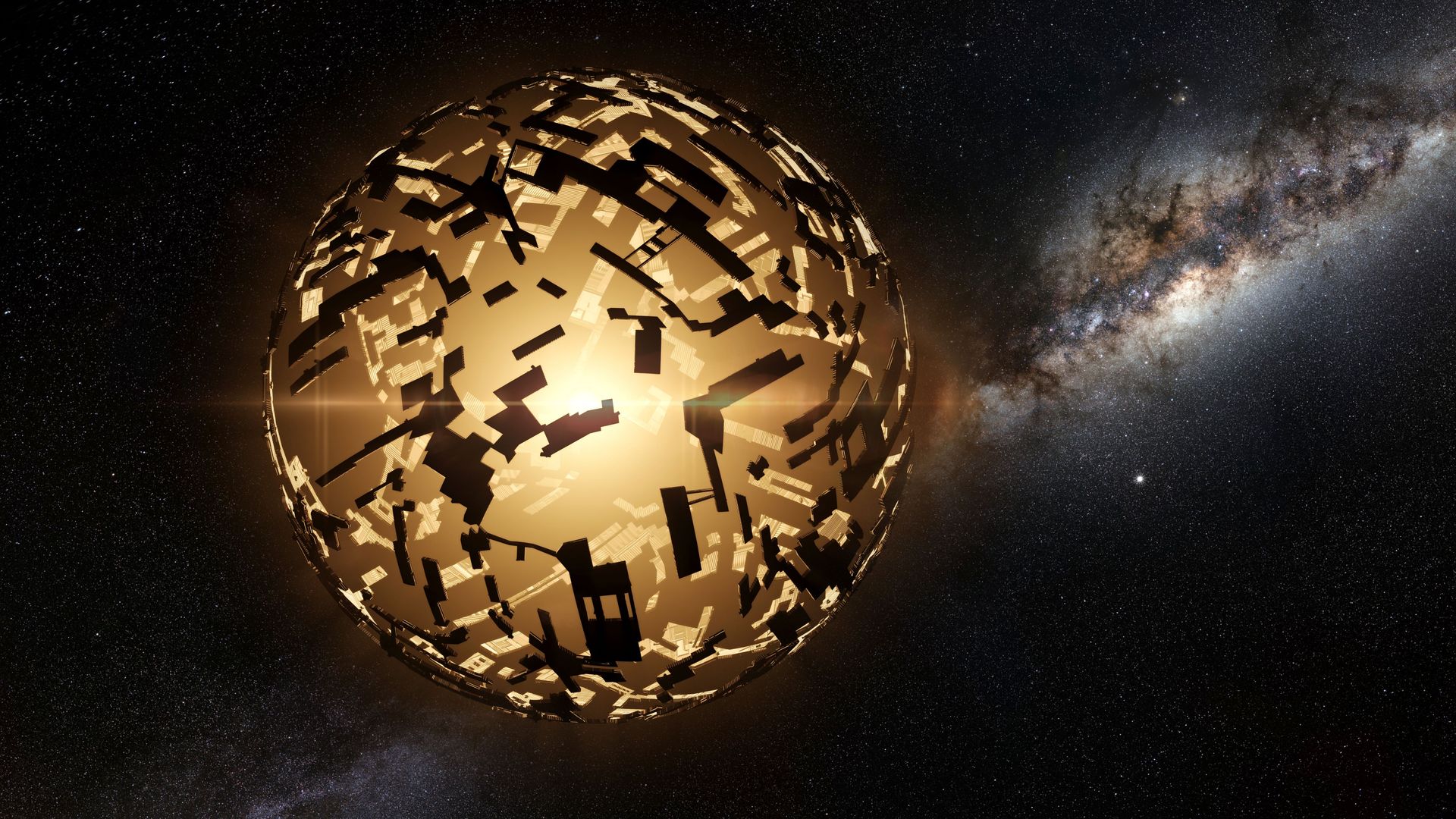
The James Webb Space Telescope has fundamentally changed how astronomers investigate potential technological signatures in deep space, effectively ruling out early hypotheses regarding alien megastructures around distant stars. Recent high-resolution infrared observations by NASA’s flagship observatory have clarified the true nature of several enigmatic celestial targets, providing natural explanations for anomalies that once sparked intense public speculation about advanced extraterrestrial civilizations.
For years, scientists and astronomy enthusiasts debated whether unusual dimming patterns or unexpected infrared excesses observed by earlier missions might indicate the presence of Dyson spheres—hypothetical megastructures built by advanced civilizations to harvest energy from their host stars. However, according to recent findings published by research teams utilizing the James Webb Space Telescope, these anomalous signatures consistently trace back to natural astrophysical phenomena rather than artificial engineering.
Advanced space telescopes like NASA’s James Webb Space Telescope have revolutionized our ability to peer through cosmic dust and analyze the chemical and thermal profiles of distant planetary systems with unprecedented precision. By capturing detailed mid-infrared spectra, researchers can now distinguish between the heat radiated by circumstellar dust disks and any hypothetical artificial waste heat that a theoretical megastructure might produce.
Advanced Infrared Astronomy and the Search for Technosignatures
The search for extraterrestrial intelligence has increasingly shifted toward looking for technosignatures—measurable indicators of technology—rather than relying solely on radio wave detection. Among these concepts, the Dyson sphere remains the most famous, originally theorized by physicist Freeman Dyson in 1960. The core premise involves an advanced civilization enclosing a star to capture a significant fraction of its energy output, which would theoretically produce a distinct infrared radiation signature as the structure reradiates absorbed stellar energy.
Before the deployment of modern space-based infrared observatories, telescopes such as NASA’s Wide-field Infrared Survey Explorer (WISE) flagged a small fraction of stellar sources exhibiting unexplained excess infrared emissions. These outliers immediately captured the attention of researchers studying stellar evolution and astrobiology. Yet, distinguishing between a dusty debris disk surrounding a young star and an artificial megastructure requires resolving capability that previous generations of instruments simply did not possess.
The James Webb Space Telescope bridge this technological gap. Equipped with powerful instruments such as the Near-Infrared Camera (NIRCam) and the Mid-Infrared Instrument (MIRI), the observatory allows astronomers to separate closely bundled light sources and rule out background galaxy contamination. According to data analyzed by independent astronomical teams, nearly all previously identified candidates for anomalous infrared excesses turn out to be contaminated by distant galaxies, active galactic nuclei, or young stellar objects surrounded by dense protoplanetary dust.
Natural Explanations Displace Speculative Megastructures
Investigating potential Dyson sphere candidates requires rigorous elimination of natural astrophysical impostors. Young stellar objects, in particular, naturally emit large amounts of infrared radiation because they are embedded within dense cocoons of gas and dust left over from their formation. As these materials coalesce into planets and planetesimals, the dust warms up and glows brightly in the infrared spectrum, mimicking the exact thermal profile that a partial Dyson sphere might exhibit.
Furthermore, distant background galaxies often align so closely with foreground stars in our own galaxy that low-resolution telescopes perceive them as a single, peculiar point source. When the James Webb Space Telescope targets these ambiguous objects, its high angular resolution easily resolves the background galaxy, explaining the anomalous infrared signal without invoking artificial constructs. This methodological rigor ensures that modern astrobiology remains grounded in verifiable empirical evidence.
Institutions coordinating these investigations continue to publish updated data through public archives and peer-reviewed journals, allowing the global scientific community to scrutinize every step of the analytical process. Observers interested in tracking future updates regarding infrared anomalies and exoplanet characterization can monitor official mission logs provided by the European Space Agency, which collaborates closely with NASA on Webb operations.
Implications for the Search for Extraterrestrial Life
While the elimination of these candidate anomalies closes the door on specific speculative theories, it strengthens the broader scientific framework for searching for extraterrestrial intelligence. By systematically establishing baseline models for natural dust disks and stellar emissions, researchers reduce false positives and refine the criteria for identifying true technological anomalies in future datasets.
The scientific community emphasizes that ruling out these initial candidates does not diminish the value of technosignature research. Instead, it demonstrates the self-correcting nature of modern astrophysics, where advanced instrumentation replaces speculation with concrete data. As upcoming sky surveys come online, the methodologies developed through these Webb telescope observations will play a critical role in evaluating new cosmic signals.
Researchers will present further updates on exoplanet atmospheres and stellar debris disk analysis at upcoming international astronomy symposia scheduled throughout the year. Observers can follow ongoing discoveries by checking institutional announcements from major astronomical research centers as new telescope observation cycles yield fresh data.
Related reading