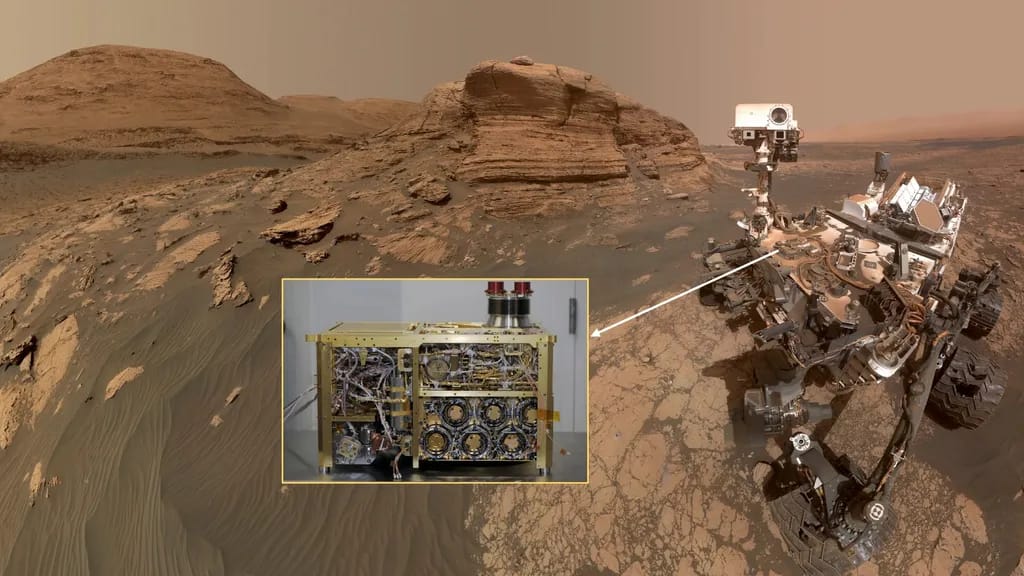
NASA’s Curiosity Mars rover has uncovered the most diverse collection of organic molecules ever found on the Red Planet, including seven that had never been detected there before. This discovery, based on analysis of a rock sample drilled in 2020, provides compelling evidence that complex organic matter can persist on Mars for billions of years despite its harsh environment. The findings, published in Nature Communications, represent a significant step forward in understanding Mars’ potential to have supported life in its ancient past.
The organic molecules were identified in a sample from a site named after British paleontologist Mary Anning, located in the Gale Crater region where Curiosity has been exploring since 2012. After years of laboratory work to process the data, researchers confirmed that the 21 carbon-containing molecules detected include compounds widely considered building blocks for life on Earth. Of these, seven were observed on Mars for the first time, marking a milestone in the rover’s mission to assess the planet’s habitability.
Dr. Amy Williams, lead study author and associate professor of geological sciences at the University of Florida, emphasized the importance of the preservation of these molecules over geologic timescales. “These findings are important because they confirm that larger complex organic matter is preserved on Mars over geologic time periods, despite the harsh radiation environment,” Williams said. “This supports the search for habitable environments on Mars, which is defined as a place where life would have wanted to live if it was present.”
The experiment conducted by Curiosity involved collecting the rock sample and dissolving it in a chemical solution to release and analyze its organic components—a first-of-its-kind procedure on Mars. This method allowed scientists to access molecules that might have remained bound in the rock matrix and undetectable through simpler heating techniques previously used by the rover.
Ashwin Vasavada, Curiosity’s project scientist at NASA’s Jet Propulsion Laboratory, noted that the discovery complements earlier detections of simpler organic compounds and strengthens the hypothesis that Mars was once a habitable world. “The revelation of the mission to me has been not just that Mars was habitable,” Vasavada said. “It’s just how amazingly habitable it was.”
The organic molecules identified include substances such as benzoic acid, ammonia, and various nitrogen-containing compounds, which on Earth are associated with biological processes. While their presence does not confirm past life, it demonstrates that the necessary chemical ingredients were available and stable enough to be detected billions of years later.
This discovery comes at a time when interest in Mars exploration is intensifying, with multiple international missions underway or planned. The Perseverance rover is currently collecting samples in Jezero Crater for potential return to Earth, while orbiters from NASA, ESA, and other agencies continue to study the planet’s atmosphere, and surface.
The preservation of organic material in the Gale Crater sample suggests that certain environments on ancient Mars may have offered protection from radiation and chemical breakdown, possibly through rapid burial in sedimentary layers or interaction with minerals that stabilized the compounds.
Scientists caution that abiotic processes—such as volcanic activity or reactions between water and rock—can also produce organic molecules without the involvement of life. However, the diversity and complexity of the molecules found in this sample increase the likelihood that they originated in or were processed by a habitable environment.
Future missions will aim to build on these findings by searching for additional biosignatures and analyzing returned samples in sophisticated Earth-based laboratories. The Mars Sample Return campaign, a collaboration between NASA and ESA, seeks to bring carefully selected Martian rocks and soil to Earth for detailed study using instruments too large or complex to send to space.
As Curiosity continues its journey up the slopes of Mount Sharp within Gale Crater, each latest drill site offers the potential to reveal more about Mars’ evolving climate and chemistry. The rover’s enduring mission has already far exceeded its original two-year timeline, providing a continuous stream of data that reshapes our understanding of the planet.
The detection of these ancient organic molecules serves as a reminder that Mars, though now a cold and arid world, may have once possessed the conditions necessary for life to emerge. While definitive proof remains elusive, each discovery brings scientists closer to answering one of humanity’s most profound questions: Are we alone in the universe?
For ongoing updates on Mars exploration and the search for life beyond Earth, readers can follow NASA’s official mission websites and peer-reviewed scientific journals where new findings are regularly published.
What are your thoughts on the implications of discovering organic molecules on Mars? Share your perspective in the comments below and aid keep the conversation going about our place in the cosmos.
Worth a look