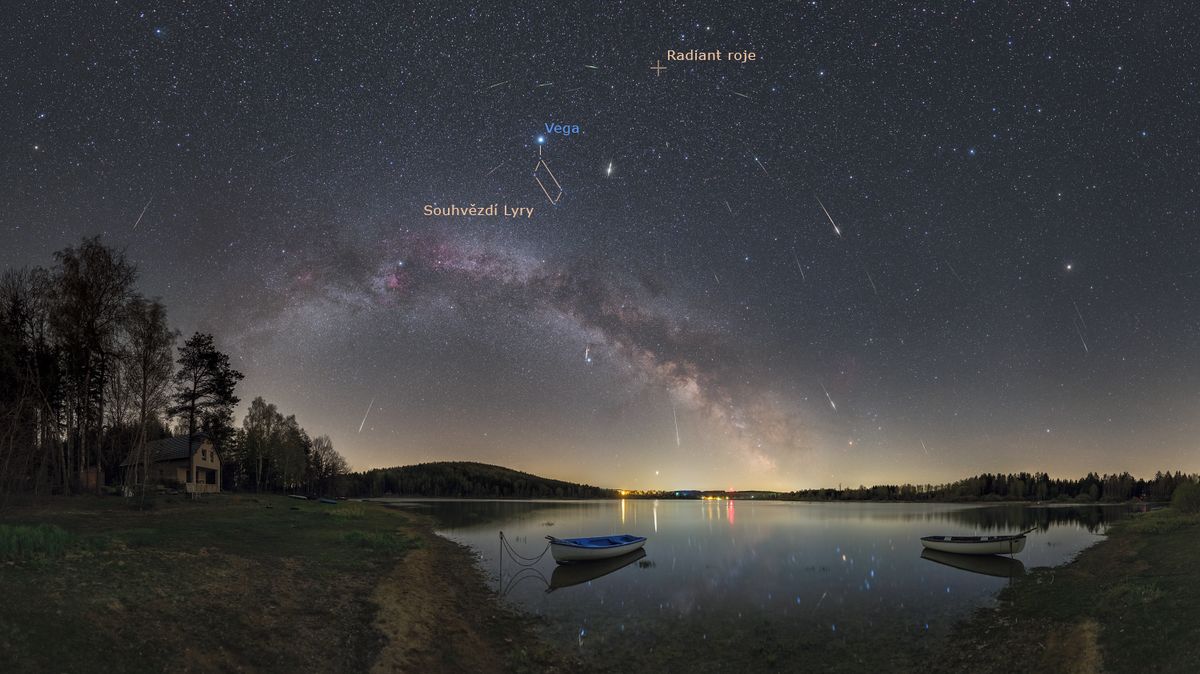
The Lyrid meteor shower, one of the oldest known celestial events observed by humanity, is set to reach its peak in the coming days, offering skywatchers across the globe a chance to witness streaks of light tracing paths through the night sky. Originating from debris left behind by comet C/1861 G1 Thatcher, the Lyrids have been recorded for over 2,700 years, with the earliest known sighting documented by Chinese astronomers in 687 BCE. This year’s peak is expected to occur on the night of April 21–22, 2025, when Earth passes through the densest part of the comet’s orbital trail.
During its maximum, the Lyrid shower typically produces between 10 and 20 meteors per hour under ideal dark-sky conditions, though bursts of up to 100 per hour have been recorded in exceptional years. The meteors appear to radiate from the constellation Lyra, specifically near the bright star Vega, which rises in the northeastern sky after midnight and climbs high before dawn. Observers in the Northern Hemisphere will have the best viewing opportunities, particularly in the hours between moonset and sunrise when the sky is darkest.
To maximize visibility, experts recommend finding a location away from city lights, allowing at least 20–30 minutes for eyes to adjust to the darkness, and lying flat on your back with feet pointing east. No telescopes or binoculars are needed—in fact, they limit the field of view and reduce the chances of spotting meteors. The shower is visible to the naked eye and poses no danger to observers. all particles burn up high in the atmosphere, typically between 80 and 120 kilometers above Earth’s surface.
While the Lyrids are not as prolific as the Perseids or Geminids, their historical significance and reliable annual return make them a favorite among both amateur astronomers and casual stargazers. The shower’s consistency is due to the stable orbit of its parent comet, Thatcher, which takes approximately 415 years to complete one journey around the Sun. Unlike some meteor showers tied to recently discovered or unstable comets, the Lyrids’ source is well-characterized, allowing astronomers to predict its return with high confidence.
Historical Observations and Cultural Significance
The Lyrid meteor shower holds the distinction of being the oldest meteor shower with confirmed historical records. Ancient Chinese chronicles from the Zhou Dynasty describe “stars falling like rain” in the spring, a phenomenon now identified as the Lyrids. Medieval European and Middle Eastern observers as well noted the April meteors, though without understanding their extraterrestrial origin. It wasn’t until the 19th century, after the discovery of comet Thatcher by A.E. Thatcher in 1861, that scientists connected the annual meteor display to a specific parent body.
In modern times, the Lyrids have gained attention not only for their reliability but also for occasional outbursts. In 1982, observers in the United States reported rates nearing 90 meteors per hour, and similar enhancements were noted in 1922 and 1945. These fluctuations are thought to result from Earth passing through denser filaments of debris within the comet’s trail, remnants shed during previous orbits. While no such outburst is guaranteed for 2025, skywatchers remain hopeful for a surprise display.
Today, the Lyrids serve as an accessible entry point to observational astronomy. Unlike events requiring specialized equipment or timing—such as eclipses or planetary transits—the meteor shower demands only patience, darkness, and an open view of the sky. Educational outreach programs from organizations like NASA’s Night Sky Network and the Astronomical Society of the Pacific often highlight the Lyrids in April as a way to engage the public with real-time celestial mechanics.
How to Watch: Tips for Optimal Viewing
For those planning to observe the Lyrids this year, timing and preparation are key. The shower is active from approximately April 14 to April 30, but the strongest activity occurs within a narrow window around the peak. In 2025, the International Meteor Organization (IMO) forecasts the maximum to occur around 04:00 UTC on April 22, which corresponds to late evening on April 21 for observers in North America and early morning on April 22 for Europe and Africa.
Moon phase plays a critical role in visibility. This year, the Moon will be in its waning gibbous phase during the peak, rising after midnight and potentially washing out fainter meteors. To counteract this, observers are advised to face away from the Moon and focus on the darker portions of the sky. The radiant point in Lyra will be high enough for good viewing by 10 p.m. Local time, but the best rates typically come after 2 a.m., when the radiant is highest and the observer’s location on Earth is facing directly into the meteor stream.
Weather conditions remain the most unpredictable factor. Clear, cloud-free skies are essential, and viewers should check local forecasts in the days leading up to the event. Websites such as Clear Outside and Astrospheric provide detailed astronomy-focused weather predictions, including cloud cover, transparency, and darkness indices. Dressing warmly is also recommended, as April nights can still be chilly, especially in higher latitudes or elevated areas.
Light pollution significantly reduces meteor visibility. Urban observers may see only a handful of meteors per hour, if any, while those in rural or designated dark-sky parks could witness the full potential of the shower. Resources like the International Dark-Sky Association’s Find a Dark Site tool help locate areas with minimal artificial lighting. National parks, remote campgrounds, and rural farms often provide ideal conditions, provided permission is obtained for overnight stays.
Science Behind the Streaks
Each meteor in the Lyrid shower is a tiny fragment of comet Thatcher, typically no larger than a grain of sand, traveling at speeds of approximately 49 kilometers per second (110,000 miles per hour) when it enters Earth’s atmosphere. The intense friction with air molecules causes the particle to heat up and glow, creating the brief streak of light we perceive as a shooting star. Most Lyrid meteors disintegrate completely before reaching the ground; true meteorites from this shower are extremely rare.
The greenish or yellowish hue sometimes seen in brighter Lyrid meteors results from the ionization of atmospheric oxygen and the metallic content of the comet dust, particularly sodium and magnesium. These emissions are similar to those seen in fireworks and are analyzed by spectrometers to study the composition of cometary material. While amateur observers cannot conduct such measurements, professional teams occasionally use the Lyrids to calibrate instruments or test recent detection methods.
Unlike some meteor showers associated with asteroids or dormant comets, the Lyrids originate from a long-period comet with a highly elliptical orbit. Comet Thatcher spends most of its time in the outer solar system, only venturing close to the Sun every few centuries. Its last perihelion (closest approach to the Sun) occurred in 1861, the year it was discovered, and it will not return until the 23rd century. This means the debris stream we encounter today was laid down over many orbits, creating a relatively stable but diffuse trail.
Research into meteor showers like the Lyrids contributes to our understanding of solar system formation and evolution. By analyzing the density, distribution, and composition of debris trails, scientists can infer the physical properties of parent comets and how they shed material over time. This knowledge aids in modeling the population of small bodies in the solar system and assessing potential hazards, though the Lyrids pose no threat to Earth due to the small size and high disintegration rate of their particles.
Where to Find Updates and Live Coverage
For real-time updates on the Lyrid meteor shower, several authoritative sources provide reliable information. The International Meteor Organization (IMO.net) maintains a live meteor shower calendar and accepts observer reports to refine activity predictions. Their website includes detailed guides on how to observe and record meteors scientifically.
NASA’s Meteor Watch page (science.nasa.gov/meteors/meteor-showers/lyrids) offers accessible explanations, viewing tips, and historical context for the Lyrids, along with links to all-sky camera networks that stream live feeds during active periods. The agency also publishes annual meteor shower forecasts based on planetary dynamics models.
The American Meteor Society (amsmeteors.org) provides a visual meteor shower calendar, peak predictions, and a platform for submitting fireball reports. Their data contributes to ongoing research into meteor stream behavior and helps validate predictions from numerical models. All three organizations update their information regularly in the days leading up to and during the shower.
many planetariums and astronomy clubs host public viewing events during the Lyrid peak, often accompanied by talks on comet origins and meteor science. Checking with local science centers or universities can reveal opportunities to observe with experienced guides and, in some cases, access to dark-sky locations away from urban glare.
The Lyrid meteor shower reminds us that even in our modern, light-polluted world, the cosmos still offers moments of quiet wonder. Whether you’re a seasoned astronomer or someone stepping outside for the first time in hopes of catching a falling star, the Lyrids provide a chance to connect with an ancient rhythm of the sky—one that has unfolded, uninterrupted, for millennia. As Earth once again crosses the path of comet Thatcher, we join countless generations who have looked up and seen the same fleeting lights, each a tiny messenger from the depths of space.
The next major meteor shower to follow the Lyrids will be the Eta Aquariids, peaking in early May. For those inspired by this month’s display, marking calendars for future events ensures a continued connection to the ever-changing sky. If you witnessed the Lyrids this year, consider sharing your experience—your observations could help refine our understanding of this enduring celestial phenomenon.
Related reading