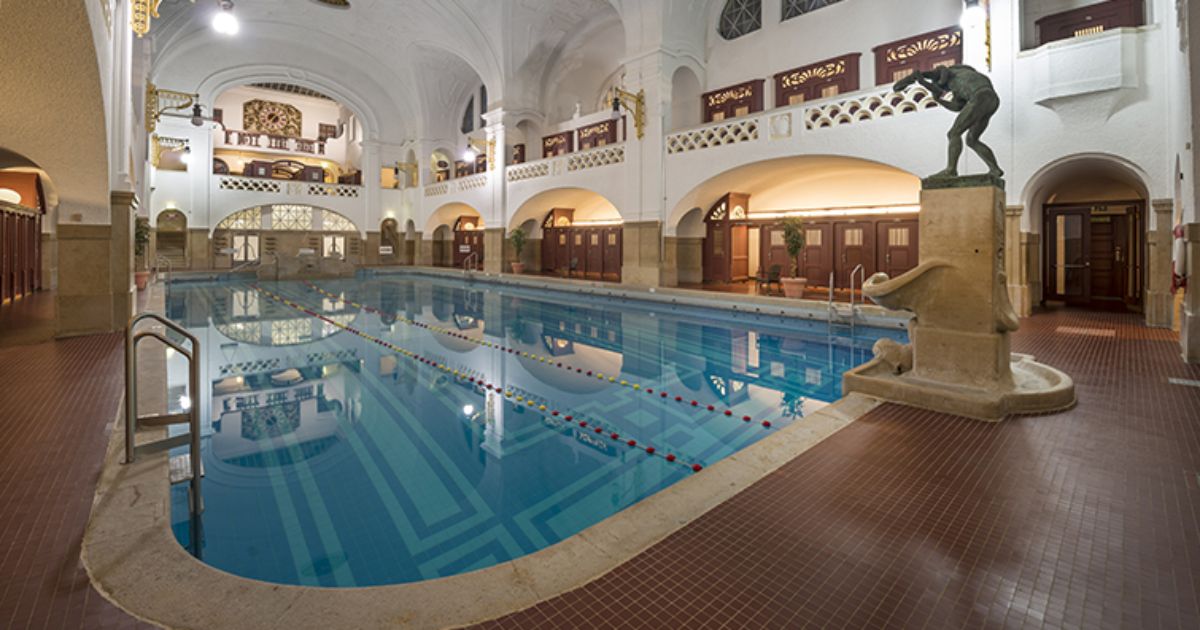
Stepping into the Müller’sches Volksbad Munich is less like entering a municipal swimming facility and more like walking into a cathedral dedicated to the art of bathing. With its soaring barrel vaults, intricate stucco work, and a pervasive sense of turn-of-the-century grandeur, the facility serves as a living testament to a time when public health and high art were inextricably linked.
As of April 2026, this architectural jewel celebrates 125 years of operation. Since first opening its doors in 1901, the bath has evolved from a pioneering social welfare project into one of the most iconic landmarks in Bavaria. For the modern swimmer, it offers a rare juxtaposition: the rigor of lap swimming conducted within a setting of opulent Neo-Baroque and Art Nouveau splendor.
For those of us in the sports world, the Müller’sches Volksbad represents more than just a place to exercise; it is a monument to the democratization of wellness. At a time when private baths were the exclusive province of the wealthy, this institution was designed specifically to bring hygiene and recreation to the working class, proving that the benefits of sport and water should be accessible to all, regardless of social standing.
The Vision of Karl Müller: A Legacy of Social Welfare
The existence of the facility is the result of a profound act of philanthropy. The baths are named after their founder, Karl Müller, an engineer whose vision was rooted in the social challenges of the industrial era. In the late 19th century, many of Munich’s urban residents lived in cramped quarters without access to running water or bathing facilities, creating significant public health risks.
Müller donated the building to the City of Munich with a specific, non-negotiable mandate: it had to serve as a public bath for the less fortunate members of society. This commitment to social equity ensured that the “Volksbad” (People’s Bath) remained a space for the community. By providing a clean, dignified environment for hygiene and exercise, Müller helped catalyze a shift in urban living standards in Munich according to historical records from Munich Travel.
This mission of accessibility continues today. Whereas the facility is now a major tourist attraction, it remains a functioning public pool managed by the Stadtwerke München (SWM), ensuring that the original intent of providing public aquatic access is preserved for a new generation of Munich residents and visitors.
Architectural Grandeur: Where Jugendstil Meets Neo-Baroque
The visual impact of the Müller’sches Volksbad Munich is attributed to the genius of architect Carl Hocheder. Hocheder did not merely design a functional pool; he created a sensory experience. The building is a premier example of Jugendstil (the German expression of Art Nouveau), blended seamlessly with Neo-Baroque elements that evoke the opulence of a royal palace.
Hocheder’s design was heavily inspired by the tradition of Roman thermal spas and Oriental hammam baths. This influence is evident in the facility’s layout and its emphasis on the ritual of bathing. The interior is characterized by a breathtaking barrel vault that crowns the main pool, creating an airy, expansive atmosphere that prevents the massive structure from feeling oppressive.
The attention to detail throughout the complex is meticulous. Visitors will identify:
- Ornate Stucco and Murals: The walls are adorned with elaborate paintings and plasterwork that reflect the aesthetic priorities of the early 20th century.
- Bronze Statuary: Carefully placed sculptures add to the classical feel of the halls.
- Decorative Ironwork: Ornate grilles and railings serve as both functional barriers and artistic accents.
- Grand Staircases: The sweeping entrances transition the visitor from the bustle of the city into a sanctuary of calm.
This commitment to aesthetic excellence was intended to elevate the spirit of the bather. In Hocheder’s vision, the beauty of the surroundings was not just for show; it was part of the healing and restorative process of the bath.
A Functional Legacy: From Gender Segregation to Modern Wellness
While the architecture is timeless, the way the Müller’sches Volksbad Munich is used has shifted significantly over the last 125 years. In the early 1900s, the facility operated under the strict social norms of the era, featuring two entirely separate pools for men and women.

Today, those boundaries have vanished, but the two pools remain distinct in their purpose and temperature, catering to different types of aquatic activity as detailed by muenchen.de:
The Sporting Pool (Former Men’s Pool)
The larger of the two pools is designed for those seeking a more active experience. With a water temperature approximately 3 degrees cooler than its counterpart, it is the primary hub for lap swimming and athletic training. The environment here is geared toward “sporting requirements,” making it a favorite for local swimmers who value the combination of a rigorous workout and a historic atmosphere.
The Relaxation Pool (Former Women’s Pool)
The smaller pool is dedicated to leisure and recovery. Maintained at a warmer 30 degrees Celsius, it invites visitors to bathe slowly and relax. This pool serves as a sanctuary for those looking to unwind, mirroring the “thermal spa” inspiration that Hocheder originally envisioned.
The Sauna and Sweat Bath
Beyond the swimming halls, the facility is renowned for its exceptional sauna complex. A highlight is the Roman-Irish sweat bath, which provides a traditional heat experience that complements the swimming facilities. Modern additions, such as Finnish saunas with colored light effects, steam baths, and cascade fountains, ensure that the 125-year-old institution remains competitive with contemporary wellness centers according to SWM.
Preserving a Living Monument
Maintaining a century-old public pool is a monumental task. The combination of high humidity, chlorine, and constant public use creates a harsh environment for delicate Art Nouveau stucco and Baroque murals. However, the City of Munich and SWM have treated the facility as a protected monument, employing “lovingly detailed” restoration work to preserve the original equipment and ornamentation.

Recent efforts have focused on balancing the needs of modern safety and hygiene standards with the requirement to maintain historical authenticity. While certain areas, such as the sauna’s outdoor courtyard or specific changing rooms, occasionally undergo necessary maintenance and capacity restrictions to ensure structural integrity, the core experience of the bath remains unchanged from its 1901 origins.
The facility’s ability to survive two World Wars and the rapid modernization of Munich is a testament to its value to the community. It is not merely a museum of swimming; it is a functioning piece of urban infrastructure that continues to serve the public, just as Karl Müller intended.
Visitor Guide and Practical Information
For those planning a visit to this historic site, the Müller’sches Volksbad Munich operates as a public utility. This means that while it is a landmark, it follows the regulations of a municipal pool.
| Feature | Details |
|---|---|
| Architecture | Jugendstil / Neo-Baroque |
| Pools | Two (One for sport, one for relaxation) |
| Specialty | Roman-Irish sweat bath and Finnish sauna |
| Historical Significance | Munich’s first public indoor pool (est. 1901) |
| Access | Open to the general public |
Visitors are encouraged to check the real-time occupancy levels provided by the SWM website to avoid peak crowds, particularly in the sauna areas. The facility offers guided tours that capture visitors “behind the scenes,” providing deeper insight into the engineering and architectural secrets of the building.
The facility is located in the Haidhausen district, conveniently situated near other cultural landmarks such as the Deutsches Museum and the Gasteig cultural center, making it an ideal stop for those exploring the banks of the Isar river.
As we mark the 125th anniversary of the Müller’sches Volksbad Munich, we celebrate more than just a attractive building. We celebrate the enduring belief that health, beauty, and sport should be accessible to every citizen. In an era of sterile, modern gyms and corporate wellness centers, this “jewel of Art Nouveau” reminds us that the environment in which we exercise can be just as restorative as the exercise itself.
The next official update regarding the completion of ongoing maintenance in the sauna changing areas and the reopening of the outdoor sauna courtyard is expected to be released via the Stadtwerke München (SWM) official portal. We will continue to monitor these developments to provide the most current access information for our readers.
Do you have a favorite historic sporting venue or a memory of swimming in a landmark pool? Share your stories in the comments below or share this article with a fellow travel and sports enthusiast.