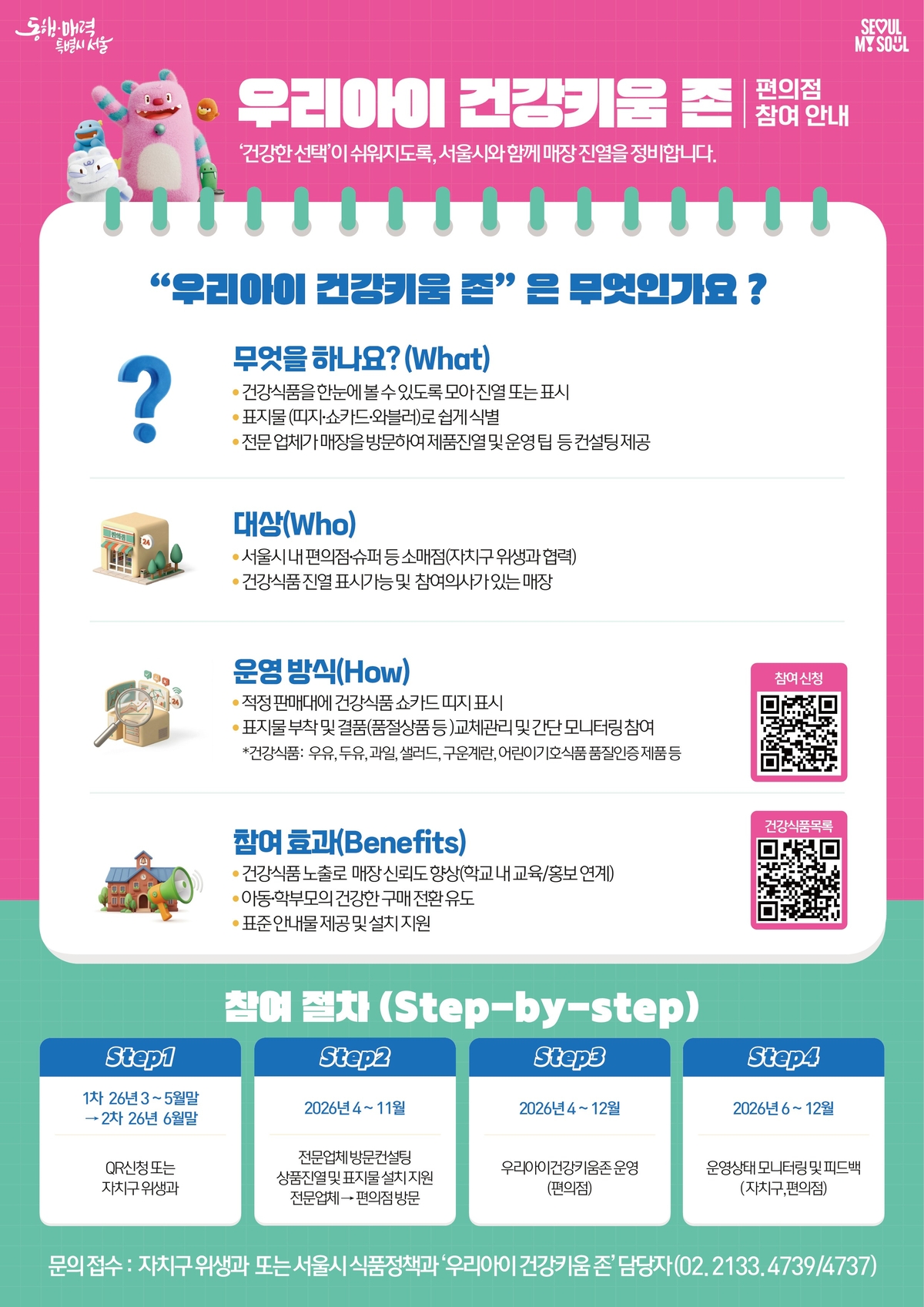
As a physician and health journalist, I have long observed that the environment surrounding a child is just as critical to their development as the care they receive inside the home. In Seoul, where the urban landscape is dense with convenience stores and fast-food options, the challenge of fostering healthy eating habits is acute. A significant initiative in the Jungnang District is now addressing this by targeting the “choice architecture” of where children shop and eat.
The Jungnang District government has launched a multi-pronged strategy to improve the food environment for children, focusing on two primary pillars: the creation of Health Growth Zones
(건강키움 존) within retail spaces and the implementation of a parent-observation program for childcare center meals. These measures aim to shift the default options available to children from high-calorie, low-nutrient snacks to nutrient-dense alternatives, while simultaneously increasing transparency in institutional feeding practices.
By redesigning the physical layout of convenience stores and marts located within school zones—areas officially designated as Green Food Zones under the Children’s Dietary Life Safety Management Special Act—the district is attempting to nudge children toward healthier choices. This systemic approach recognizes that for a child, accessibility and visibility often dictate consumption more than nutritional knowledge.
Redesigning Retail: The ‘Health Growth Zone’ Initiative
The Health Growth Zone
is not merely a labeling effort but a spatial intervention. In convenience stores and supermarkets situated within child protection zones, the district is encouraging retailers to prioritize the display of high-nutrition foods. Specifically, items such as milk, soy milk, and eggs are being positioned at the eye level of children, replacing the traditional placement of processed sweets and high-sodium snacks.
This strategy leverages a psychological principle known as “nudging.” When nutrient-dense foods are the first things a child sees upon entering a store, the cognitive load required to make a healthy choice is reduced. By placing healthy staples in prime real estate, the district aims to normalize the consumption of proteins and calcium-rich beverages over processed sugars.
This initiative mirrors similar efforts seen in other parts of Seoul. For instance, the Gangseo District recently expanded its own Health Growth Zone
program, conducting inspections and promotional activities through April 2026 to ensure that health-conscious displays are maintained and that retailers are adhering to safety standards for children’s preference foods.
Increasing Transparency in Childcare Nutrition
Beyond the retail environment, Jungnang is tackling the “black box” of institutional feeding. The district has introduced a parent-observation program for childcare center meals, allowing parents to personally visit and inspect the facilities where their children’s food is prepared and served.
This program serves two critical functions. First, it provides parents with peace of mind regarding hygiene and nutritional quality. Second, it creates a feedback loop that encourages childcare centers to maintain high standards of food preparation. When the “kitchen door” is open to parents, the incentive for rigorous adherence to health protocols increases.
The effort is supported by the Jungnang District Center for Children and Social Welfare Foodservice Management, which provides standardized recipes and nutritional guidelines to ensure that meals are balanced and age-appropriate. These guidelines are updated regularly, with standard recipes for January 2026 already disseminated to participating centers to ensure consistency in nutritional delivery.
Strategic Partnerships for Food Security
To ensure that the “health” in these zones is backed by quality ingredients, Jungnang has looked beyond the city limits. In September 2024, the district entered into a “Urban-Rural Win-Win Public Food Supply Agreement” (MOU) with Goesan County. This partnership is designed to establish a stable supply chain of eco-friendly, locally sourced ingredients for childcare centers within the district.
By bypassing complex distribution layers and sourcing directly from Goesan, the district can ensure that the produce is fresh and free from excessive chemical processing. The agreement includes “farm-to-table” experience programs, allowing children and educators to visit the source of their food, thereby connecting the act of eating with an understanding of agriculture and nature.
Why This Matters: The Public Health Perspective
From a medical standpoint, the early childhood years are a critical window for “taste programming.” Children who are consistently exposed to high-sugar and high-sodium foods develop a preference for those flavors, which can lead to lifelong struggles with obesity, Type 2 diabetes, and cardiovascular issues.
The Jungnang model is significant because it addresses the environmental drivers of poor nutrition. While educating children on “healthy eating” is valuable, it is often ineffective if the environment—the convenience store on the way home from school—is designed to sell the opposite. By altering the physical environment, the district is creating a supportive infrastructure that makes the healthy choice the easy choice.
Key Components of the Jungnang Health Initiative
| Initiative | Target Area | Primary Goal | Key Action |
|---|---|---|---|
| Health Growth Zone | Retail Stores/Marts | Nudge healthy choices | Eye-level display of milk, eggs, and soy milk |
| Parent Observation | Childcare Centers | Increase transparency | Direct parental inspection of meal prep |
| Goesan MOU | Supply Chain | Ensure ingredient quality | Direct sourcing of eco-friendly produce |
| Management Center | Institutional Kitchens | Nutritional standardization | Provision of standard recipes and menus |
What to Expect Next
The success of these programs will likely be measured by the continued expansion of the Health Growth Zone
participants and the frequency of parent-led inspections. The Jungnang District Center for Children and Social Welfare Foodservice Management will continue to release updated nutritional guidelines and standard recipes on a monthly basis to maintain pace with seasonal availability and nutritional needs.
As these initiatives evolve, the district is expected to further integrate digital monitoring and community feedback to refine the placement of healthy foods in retail settings. Parents and residents are encouraged to engage with their local childcare centers and retail outlets to support these healthy shifts.
Do you believe retail “nudging” is an effective way to combat childhood obesity, or should the focus remain on parental education? Share your thoughts in the comments below.
Related reading