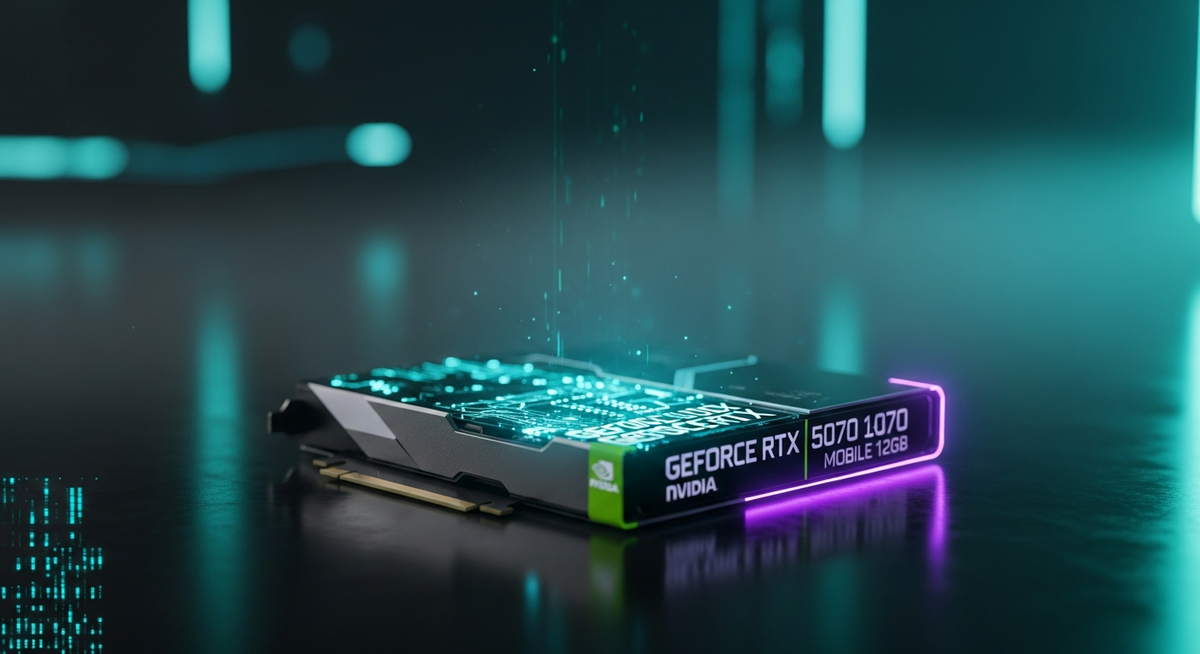
NVIDIA has officially expanded its mobile graphics lineup with the launch of a new 12GB variant of the GeForce RTX 5070 Laptop GPU. This strategic update addresses a long-standing point of contention for gamers and creators: the limitation of video RAM (VRAM) in mid-range gaming laptops, which often struggles to preserve pace with the memory-intensive demands of modern AAA titles and local AI workloads.
The new 12GB RTX 5070 Laptop GPU utilizes high-density GDDR7 memory modules to provide a 50% increase in capacity over the existing 8GB model. According to NVIDIA, this expansion is designed to maximize memory availability
and offer partners more flexibility while the industry manages ongoing memory supply constraints as reported by The Verge.
Crucially, this is not a complete architectural overhaul. The 12GB version continues to apply the same GB206 chip found in the 8GB variant, meaning raw silicon performance remains unchanged. Still, the shift to 12GB of GDDR7 memory provides critical breathing room for 1440p gaming and complex creative tasks, effectively removing the VRAM bottleneck that frequently plagued the 8GB configuration in high-resolution environments via TweakTown.
Hardware Specifications and the GDDR7 Advantage
The technical implementation of the 12GB RTX 5070 is noteworthy for its use of 3GB GDDR7 memory modules. By leveraging these denser modules, NVIDIA has increased the total memory pool without needing to widen the memory bus, which remains at 128-bit. This configuration maintains a bandwidth of 384 GB/s at 24 Gbps according to NoobFeed.
For the average user, the “why it matters” comes down to texture quality and stability. When a GPU runs out of VRAM, it must swap data to the much slower system RAM, leading to “stuttering” or significant frame rate drops. By moving to 12GB, the RTX 5070 can hold more high-resolution textures and larger AI models directly on the chip, ensuring a smoother experience in demanding titles like Cyberpunk 2077 or Alan Wake 2.
The GPU is built on the NVIDIA Blackwell architecture, which introduces several key efficiency and performance features:
- DLSS 4.5: Advanced AI-driven upscaling and frame generation to boost frame rates without sacrificing visual fidelity.
- Neural Rendering: Enhanced AI horsepower for more realistic lighting and shadows.
- Max-Q Optimization: Tailored for thin-and-light laptop chassis to balance power consumption and thermal output.
Market Availability and the Framework Integration
NVIDIA is not replacing the 8GB model with this new variant; instead, it is introducing the 12GB version as a premium option. This allows laptop manufacturers to offer different tiers of the RTX 5070 depending on the target audience’s needs and budget as detailed by VideoCardz.
One of the first companies to integrate this hardware is Framework, which has released a dedicated GeForce RTX 5070 12GB module for its Laptop 16. Because the Framework Laptop 16 features a modular design, existing owners can upgrade their graphics without replacing the entire machine. The new 12GB module is priced at $1,199.00, representing a $500 increase over the 8GB variant, which costs $699.00 per The Verge.
This modular approach highlights a growing trend toward sustainability and longevity in the gaming laptop market, allowing users to keep pace with VRAM requirements as software demands evolve.
Comparing the RTX 5070 Variants
To understand the impact of this update, it is helpful to appear at how the 12GB variant differs from the standard 8GB model. While the “brain” of the GPU (the GB206 chip) is identical, the memory capacity fundamentally changes the device’s capabilities in specific scenarios.
| Feature | RTX 5070 (Standard) | RTX 5070 (New Variant) |
|---|---|---|
| VRAM Capacity | 8GB GDDR7 | 12GB GDDR7 |
| Memory Bus | 128-bit | 128-bit |
| Bandwidth | 384 GB/s | 384 GB/s |
| GPU Chip | GB206 | GB206 |
| Primary Use Case | 1080p / Entry 1440p Gaming | High-end 1440p / Local AI Workloads |
Who Should Opt for the 12GB Model?
The decision to spend the extra premium for the 12GB variant depends largely on the user’s workflow. For casual gamers playing esports titles (like Valorant or League of Legends), 8GB remains more than sufficient. However, the 12GB model is a significant upgrade for:
- Content Creators: Those using DaVinci Resolve, Adobe Premiere Pro, or Blender will discover the extra 4GB of VRAM essential for rendering complex scenes and handling 4K timelines.
- AI Enthusiasts: Running local Large Language Models (LLMs) or Stable Diffusion requires significant VRAM; the jump to 12GB allows for larger models to be loaded without crashing.
- Hardcore Gamers: Users who prefer “Ultra” texture settings at 1440p resolution will avoid the stuttering associated with VRAM overflow.
Looking Ahead: The Broader Impact on Gaming Laptops
The introduction of the 12GB RTX 5070 reflects a broader shift in the industry. For several generations, NVIDIA’s mid-range laptop GPUs were often criticized for having insufficient VRAM, which limited their lifespan as games became more demanding. By introducing a higher-capacity variant, NVIDIA is acknowledging that memory is now as critical as clock speed for the modern gaming experience.
This move also puts pressure on competitors to ensure their mid-range offerings are not bottlenecked by memory. As GDDR7 becomes more widely available and denser modules are perfected, One can expect to see similar “memory refreshes” across other tiers of the Blackwell architecture.
For consumers, the immediate takeaway is that the “sweet spot” for mid-range gaming laptops has shifted. While 8GB was the standard for years, 12GB is rapidly becoming the baseline for anyone intending to keep their laptop for three to five years.
The first wave of laptops featuring the 12GB RTX 5070 is expected to ship around June 2026 according to The FPS Review. Users should keep an eye on official manufacturer announcements from brands like MSI, ASUS, and Razer for specific model availability and pricing.
We want to hear from you: Is 12GB of VRAM enough for the next generation of games, or should NVIDIA have gone even higher? Let us know in the comments below and share this article with your fellow tech enthusiasts.