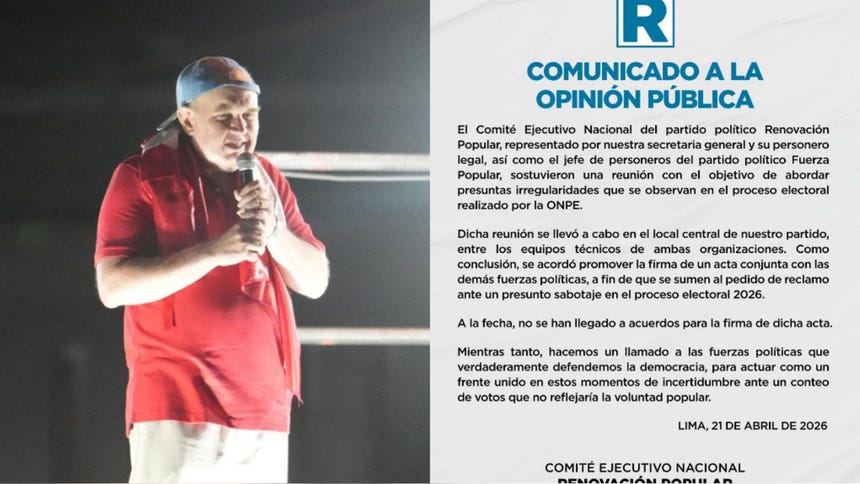
Renovación Popular confirmed it held discussions with Fuerza Popular regarding alleged electoral irregularities in Peru’s 2026 general election, though no formal agreement was reached, according to party representatives. The meeting, which took place amid ongoing vote tabulation, focused on claims of “presunto sabotaje” (presumed sabotage) in the electoral process, particularly concerning logistical failures during the initial voting day. Both parties expressed concerns about the integrity of the process but did not issue a joint statement or commit to coordinated legal action following the talks.
The discussions occurred as Roxana Rocha, Renovación Popular’s congressional candidate and spokesperson, reiterated allegations of widespread irregularities, including claims of “180,000 phantom votes” detected during partial ballot counting. Rocha cited internal projections showing Rafael López Aliaga, the party’s presidential candidate, maintaining a lead of over 200,000 votes against his nearest rival at approximately 75% of processed ballots. She argued that any result denying López Aliaga a place in the runoff would be interpreted as systematic manipulation, citing delays in electoral material distribution that affected 211 voting stations nationwide on April 12, 2026.
These claims echo earlier statements by Rocha, who accused the National Office of Electoral Processes (ONPE) of failing to ensure transparent logistics and called for the removal of its head, Piero Corvetto, asserting he lacked legitimacy to oversee a potential runoff. López Aliaga had previously urged supporters to protest outside the National Elections Jury (JNE) headquarters, framing the demonstrations as a defense against alleged vote theft. The JNE has not publicly confirmed any evidence supporting the fraud allegations raised by the parties.
Peruvian electoral authorities maintained that the extension of voting to April 13 in affected areas was a standard procedural response to unforeseen circumstances and did not indicate systemic failure. The ONPE stated that all necessary measures were taken to guarantee voter access and that results would be published only after full verification of actas. International observation missions present during the election have not issued public reports corroborating claims of widespread fraud or sabotage as of the latest updates.
The dialogue between Renovación Popular and Fuerza Popular reflects heightened tensions among right-leaning factions contesting the preliminary outcomes, with both parties positioning themselves as defenders of electoral transparency despite lacking verifiable proof of criminal conduct. Analysts note that such allegations, while common in polarized electoral environments, require substantiation through formal complaints to electoral courts to trigger investigations.
As of the most recent official updates, the JNE continues to process outstanding ballots, particularly from rural and remote regions where geographic and infrastructural challenges delay transmission. No deadline has been announced for the final count, though electoral law mandates completion within a legally defined period following election day. Parties retain the right to challenge specific actas through judicial channels, but no mass challenges have been filed to date that would alter the current trajectory of results.
For ongoing developments, readers are directed to the Jurado Nacional de Elecciones’ official bulletin board and the ONPE’s live results portal, both updated in real time as verification proceeds. Civil society monitors such as Transparencia and the Oficina Nacional de Procesos Electorales’ citizen observation program also provide parallel tracking of incidents reported at polling stations.
Stay informed and share verified updates to help maintain clarity in democratic processes. Comments reflecting firsthand observation or official documentation are welcome below.