
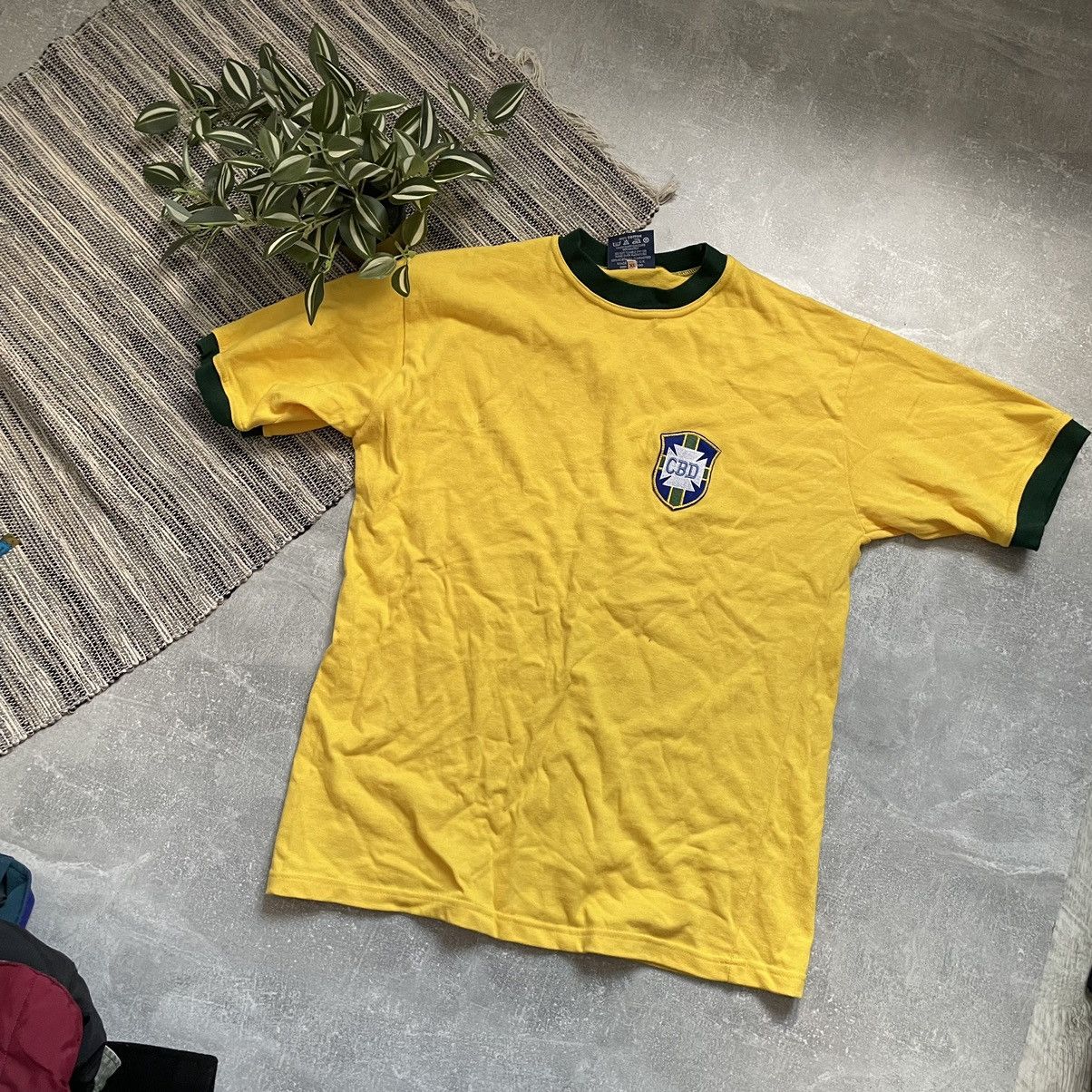
For football historians and kit collectors, the intersection of sportswear and national identity often reveals the most interesting stories. One such artifact is the Brésil Penalty 1980s supporter tee, a piece of sportswear produced by the Brazilian brand Penalty specifically for the local market. This garment represents a distinct era of Brazilian football, mirroring the aesthetic of the kits worn by the national team during the mid-1980s.
Unlike the official match-worn jerseys provided to the squad, these supporter versions were designed to allow the domestic fanbase to align themselves with the “Seleção” using locally manufactured gear. The mid-80s were a transitional period for Brazilian football, characterized by a search for a new identity following the 1982 World Cup and leading toward the 1986 tournament. This specific tee, often found in specialized archives like Classic Football Shirts, captures that specific cultural moment.
The production of these shirts by Penalty highlights the importance of the domestic sporting goods industry in Brazil. By creating apparel similar to the models worn by the national team, Penalty tapped into the immense patriotic fervor surrounding the yellow jersey, providing a more accessible option for the local population while maintaining the iconic visual cues of the national side.
The Legacy of the Seleção and Penalty
The Brazil national football team, known globally as the Seleção Brasileira de Futebol, is one of the most successful sporting entities in history. Their identity is inextricably linked to the “Canarinho” (Little Canary) yellow jersey, a symbol that transcends sport to become a mark of national pride. During the 1980s, the demand for this imagery led to the creation of various supporter-grade garments.

Penalty, as a Brazilian manufacturer, played a role in this ecosystem by producing gear for the local market. The 1980s supporter tee is characterized by its simplicity and its adherence to the classic color palette. While official match kits of the era often featured specific technical fabrics and sponsorships, the supporter tees focused on the core visual identity: the vibrant yellow paired with green accents, reflecting the colors of the Brazilian flag.
This era of Brazilian football was not without its challenges. The team’s history in the 1980s was marked by both brilliance and heartbreak. For instance, the 1986 World Cup saw Brazil face a difficult exit, including a pivotal penalty shootout defeat against France, which remains a significant point of reference in the team’s historical record of “traumas” at the penalty spot according to Lance!.
Collector’s Value and Historical Context
In the modern market for vintage sportswear, items like the Penalty supporter tee are prized for their authenticity to the local experience. Collectors distinguish between “match-worn” (worn by players during games), “player-issue” (distributed to the squad) and “supporter” versions. The supporter tee is a testament to how the average Brazilian fan engaged with the team’s image during the 1980s.
The mid-80s aesthetic typically involved a more relaxed fit and simpler collar designs compared to the high-performance, tight-fitting garments of the 21st century. These shirts serve as a physical archive of the textile industry’s evolution in South America and the growing commercialization of football fandom.
Evolution of the Brazilian National Team
The trajectory of the Seleção from the 1980s to the present day shows a continuous evolution in both tactical approach and visual branding. While the 1980s were a period of searching, the team eventually reclaimed its dominance in the 1990s and early 2000s, securing World Cup titles in 1994 and 2002.
Today, the team continues to evolve under new leadership. As of April 2026, the head coach is Carlo Ancelotti. The current squad remains focused on reaching the “maximum level” for the World Cup, with a strong emphasis on professional environment and patriotism. Recent activities include friendly matches in France, such as a 1-1 draw against Tunisia in November 2025, where the team tested various players and penalty takers to prepare for the pressures of tournament play per ESPN.
The contrast between the 1980s supporter tee and modern kits is stark. Modern apparel is engineered for aerodynamics and moisture management, whereas the Penalty tees of the 80s were designed for comfort and visibility in the stands. Though, the emotional connection—the desire to wear the colors of the nation—remains unchanged across the decades.
Key Historical Milestones in Brazil’s World Cup Journey
To understand why a 1980s shirt is so evocative, one must appear at the stakes of that era. Brazil’s history in the World Cup is a narrative of unparalleled success and occasional deep frustration.
| Year | Opponent | Result |
|---|---|---|
| 1986 | France | Defeat |
| 1994 | Italy | Victory |
| 1998 | Netherlands | Victory |
| 2014 | Chile | Victory |
| 2022 | Croatia | Defeat |
The 1986 defeat mentioned above occurred during a period when the “supporter” culture was evolving, and the demand for local gear like the Penalty tees was peaking. These garments allowed fans to be part of the journey, sharing in the triumphs and the “traumas” of the national side.
Why Vintage Kits Matter
The study of vintage football shirts is more than a hobby. it is a form of material culture analysis. A shirt produced by Penalty for the local Brazilian market in the 1980s tells us about the economic conditions of the time, the accessibility of sports merchandise, and the relationship between global brands and local manufacturers.
For the global audience, these shirts represent a nostalgic link to a time before the hyper-commercialization of the sport. They evoke an era of “Joga Bonito” (the beautiful game) and the legendary players who defined the Brazilian style. When a collector finds a 5/10 rated shirt from this era, they are preserving a piece of that history, despite the wear and tear of time.
As the Seleção prepares for future challenges under Carlo Ancelotti, the legacy of past generations continues to influence the present. The commitment to the “shirt”—a sentiment Ancelotti noted when describing his players as “professionals” and “patriots”—is a thread that connects the supporters wearing Penalty tees in the 1980s to the fans in the stadiums today.
The next major checkpoint for the Brazilian national team involves the finalization of the 26-man squad list for the upcoming World Cup, with observation and contact with players continuing through the March international window.
Do you own a piece of vintage football history? We invite you to share your stories and photos of classic kits in the comments below.