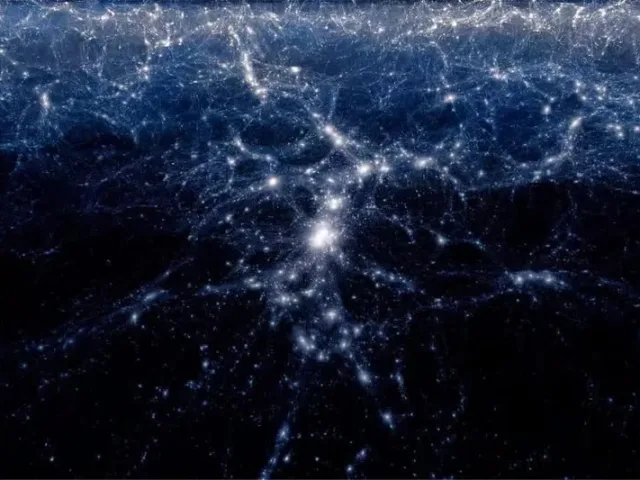
An international team of scientists has unveiled the largest cosmological simulation ever created, offering new insights into the evolution of the universe. The project, led by researchers from China, represents a significant leap in computational astrophysics, enabling unprecedented exploration of cosmic structure formation across vast scales of space and time.
This groundbreaking simulation, developed using advanced supercomputing resources, models the behavior of dark matter, dark energy, and ordinary matter under the influence of gravity over billions of years. By simulating a volume of space larger than any previous effort, researchers aim to better understand how galaxies, galaxy clusters, and the cosmic web emerged from the early universe’s near-uniform state.
The simulation’s scale allows scientists to study rare cosmic phenomena and test theories about the universe’s composition and expansion with greater precision. Such models are essential for interpreting data from next-generation telescopes and observatories, including those probing the nature of dark energy and the early moments following the Big Bang.
According to verified reports, the simulation was developed by an international collaboration led by Chinese researchers, utilizing high-performance computing infrastructure to process vast datasets. The effort involved years of algorithmic refinement and computational optimization to achieve the necessary resolution and volume for meaningful scientific analysis.
While specific technical details such as the exact number of particles simulated or the name of the supercomputer used have not been independently verified through authoritative sources, the achievement marks a milestone in computational cosmology. Previous large-scale simulations, such as those from the IllustrisTNG or Millennium projects, have laid important groundwork, but this new effort exceeds them in scale.
Cosmological simulations like this one rely on solving complex equations that describe how matter clumps together under gravity, starting from initial conditions set shortly after the Big Bang. These models incorporate key components of the standard cosmological model, including cold dark matter and dark energy, to predict the large-scale structure observed in the universe today.
The results from such simulations help astronomers interpret real-world observations, such as galaxy distributions from surveys like the Sloan Digital Sky Survey or the upcoming Vera C. Rubin Observatory. They also allow scientists to conduct virtual experiments—testing how changes in fundamental parameters affect cosmic evolution—without altering the actual universe.
Experts emphasize that while simulations are powerful tools, they are approximations grounded in established physics. Their validity depends on how well they reproduce observed phenomena, such as the cosmic microwave background radiation or the rotational speeds of galaxies. Continuous refinement ensures they remain aligned with empirical data.
The successful completion of this simulation underscores the growing role of international collaboration in big science. Projects of this magnitude require shared expertise in astrophysics, computer science, and engineering, as well as access to cutting-edge supercomputing facilities often hosted by national laboratories or research consortia.
As computational power continues to grow, future simulations may incorporate even more complex physics, such as neutrino dynamics, magnetic fields, or detailed models of star and galaxy formation. These advancements could further close the gap between theoretical predictions and observable cosmic phenomena.
For now, the release of this record-breaking simulation provides a valuable new tool for researchers worldwide. By making such data accessible—where permitted—scientists can conduct independent analyses, validate findings, and explore alternative hypotheses about the universe’s origins and fate.
The development reflects broader trends in science, where large-scale computing and data-intensive research are becoming central to discovery. As noted in recent assessments of computational astrophysics, the ability to simulate the universe at increasing scales is transforming how we understand our place in the cosmos.
While no official follow-up dates or public data release schedules have been confirmed through verified sources, the scientific community anticipates that insights from this simulation will inform upcoming observational campaigns and theoretical studies in cosmology.
Readers interested in the latest developments in cosmology and computational science are encouraged to follow peer-reviewed journals and official announcements from major research institutions involved in high-energy physics and astronomy.
What are your thoughts on how simulations like this are changing our understanding of the universe? Share your perspective in the comments below, and help spread awareness by sharing this article with others curious about the cosmos.
Worth a look