
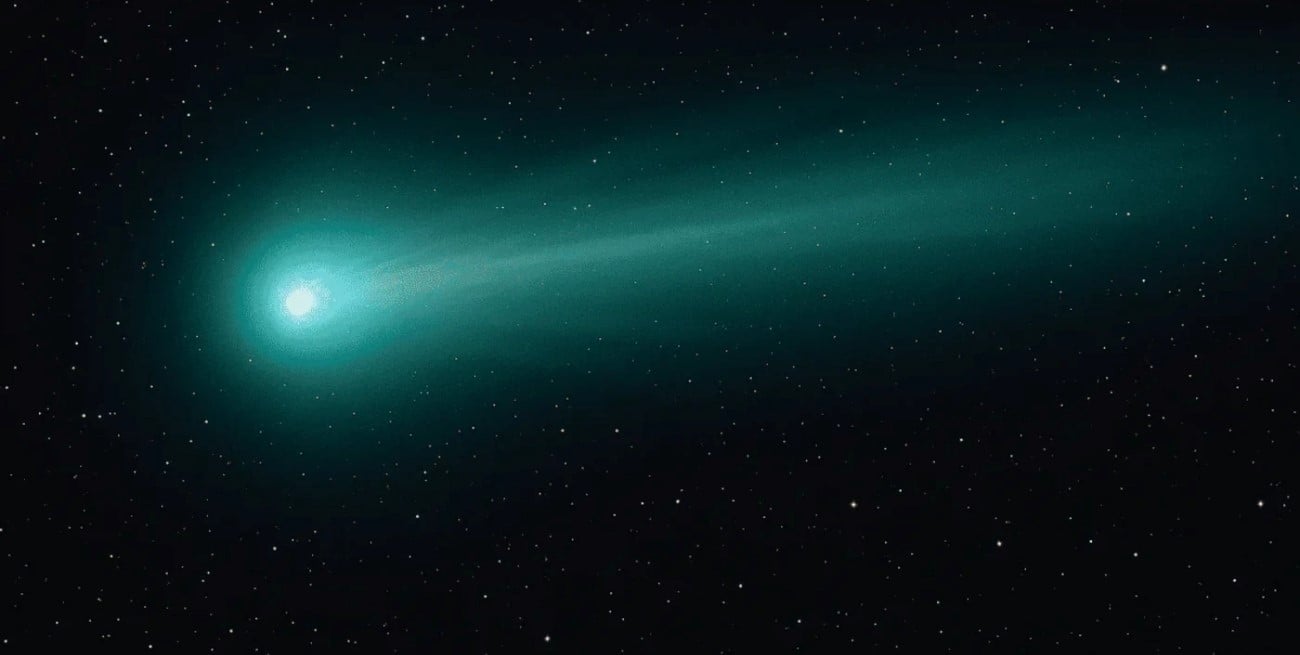
The interstellar comet 3I/ATLAS has become a focal point for astronomers seeking to understand the conditions under which planetary systems form beyond our solar system. Recent observations have revealed unusual characteristics in its composition, particularly the presence of heavy water with elevated levels of deuterium, suggesting an origin in an extremely cold and low-radiation environment. These findings are reshaping scientific understanding of how comets from interstellar space carry chemical signatures of their distant birthplaces.
Designated as the third known interstellar object to pass through our solar system, 3I/ATLAS was first detected in 2025 and has since been studied by multiple observatories, including the European Space Agency’s Jupiter Icy Moons Explorer (Juice) and the James Webb Space Telescope. Instruments aboard Juice, specifically the MAJIS and JANUS sensors, identified strong infrared emissions from water vapor and carbon dioxide as the comet approached the inner solar system, indicating active sublimation of ices even at considerable distances from the Sun.
Analysis of the water released by 3I/ATLAS shows a deuterium-to-hydrogen ratio that is approximately 40 times higher than that found in Earth’s oceans and 30 times greater than in any previously observed comet within our solar system. This significant enrichment in deuterium points to formation in a region where temperatures were low enough to preserve such isotopic anomalies, likely in a distant, shielded part of a molecular cloud far from energetic stellar radiation.
Researchers from the University of Michigan, publishing in Nature Astronomy, concluded that the comet’s water carries chemical evidence of an origin in a frigid, low-radiation environment unlike the conditions that prevailed during the formation of our own solar system. According to lead author Luis Salazar Manzano, the deuterium levels observed in 3I/ATLAS exceed those seen in any other known planetary system or comet, marking a breakthrough in characterizing the origins of interstellar visitors.
The high deuterium signature suggests that 3I/ATLAS formed in a region where ice grains could accumulate deuterium over long periods through ion-molecule reactions in cold interstellar clouds, a process that is inefficient in warmer, more irradiated environments. This implies that the comet may have spent millions of years in a dense, shielded core of a molecular cloud before being ejected into interstellar space, possibly by gravitational interactions with forming stars.
Adding to the intrigue, early observations from the James Webb Space Telescope indicated an unusually high carbon dioxide-to-water ratio in 3I/ATLAS’s coma, further distinguishing it from typical solar system comets. This chemical makeup, combined with its isotopic signature, supports the hypothesis that the comet originated in a planetary system with different chemical abundances and evolutionary pathways than our own.
Despite its interstellar origin, 3I/ATLAS behaves in many ways like a native comet when heated by solar radiation, developing a coma and tail as its ices sublimate. However, it began releasing water activity earlier than expected — detected while still far from the Sun — suggesting that its surface ices are particularly volatile or that its internal structure allows for efficient heat transfer. Scientists describe this outgassing as resembling “a fire hose on full blast,” highlighting the comet’s surprising activity given its distant origin.
The ongoing study of 3I/ATLAS provides a rare opportunity to sample material from beyond our solar system, offering direct insights into the protoplanetary disks and formation environments of distant stars. As the Juice mission continues its journey toward Jupiter, scientists hope to gather additional data on the comet’s trajectory and composition during future observation windows, though 3I/ATLAS is now on an outbound path and will not return.
Understanding objects like 3I/ATLAS helps astronomers refine models of how planetary systems form and evolve across the galaxy, particularly regarding the distribution of volatiles like water and organics that are essential to habitability. Each interstellar visitor acts as a natural spacecraft, carrying preserved records of the conditions in its birthplace across light-years of space.
As of April 2025, no further missions are specifically planned to intercept 3I/ATLAS, but archival and observational data from existing telescopes continue to be analyzed. Scientists encourage continued monitoring of long-period and interstellar objects through survey programs such as the Vera C. Rubin Observatory’s Legacy Survey of Space and Time, which may detect future interstellar arrivals.
The study of 3I/ATLAS underscores the value of interdisciplinary approaches in astronomy, combining spectroscopy, isotopic analysis, and dynamical modeling to reconstruct the histories of objects that drift between stars. For researchers, each data point brings them closer to answering a fundamental question: how common are Earth-like conditions in the universe?
For updates on interstellar object research and mission developments, readers can follow official communications from the European Space Agency and NASA’s astrophysics division. Share your thoughts on what these distant travelers might teach us about our place in the cosmos.