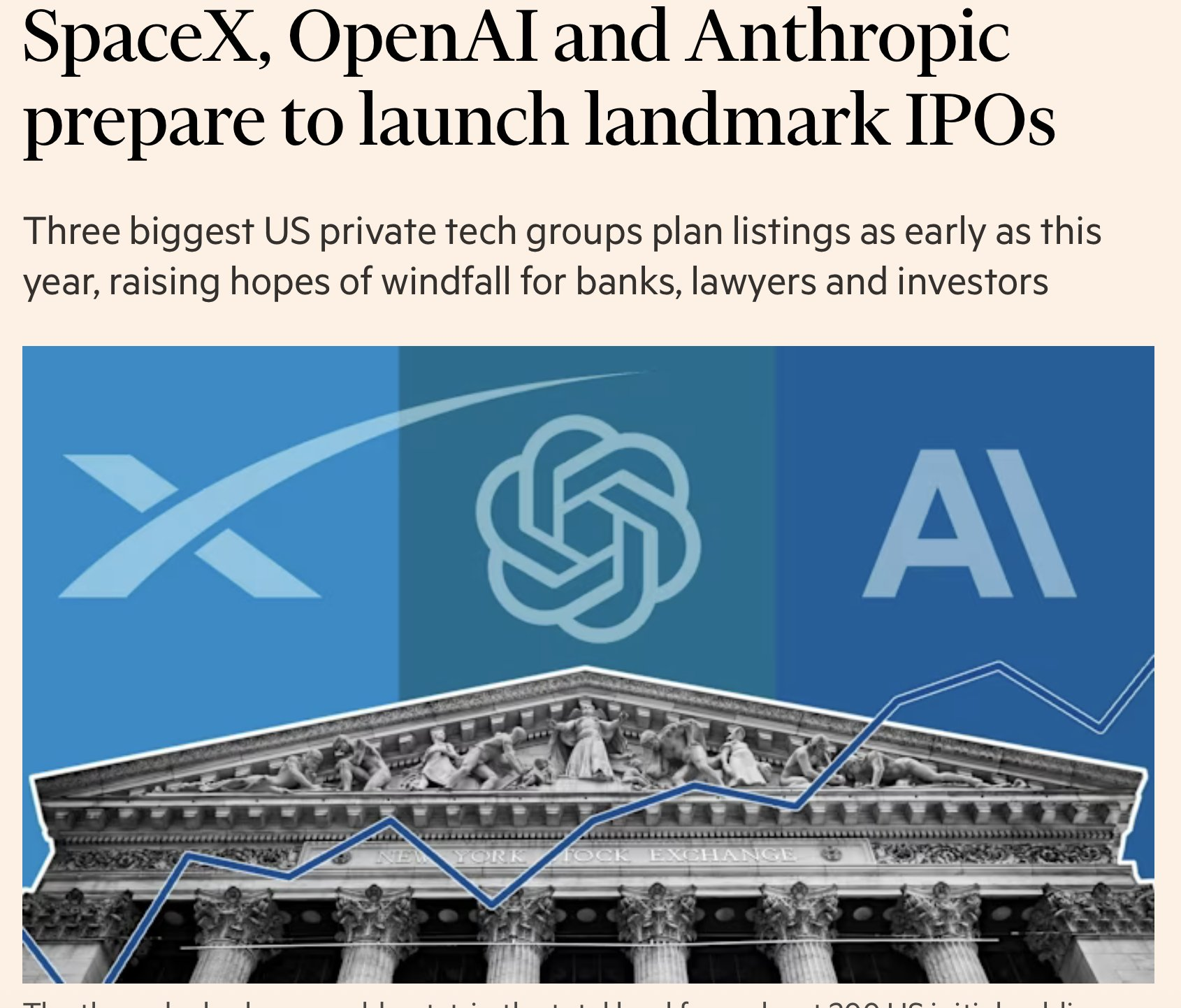
On April 24, 2026, the U.S. Stock market is bracing for what could develop into the largest wave of initial public offerings in history, driven by three major artificial intelligence and space technology companies: SpaceX, OpenAI, and Anthropic. Despite remaining unprofitable, these firms are collectively targeting valuations that could add approximately $3 trillion to the U.S. Equity market, according to estimates from LPL Financial cited in recent financial reporting.
The anticipated public listings come amid growing investor interest in high-growth technology stocks, even as concerns mount over the widening gap between soaring private valuations and the absence of consistent profitability. Reuters has highlighted that this combination of massive valuations and ongoing losses represents an unprecedented scenario in modern U.S. Market debuts, raising questions about how long investors will continue to prioritize growth potential over financial fundamentals.
SpaceX, the aerospace manufacturer and space transport company founded by Elon Musk, is reportedly aiming for a valuation of around $1.75 trillion in its prospective IPO, which would surpass all previous technology company debuts in size. The company continues to generate significant revenue from its Starlink satellite internet service and launch contracts, though it has not yet achieved annual profitability.
OpenAI, the artificial intelligence research laboratory behind the widely adopted GPT series of language models, is also preparing for a public offering. The company has seen rapid revenue growth driven by enterprise adoption of its AI tools and consumer subscriptions to ChatGPT, but it continues to operate at a loss due to the high costs of training and running large-scale AI models.
Anthropic, another leading AI safety and research company known for its Claude series of models, is similarly positioned for a potential IPO. Backed by major technology investors and cloud providers, Anthropic has experienced strong uptake of its AI assistants in business applications, yet it remains unprofitable as it invests heavily in model development and infrastructure.
Market analysts note that the combined scale of these three potential listings could significantly influence major indices such as the S&P 500, particularly if their valuations meet or exceed current projections. However, inclusion in such indices depends on meeting specific profitability and float requirements, which these companies may not satisfy immediately upon going public.
The surge in investor interest reflects broader trends in the technology sector, where long-term growth narratives often outweigh short-term financial performance in valuation assessments. Similar dynamics were observed during the listings of companies like Tesla and Palantir, which also faced scrutiny over profitability despite strong market enthusiasm.
Regulatory bodies and market observers are closely monitoring the situation, as the scale of these potential IPOs could test existing frameworks for evaluating newly public companies, especially those with dual-class share structures or significant founder control. In the case of SpaceX, Elon Musk has indicated an intention to retain substantial voting power even after a public listing, a structure that has drawn both support and criticism from governance experts.
For investors, the upcoming IPO wave presents a complex risk-reward calculation. While the companies operate in high-potential sectors—space exploration, artificial intelligence, and advanced computing—their current lack of profitability means that future stock performance will depend heavily on their ability to scale revenue while managing substantial fixed costs.
Industry experts suggest that the outcome of these listings could shape market expectations for years to come, particularly regarding how Wall Street evaluates innovation-driven companies that prioritize market expansion over immediate earnings. The period following their public debuts will likely serve as a critical benchmark for investor patience in the face of sustained losses.
As of late April 2026, no official S-1 filings have been publicly submitted by SpaceX, OpenAI, or Anthropic to the U.S. Securities and Exchange Commission, indicating that precise timing and pricing details remain subject to change. Market participants continue to await formal disclosures that will provide greater clarity on share structure, leverage of proceeds, and forward-looking financial projections.
The potential IPOs of SpaceX, OpenAI, and Anthropic represent more than just financial events—they reflect a broader shift in how transformative technologies are funded and valued in the public markets. Whether this wave ultimately strengthens or strains investor confidence in long-term growth narratives will depend on the companies’ ability to translate technological leadership into sustainable financial performance.
Investors seeking updates on these developments are encouraged to monitor official SEC filings and verified corporate disclosures for the most accurate and timely information.
Share your thoughts on the upcoming IPO wave and what it means for the future of tech investing in the comments below.
Related reading