
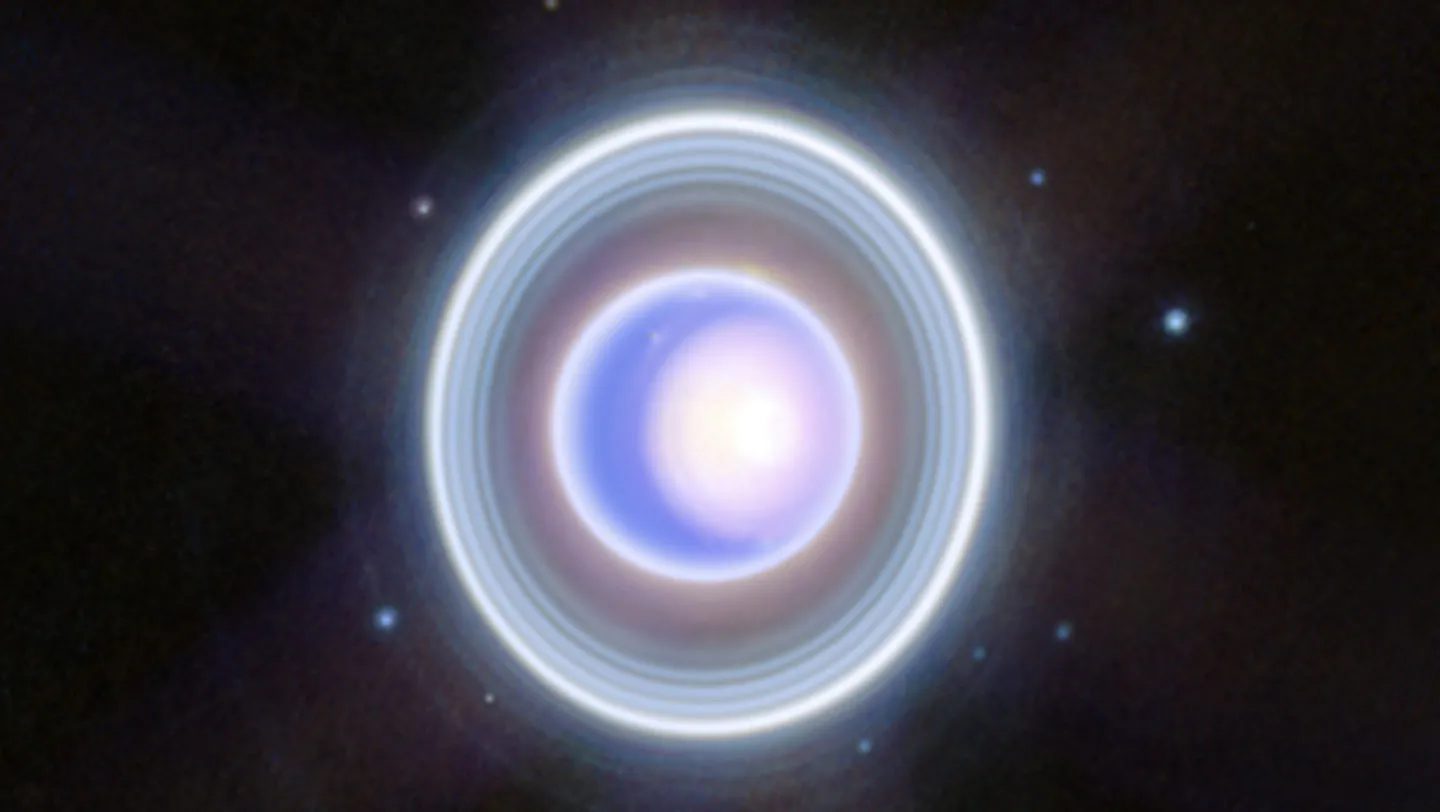
Uranus’s Mysterious Rings: Astronomers Uncover the Origins of Two Puzzling Structures
For nearly half a century, the faint rings encircling Uranus have baffled scientists. Unlike the dazzling rings of Saturn, Uranus’s rings are dim, sparse, and composed of materials that defy easy explanation. Now, after decades of speculation, astronomers have finally pinpointed the likely sources of two of its most enigmatic rings: the blue-tinged Mu ring and the reddish Nu ring. Their findings, published in the Journal of Geophysical Research: Planets, reveal a dynamic system shaped by cosmic collisions and the hidden moons of this distant ice giant.
Uranus, the seventh planet from the sun, is a world of extremes. Located 19 times farther from the sun than Earth, This proves a frigid, gaseous planet tilted dramatically on its side, orbiting with at least 28 known moons and 13 faint rings. The outermost rings, Mu and Nu, have long stood out for their striking differences in composition, and appearance. While Mu glows with a distinctive blue hue, Nu appears reddish, hinting at fundamentally different origins. The new research, led by a team of astronomers using a combination of ground- and space-based telescopes, offers the first concrete evidence of how these rings formed—and why they look so different.
“It’s typical of Uranus to spice things up,” quipped Dr. James O’Donoghue, an astronomer at the University of Reading who was not involved in the study. His remark underscores the planet’s reputation for defying expectations. While Saturn’s rings are primarily composed of ice and dust, Uranus’s rings are far more complex, with compositions that vary dramatically from one ring to the next. The discovery of Mu and Nu’s origins not only sheds light on Uranus’s unique ring system but also deepens our understanding of how planetary rings evolve over time.
The Mu Ring: A Moon’s Icy Legacy
The Mu ring, the outermost of Uranus’s known rings, owes its existence to a compact, icy moon named Mab. Discovered in 2003 by the Hubble Space Telescope, Mab is a diminutive satellite, measuring just 24 kilometers (15 miles) in diameter. Despite its small size, Mab plays a crucial role in feeding the Mu ring with fresh material. The study’s authors, led by Dr. Imke de Pater of the University of California, Berkeley, found that the Mu ring is composed almost entirely of water ice—material that closely matches the composition of Mab itself.

So how does a moon contribute to a ring? The answer lies in micrometeorite impacts. Over time, tiny space rocks bombard Mab’s surface, chipping away at its icy exterior and ejecting debris into orbit around Uranus. This process, known as impact gardening, is a common mechanism for ring formation in the outer solar system. The ejected ice particles then spread out to form the Mu ring, giving it its distinctive blue color. The researchers confirmed this link by analyzing the ring’s reflectance spectrum—a measurement of how light bounces off its particles—and comparing it to the spectral signature of Mab’s surface.
Mab’s role in the Mu ring’s formation is not just a curiosity; it also provides clues about the moon’s history. The fact that Mab is still actively feeding the ring suggests that it is a relatively young moon, or at least one that has not yet been stripped of all its surface material. This raises intriguing questions about the age of Uranus’s ring system and whether other moons might be contributing to it in ways we have yet to discover.
The Nu Ring: A Rocky Mystery
While the Mu ring’s origins are now clear, the Nu ring remains more enigmatic. Unlike Mu, the Nu ring is reddish in color and composed of rocky, carbon-rich material. The study’s authors determined that this material is likely sourced from one or more unseen rocky moons orbiting near the Nu ring. These moons, too small to be detected by current telescopes, are bombarded by micrometeorites just like Mab. However, instead of ejecting ice, they release rocky debris rich in organic compounds, which then coalesce to form the Nu ring.
The researchers estimate that the Nu ring contains between 10% and 15% carbon-rich organic compounds, a composition that sets it apart from the icy Mu ring. This finding aligns with earlier observations of Uranus’s rings, which have shown that the planet’s ring system is far more diverse than those of Saturn or Jupiter. “Ring systems can form in myriad ways,” said Dr. De Pater. “For Uranus, impacts have played a huge role, and still play a role.”
The discovery of the Nu ring’s rocky composition also raises questions about the broader environment of Uranus’s moons. If the Nu ring is indeed fed by unseen rocky moons, it suggests that Uranus’s moon system may be far more crowded than previously thought. Some of these moons could be remnants of larger bodies that were shattered by collisions, while others might be captured asteroids or comets. The presence of organic compounds in the Nu ring is particularly intriguing, as it hints at the possibility of complex chemistry occurring in the outer solar system—chemistry that could, in theory, play a role in the origins of life.
Why This Discovery Matters
At first glance, the origins of Uranus’s rings might seem like a niche topic, relevant only to planetary scientists. However, the implications of this research extend far beyond the ice giant itself. Understanding how planetary rings form and evolve can provide insights into the history of our solar system, the dynamics of moon systems, and even the processes that shape planets around other stars.
For example, the discovery that micrometeorite impacts play a key role in feeding Uranus’s rings could support explain the formation of ring systems around other planets, both in our solar system and beyond. It also underscores the importance of small moons in shaping the environments of giant planets. In the case of Uranus, these moons act as “shepherds,” maintaining the structure of the rings and preventing them from dispersing into space. Without them, Uranus’s rings might look particularly different—or might not exist at all.
the study highlights the value of combining observations from different telescopes. The research team used data from the Hubble Space Telescope, the Keck Observatory in Hawaii, and the Very Large Telescope in Chile to piece together the story of Mu and Nu. This multi-instrument approach allowed them to analyze the rings’ compositions in unprecedented detail, demonstrating how modern astronomy relies on collaboration and technological innovation.
Unanswered Questions and Future Research
Despite this breakthrough, many questions about Uranus’s rings remain unanswered. For instance, why is Mab icy while the moons feeding the Nu ring are rocky? One possibility is that Mab formed in a different region of the Uranian system, where temperatures were cold enough to preserve water ice. Alternatively, Mab might be a fragment of a larger, icy moon that was shattered in a collision, leaving behind a remnant rich in ice.

Another mystery is the fate of the unseen moons feeding the Nu ring. If these moons are indeed small and rocky, they may be difficult to detect with current telescopes. However, future missions to Uranus—such as a proposed NASA orbiter—could provide the high-resolution data needed to identify them. Such a mission would also allow scientists to study Uranus’s rings and moons in greater detail, potentially uncovering new rings or moons that have yet to be discovered.
Finally, the discovery of organic compounds in the Nu ring raises the tantalizing possibility that similar chemistry might be occurring elsewhere in the solar system. If organic molecules are common in the outer solar system, they could provide clues about the building blocks of life and how they are distributed throughout the cosmos. This is a question that future missions to Uranus, as well as to other icy worlds like Neptune and Pluto, will be well-positioned to explore.
Key Takeaways
- The Mu ring is fed by icy debris from the moon Mab. Micrometeorite impacts chip away at Mab’s surface, ejecting water ice that forms the blue-tinged Mu ring.
- The Nu ring is composed of rocky, carbon-rich material. This material likely comes from unseen rocky moons bombarded by micrometeorites, which release debris into orbit around Uranus.
- Uranus’s rings are more diverse than those of Saturn or Jupiter. The planet’s rings vary dramatically in composition, from icy to rocky, and may be shaped by ongoing collisions.
- Micrometeorite impacts play a key role in ring formation. This process is not unique to Uranus and could help explain the origins of ring systems around other planets.
- Future missions to Uranus could uncover new moons and rings. High-resolution observations from an orbiter or flyby mission would provide unprecedented insights into the planet’s dynamic system.
What’s Next?
The next major milestone in the study of Uranus’s rings will likely come from future space missions. NASA has identified Uranus as a priority target for exploration in the coming decades, with proposals for an orbiter and probe currently under consideration. Such a mission would provide the first close-up observations of Uranus since Voyager 2’s flyby in 1986, offering a wealth of new data on the planet’s rings, moons, and atmosphere.
In the meantime, astronomers will continue to study Uranus using ground- and space-based telescopes, refining their models of how its rings formed and evolved. The discovery of Mu and Nu’s origins is a significant step forward, but it is only the beginning of unraveling the mysteries of this distant, enigmatic planet.
What do you think about the origins of Uranus’s rings? Are there other planetary systems where similar processes might be at work? Share your thoughts in the comments below, and don’t forget to share this article with fellow space enthusiasts!