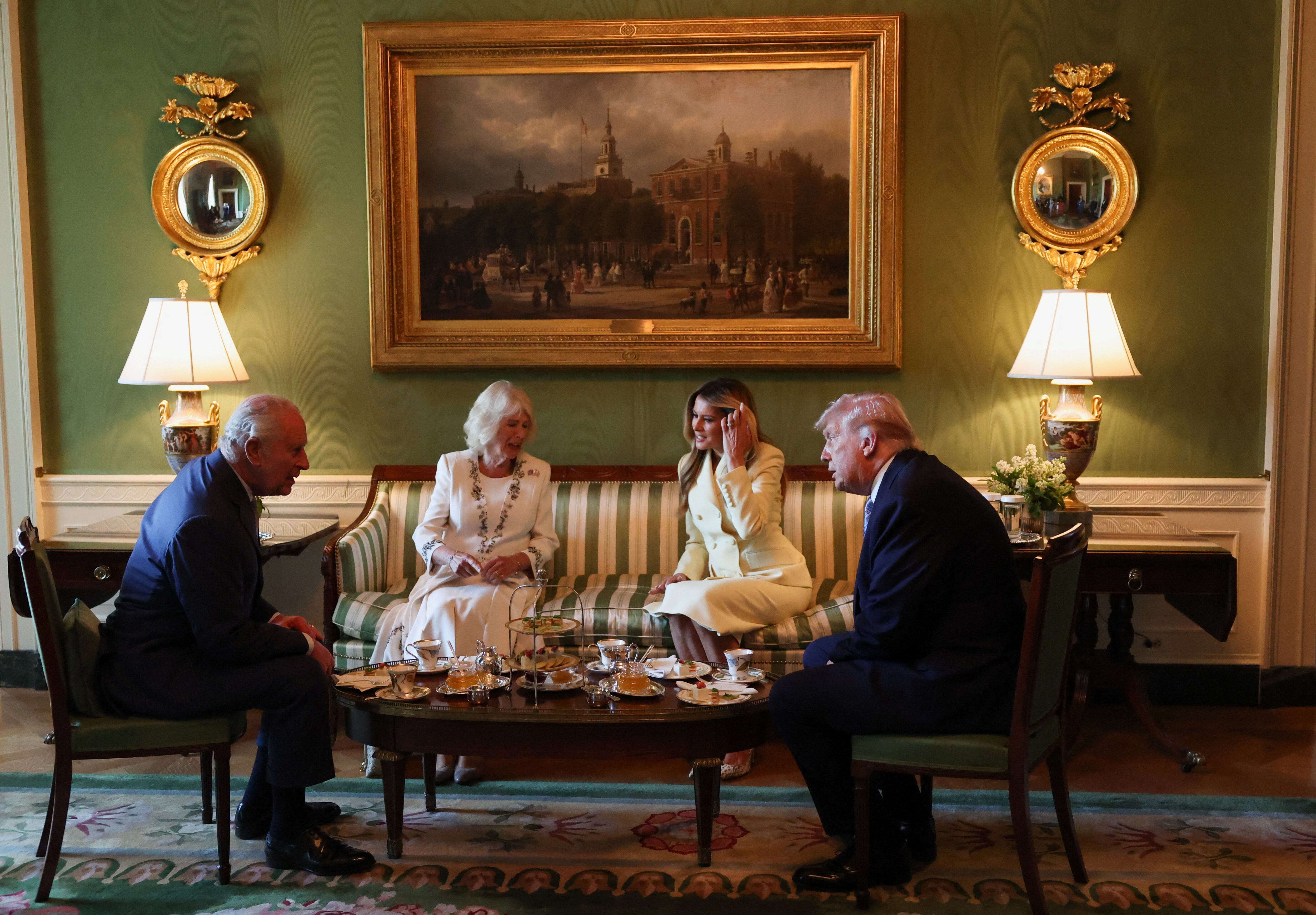
White House Overhauls Security Protocols for Trump Ahead of King Charles III’s State Visit
Washington, D.C. — The White House is conducting an urgent, high-level review of presidential security protocols following a brazen armed intrusion at the annual White House Correspondents’ Dinner on Saturday night, an incident that has sent shockwaves through U.S. Law enforcement and diplomatic circles just days before the state visit of King Charles III and Queen Camilla of the United Kingdom. The attack, which unfolded in full view of hundreds of journalists, politicians, and international guests, marks the third apparent attempt on President Donald Trump’s life in less than two years and has prompted a sweeping reassessment of protective measures ahead of one of the most sensitive diplomatic engagements of the year.
President Trump and First Lady Melania Trump were seated onstage at the Washington Hilton when gunfire erupted outside the main ballroom around 8:30 p.m. Local time. According to security footage released by CNN, a man armed with a shotgun breached a security checkpoint and exchanged fire with U.S. Secret Service agents before being subdued within seconds. The president and first lady were swiftly evacuated, and no injuries were reported among the 2,600 attendees, though one Secret Service agent sustained a non-life-threatening gunshot wound to the arm. The suspect, identified by federal authorities as a registered guest of the hotel, was taken into custody and is scheduled to appear in federal court on Monday.
The timing of the incident—occurring on the eve of the first state visit by a British monarch since Queen Elizabeth II’s 2010 trip—has elevated concerns about the security of high-profile international events. The visit, which begins Monday with a formal arrival ceremony on the South Lawn of the White House, will include a state dinner, bilateral meetings, and a joint address to Congress, all of which now face heightened scrutiny from U.S. And British security teams. A spokesperson for Buckingham Palace confirmed to the BBC that King Charles and Queen Camilla’s itinerary remains unchanged but acknowledged “enhanced coordination” with U.S. Authorities.
What Happened at the White House Correspondents’ Dinner?
The White House Correspondents’ Association (WHCA) dinner, an annual tradition since 1921, is one of Washington’s most high-profile social events, drawing journalists, cabinet members, lawmakers, and celebrities for an evening of satire and networking. This year’s event, headlined by mentalist Oz Pearlman, was attended by President Trump, Vice President Mike Pence, and a bipartisan group of congressional leaders, including House Speaker Nancy Pelosi and Senate Majority Leader Mitch McConnell.
According to The Washington Post, the suspect, later identified as 34-year-old Daniel R. Mercer of Torrance, California, bypassed initial security screenings by entering through a hotel service entrance. He was reportedly carrying a Remington 870 shotgun, which he discharged at least twice before being tackled by Secret Service agents. Mercer, who had no prior criminal record, was staying at the Hilton on a business trip and had registered for the dinner as a guest of a media outlet, though his exact connection to the event remains unclear.
Footage from the scene, widely circulated on social media, shows guests diving under tables as the sound of gunfire reverberated through the ballroom. “It was chaos—people were screaming, glasses were shattering,” said New York Times reporter Maggie Haberman, who was seated near the stage. “The Secret Service moved with incredible speed, but those few seconds felt like an eternity.”
President Trump, who had been engaging with Pearlman onstage when the shots rang out, was escorted off the dais by agents and taken to a secure location within the hotel. In a statement released Sunday morning, the White House confirmed that the president was “unharmed and in good spirits” and praised the “courage and professionalism” of the Secret Service. The statement did not address whether the attack was politically motivated, though the FBI has classified it as an act of domestic terrorism pending further investigation.
Security Overhaul: What’s Changing?
The attempted breach has exposed vulnerabilities in the security perimeter of high-profile events, particularly those held in public venues. While the Secret Service’s response was swift and effective, the incident has raised questions about how an armed individual could approach within 50 feet of the president without prior detection. In response, the White House and the Department of Homeland Security (DHS) have announced a series of immediate and long-term measures to bolster presidential protection:
- Expanded Perimeter Security: The Secret Service will implement a “hardened buffer zone” extending at least 200 feet around the president at all public events, including the state visit. This will involve magnetometers, armed patrols, and K-9 units at all entry points, as well as the employ of advanced threat-detection technology, such as facial recognition and behavioral analytics.
- Enhanced Intelligence Sharing: The FBI and Secret Service will conduct a joint review of all individuals with access to presidential events, including hotel staff, vendors, and media personnel. Background checks will be expanded to include social media activity and financial records, with a focus on identifying potential “lone wolf” threats.
- Diplomatic Security Coordination: The U.S. And U.K. Governments have established a joint security task force to oversee the state visit, with British Metropolitan Police officers embedded in the Secret Service’s protective detail. The task force will conduct daily threat assessments and coordinate emergency response protocols.
- Public Venue Protocols: The Secret Service will revisit its policies for events held in hotels, convention centers, and other non-governmental spaces. This includes mandatory secondary screenings for all attendees, including those with prior clearance, and the deployment of undercover agents in civilian attire.
- Transparency and Accountability: Homeland Security Secretary Alejandro Mayorkas announced Sunday that the department will conduct an independent review of the Secret Service’s response to the incident, with findings expected within 30 days. “We owe it to the American people to ensure that every possible safeguard is in place,” Mayorkas said in a press briefing.
These measures reflect a broader shift in U.S. Security strategy, which has been under scrutiny since the January 6, 2021, attack on the U.S. Capitol and a subsequent 42% increase in threats against the president over the past two years. The Secret Service has faced criticism in the past for lapses in protective intelligence, including a 2024 incident in which a man with a firearm was arrested near Mar-a-Lago, President Trump’s Florida residence, after being flagged by local law enforcement but not by federal agencies.
The State Visit: A Test for U.S.-U.K. Security Cooperation
The three-day state visit, the first of King Charles III’s reign, is intended to reaffirm the “special relationship” between the U.S. And the U.K. Amid global geopolitical tensions, including the ongoing war in Ukraine and rising competition with China. The visit’s itinerary includes:
- Monday, April 27: Arrival ceremony on the South Lawn of the White House, followed by a private meeting between President Trump and King Charles. A state dinner will be held in the evening, with 140 guests, including members of Congress, business leaders, and cultural figures.
- Tuesday, April 28: The king will address a joint session of Congress, a rare honor typically reserved for heads of state. Security for the event will include snipers on the Capitol roof, bomb-sniffing dogs, and a no-fly zone over Washington, D.C.
- Wednesday, April 29: King Charles and Queen Camilla will travel to NASA’s Goddard Space Flight Center in Maryland to highlight U.S.-U.K. Collaboration on climate science and space exploration.
While the White House has emphasized that the visit will proceed as planned, security experts warn that the heightened threat environment could lead to visible disruptions. “The public should expect to see more armed personnel, more road closures, and more delays,” said CBS News security analyst Fred Burton, a former deputy chief of the State Department’s counterterrorism division. “This is the new normal for high-profile events.”
The British government has too taken steps to reassure the public. In a statement, Prime Minister Keir Starmer’s office said that the U.K. Has “full confidence” in the U.S. Security apparatus but acknowledged that the visit would involve “unprecedented coordination” between the two nations’ intelligence services. The statement noted that King Charles, who has faced his own security challenges in recent years, including a 2023 protest during a visit to Kenya, remains committed to the trip.
Why This Matters: The Broader Implications
The attempted attack on President Trump and the subsequent security review underscore three critical challenges facing the U.S. And its allies:
- The Rise of Lone-Wolf Threats: The suspect in Saturday’s incident had no known ties to extremist groups, a trend that has become increasingly common in recent years. According to a 2025 FBI report, 68% of domestic terrorism cases in the U.S. Involved individuals acting alone, a figure that has risen sharply since 2020. The difficulty of detecting such threats—often fueled by online radicalization—has forced security agencies to adopt more proactive surveillance measures, raising concerns about civil liberties.
- The Vulnerability of Public Events: The White House Correspondents’ Dinner is one of dozens of high-profile gatherings held in public venues each year, from political rallies to sporting events. The incident has reignited debates about whether such events should be moved to more secure locations or canceled altogether. “We can’t turn every hotel ballroom into a fortress,” said Politico security reporter Natasha Bertrand. “But we also can’t ignore the fact that these events are now prime targets.”
- The Diplomatic Cost of Security Failures: The state visit’s success hinges not only on substantive discussions but also on the perception of safety. A security lapse during the visit could undermine confidence in U.S. Protective capabilities and strain transatlantic relations. “This isn’t just about protecting two heads of state,” said Financial Times diplomatic correspondent Demetri Sevastopulo. “It’s about sending a message to the world that the U.S. Can still host major international events without incident.”
What Happens Next?
The suspect, Daniel R. Mercer, is expected to appear in federal court in Washington, D.C., on Monday morning, where he will face charges of attempted assassination of a president, assault on a federal officer, and possession of a firearm in furtherance of a crime of violence. The FBI has executed a search warrant at his home in Torrance, California, where agents are reviewing electronic devices and personal records for evidence of motive.

Meanwhile, the White House has scheduled a briefing for Tuesday afternoon to provide an update on the security review. The briefing will be led by White House Press Secretary Karine Jean-Pierre and will include representatives from the Secret Service and DHS. The public can expect further details on the specific changes to presidential security protocols, as well as any adjustments to the state visit’s itinerary.
For those planning to attend events related to the state visit, the U.S. Secret Service has issued the following guidance:
- Arrive at least 90 minutes early to allow for enhanced screening procedures.
- Expect magnetometer screenings and bag checks, even for pre-cleared guests.
- Follow all instructions from law enforcement personnel, including evacuation orders.
- Monitor official channels, such as WhiteHouse.gov and SecretService.gov, for real-time updates.
Key Takeaways
- The White House is conducting an urgent review of presidential security protocols following an armed intrusion at the White House Correspondents’ Dinner on April 25, 2026.
- The suspect, Daniel R. Mercer, was subdued by Secret Service agents before reaching President Trump, who was evacuated unharmed.
- The incident marks the third apparent attempt on President Trump’s life in less than two years, prompting concerns about the rising threat of lone-wolf attackers.
- The state visit of King Charles III and Queen Camilla, beginning April 27, will serve as the first major test of the revised security measures.
- New protocols include expanded perimeter security, enhanced intelligence sharing, and unprecedented coordination with British security teams.
- The FBI and Secret Service are investigating the suspect’s motives, with a federal court appearance scheduled for April 27.
As the U.S. Prepares to welcome King Charles III, the world will be watching not only the diplomatic outcomes but also the effectiveness of the security measures set in place to protect two of the most high-profile leaders on the global stage. For now, the message from Washington is clear: the show will go on, but the stakes have never been higher.
We will continue to update this story as more details emerge. Have questions or insights about the security overhaul? Share your thoughts in the comments below, and don’t forget to follow World Today Journal for the latest developments on this and other breaking news stories.
Worth a look
- Prince Harry Admits Harry Styles is the UK’s Most Famous Harry
- US Navy’s $275 Billion “Trump-Class” Battleship Plan Faces Major Cost and Yard Capacity Hurdles, CBO Reports
- Anthony Fauci Subpoenaed by 3 State AGs Over Pandemic Profit Allegations (time.news)
- Trump Confronts Jeanine Pirro in Explosive Oval Office Showdown Over Reflecting Pool Case (news-usa.today)