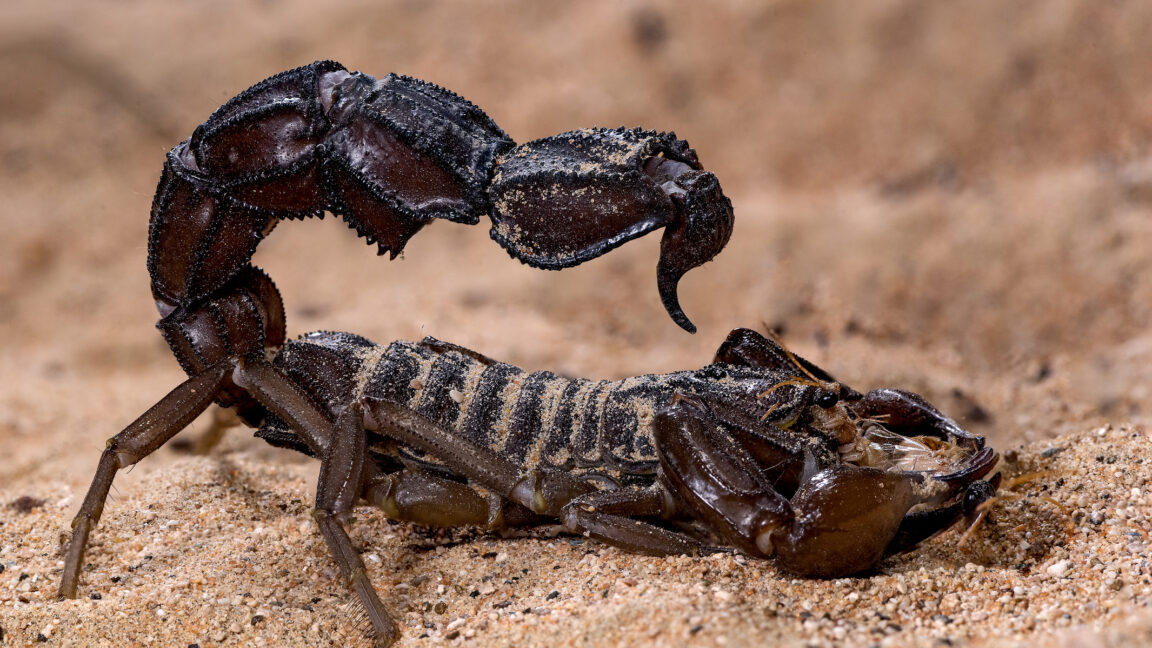
Nature has a long history of biological engineering, but few examples are as striking as the one found in the arsenal of the scorpion. New research reveals that these arachnids have been forging metal-reinforced weaponry—specifically their claws and stingers—for nearly 400 million years, long before the dawn of human metallurgy.
The study, led by PhD candidate Sam Campbell of the University of Queensland’s School of the Environment, demonstrates that scorpions do not simply absorb metals from their environment by accident. Instead, they selectively integrate zinc, iron and manganese into their exoskeletons to create tools that are harder, sharper, and more resistant to wear. This evolutionary strategy allows the creatures to maintain lethal efficiency without adding unnecessary bulk to their frames.
By mapping these metal distributions across a snapshot of the scorpion family tree, researchers have uncovered a sophisticated biological “cost-benefit analysis.” The distribution of these elements varies by species, suggesting that scorpions prioritize reinforcement based on which weapon they rely on most for hunting and defense.
The Chemistry of Biological Armor
For decades, scientists have known that metals were present in scorpion anatomy, but the purpose remained a mystery. The recent study, conducted in collaboration with experts at the Smithsonian’s National Museum of Natural History, including Dr. Hannah Wood, Dr. Ed Vicenzi, and Dr. Thomas Lam, sought to determine if this was an evolutionary trait or a byproduct of the environment.
To achieve this, the team analyzed 18 different scorpion species using high-precision imaging technology. They employed micro X-ray fluorescence microscopy, a technique typically reserved for analyzing minerals in mines, to map exactly where elements were located. This was supplemented by scanning electron microscopy to take precise measurements of the reinforced areas.

The findings revealed a specific chemical division of labor within the scorpion’s weaponry:
- Manganese: Found exclusively in the stinger.
- Iron: Found exclusively in the claws (chelae).
- Zinc: Present in both the claws and the stinger, though the concentration varies by species.
According to the research, the concentration of zinc often “flips” between weapons depending on the species. This suggests that a scorpion with higher zinc levels in its stinger likely relies more on its venomous strike, while those with zinc-heavy claws prioritize gripping and manipulating prey.
Counterintuitive Strength: Why Slender Claws Are “Metal”
One of the study’s most surprising discoveries challenged the researchers’ initial assumptions about strength. The team expected the largest, most powerful crushing claws to contain the highest concentrations of iron. However, the data showed the opposite.
The highest iron concentrations were found in long, slender claws. These appendages are not designed for crushing power but for gripping struggling prey. Because these thin claws must withstand the intense tension and friction of a fighting animal without snapping or wearing down, the biological reinforcement of iron is critical for their survival.
“Those thin claws have to hold on while the prey is fighting to escape. So it’s not about crushing strength—it’s about being tough enough not to wear down.” Sam Campbell, PhD candidate at the University of Queensland
This discovery highlights the precision of the scorpion’s evolutionary adaptation: the body places the specific metal reinforcement exactly where the mechanical stress is highest, rather than simply adding it to the largest body parts.
Implications for Materials Science and Engineering
Beyond the biological curiosity, the way scorpions reinforce protein with metal has caught the attention of the tech and engineering communities. Modern materials science often struggles to create materials that are simultaneously lightweight, thin, and incredibly hard without becoming brittle.
Scorpions have solved this problem through a natural system that integrates inorganic metals into an organic protein matrix. This biological blueprint could potentially inform the development of new synthetic materials or bio-inspired armor that mimics the scorpion’s ability to maintain a sharp edge and structural integrity under extreme stress.
The research too underscores the ecological importance of these creatures. While there are roughly 3,000 known species of scorpions, only five currently hold protected conservation status. Researchers hope that shedding light on these extraordinary adaptations will increase interest in the conservation of these ancient predators.
Key Takeaways: Scorpion Metal Reinforcement
- Evolutionary Age: Scorpions have used metal reinforcement for nearly 400 million years.
- Material Mix: Zinc, iron, and manganese are selectively embedded into claws and stingers.
- Strategic Placement: Iron is used in slender claws for durability; manganese is reserved for the stinger.
- Engineering Potential: The system provides a model for creating lightweight, high-strength materials.
The research team now plans to conduct further testing to determine exactly how different combinations of these metals alter the hardness and toughness of the weapons in real-world scenarios. Further updates on these material tests are expected as the University of Queensland and the Smithsonian continue their analysis.
Do you think bio-inspired materials could revolutionize modern armor or tool design? Share your thoughts in the comments below.