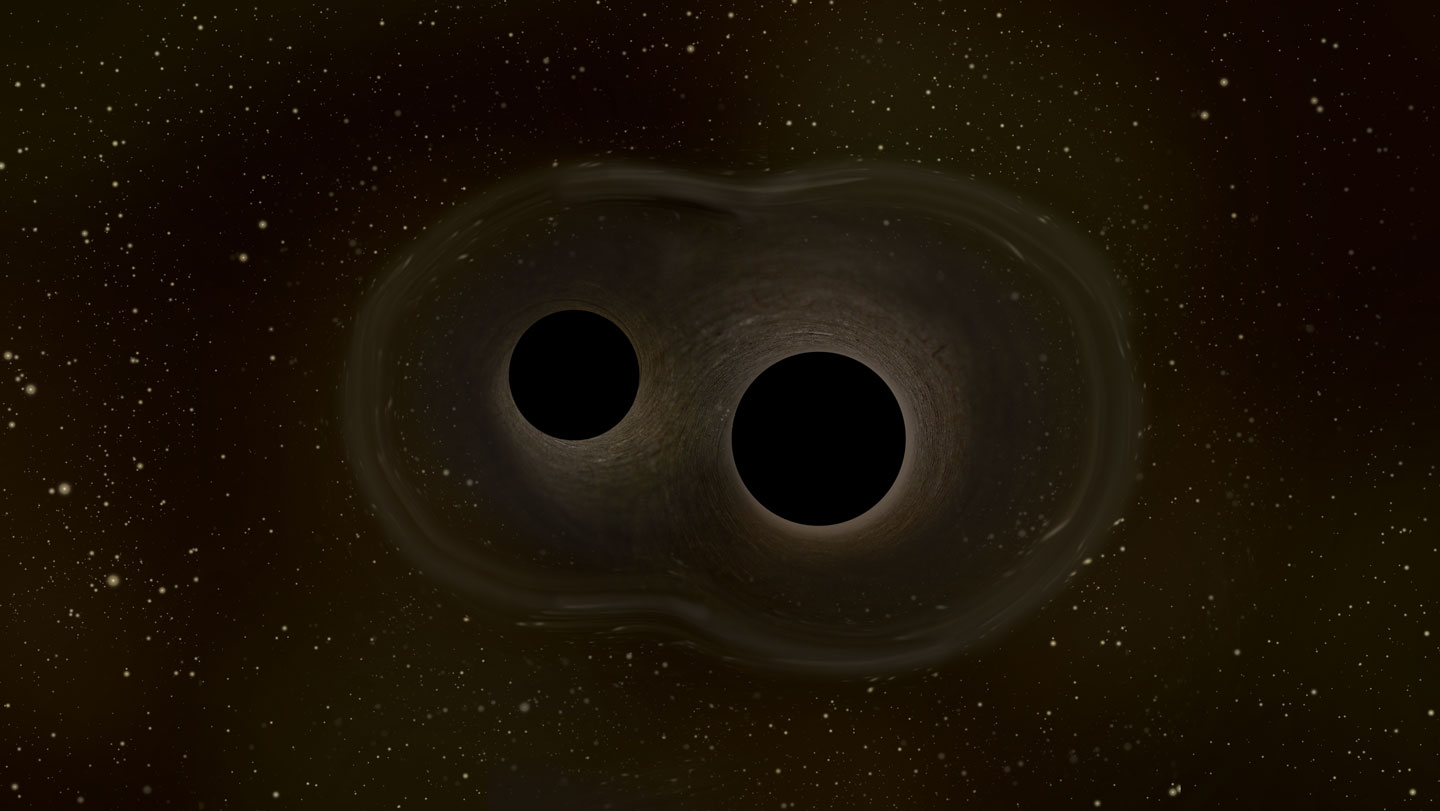
In the vast, silent stretches of the cosmos, astronomers have uncovered a phenomenon that challenges our understanding of galactic evolution. In a galaxy located approximately 4.4 billion light-years from Earth, researchers believe they have identified a record-breaking pair of black holes whose combined mass is estimated at 60 billion times that of our sun.
This discovery, centered in a galaxy known as Abell 402-BCG, reveals a staggering celestial void—a region 3,200 light-years across that is almost entirely devoid of stars. While scientists initially suspected that cosmic dust was simply obscuring the view, new data suggests a far more violent reality: two ultramassive black holes are locked in a gravitational dance, spiraling toward an inevitable collision and clearing out their stellar neighborhood in the process.
As a physician and journalist, I have always been fascinated by the parallels between the microscopic and the macroscopic. Just as a powerful biological catalyst can reshape an entire cellular environment, these gravitational behemoths are reshaping the architecture of their galaxy. This finding not only sets a new benchmark for the size of black hole binaries but also provides a rare glimpse into the “clearing” phase of a galactic merger.
The Mystery of the Star-Free Void
The investigation began with an anomaly. In 2018, astronomers noticed a peculiar “dark spot” at the center of Abell 402-BCG. In most galaxies, the center is the most crowded region, packed with ancient stars and dense gas. However, this specific region remained stubbornly dark. For years, the prevailing theory was that a thick cloud of interstellar dust was blocking the starlight, acting as a cosmic curtain.
The breakthrough came with the deployment of the James Webb Space Telescope (JWST) and the Very Large Telescope (VLT) of the European Southern Observatory. Because the JWST can peer through dust using infrared light, it was the perfect tool to test the dust theory. The results were surprising: the void was not hidden by dust; it was actually empty. The stars were simply gone.
According to research published in The Astrophysical Journal Letters, the absence of stars is the “smoking gun” for a binary black hole system. When two galaxies merge, their central supermassive black holes eventually find one another. As they orbit each other, their combined gravitational influence acts like a cosmic slingshot, ejecting nearby stars from the galactic center and creating a star-free gap.
Understanding Ultramassive Black Holes
To grasp the scale of this discovery, This proves necessary to distinguish between “supermassive” and “ultramassive” black holes. Most large galaxies, including our own Milky Way, house a supermassive black hole at their core. However, Abell 402-BCG contains something far more extreme.

The estimated combined mass of 60 billion solar masses places these objects in the ultramassive category. To put this in perspective, this pair is at least double the mass of the next most massive black hole duo ever identified. The sheer scale of these objects suggests that Abell 402-BCG has a history of multiple mergers, absorbing other galaxies and their respective black holes over billions of years.
MIT astronomer Michael McDonald and his colleagues estimate that this specific pair has likely been orbiting one another for a few tens of millions of years. In astronomical terms, this is a relatively new relationship, yet it has already been enough time to purge the center of the galaxy of its stellar population.
The Mechanics of a Cosmic Collision
The process currently unfolding in Abell 402-BCG is a masterclass in gravitational physics. The interaction follows a predictable but violent sequence:
- Galactic Merger: Two galaxies collide, their stars and gas mixing over millions of years.
- The Binary Phase: The two central black holes sink toward the center of the new, merged galaxy due to dynamical friction.
- Stellar Scouring: As the black holes orbit each other, they transfer energy to nearby stars, flinging them outward and creating the “void” observed by the JWST.
- The Final Merger: Eventually, the black holes will spiral close enough to emit powerful gravitational waves, eventually merging into a single, even more massive entity.
The “void” in Abell 402-BCG is a physical record of this scouring process. By measuring the size of the gap—roughly 3,200 light-years—scientists can infer the mass of the black holes that created it. The larger the gap, the more massive the “slingshot” effect must have been.
Why This Discovery Matters
This finding is more than just a record-breaking statistic; it helps solve a long-standing puzzle in astrophysics known as the “Final Parsec Problem.” For years, theorists wondered if two supermassive black holes would ever actually merge, or if they would stall out once they got within a few light-years of each other.
The evidence from Abell 402-BCG suggests that the process of stellar scouring is an efficient way for black holes to lose orbital energy and move closer together. By clearing out the stars, the black holes are effectively paving the way for their own eventual collision.
the discovery underscores the importance of multi-wavelength astronomy. The combination of the VLT’s optical capabilities and the JWST’s infrared precision allowed researchers to rule out dust and confirm the void, proving that the most significant discoveries often happen at the intersection of different technologies.
Key Takeaways
- The Discovery: A pair of ultramassive black holes in galaxy Abell 402-BCG with a combined mass of ~60 billion solar masses.
- The Evidence: A 3,200 light-year wide “star-free” void at the galaxy’s center, verified by the James Webb Space Telescope and the Very Large Telescope.
- The Cause: Gravitational interactions between the two black holes “slung” stars out of the galactic center.
- The Significance: This is the most massive black hole pair ever found, providing critical data on how ultramassive black holes form and merge.
Looking Ahead
The scientific community now looks toward further observations of “Brightest Cluster Galaxies” (BCGs) to determine if Abell 402-BCG is a cosmic outlier or if ultramassive binaries are more common than previously thought. Researchers expect that as the JWST continues its mission, more of these “dark voids” will be identified, potentially rewriting the timeline of how the largest structures in the universe evolve.
The next major milestone will be the analysis of follow-up spectroscopic data to more precisely determine the orbital period of the two black holes, which will allow astronomers to predict exactly when the final collision will occur.
Do you think these cosmic giants hold the key to understanding the origin of our own galaxy? Share your thoughts in the comments below or share this article with a fellow science enthusiast.
Worth a look