
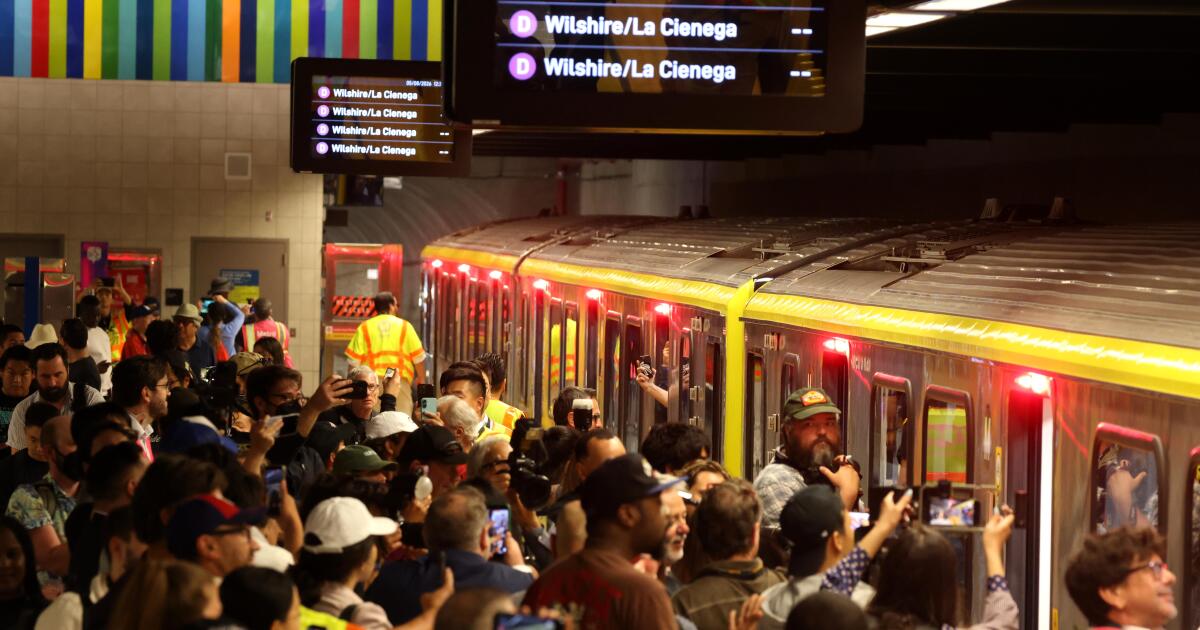
Los Angeles has officially entered a new era of urban mobility. On Friday, May 8, 2026, the Los Angeles County Metropolitan Transportation Authority (LA Metro) opened the first section of the D Line extension, bringing heavy-rail subway service to one of the most congested and economically vital corridors in the United States.
The opening of Section 1 of the D Line extension marks the completion of a multi-year engineering feat, extending the subway from the previous terminus at Wilshire/Western toward the west. For decades, the Wilshire Boulevard corridor has served as the city’s primary east-west artery, yet it remained one of the few major transit gaps in the region. This expansion is designed to drastically reduce reliance on automobiles along a stretch of road known for some of the slowest commute times in North America.
As a veteran of global news reporting, I have seen how infrastructure shifts can redefine a city’s economic geography. In Los Angeles, the D Line extension is more than just a transit project; it is a strategic effort to link the financial heart of downtown LA with the commercial hubs of Mid-City and the gateway to Beverly Hills. By shifting thousands of daily commuters from the surface to the subterranean, the city aims to alleviate the chronic gridlock that has long plagued the Wilshire district.
Connecting the Wilshire Corridor: Route and Reach
The newly opened Section 1 provides a critical link for residents and professionals navigating the dense urban environment of Central Los Angeles. This phase of the project introduces several new underground stations, allowing passengers to bypass the surface-level traffic of Wilshire Boulevard. The extension effectively pushes the rail network deeper into the city’s commercial core, facilitating a faster, more reliable connection between the civic center and the western neighborhoods.
While the ultimate goal of the D Line expansion is to reach the heart of Beverly Hills, this first phase serves as the essential foundation. The route is designed to serve high-density employment centers, medical complexes, and residential clusters that were previously underserved by rapid transit. By integrating these areas into the broader Metro network, the city is attempting to create a more seamless “polycentric” urban model where multiple hubs are connected without the need for a car.
The engineering requirements for this section were immense. Boring through the dense soil and existing infrastructure of Los Angeles required the use of massive tunnel boring machines (TBMs) to create the twin tunnels that now carry the D Line. This process involved navigating around existing utility lines and the foundations of skyscrapers, all while minimizing disruption to the millions of people who use Wilshire Boulevard daily.
The Economic and Social Impact of the D Line
The decision to prioritize the Wilshire corridor is rooted in economics. Wilshire Boulevard is often described as the “Main Street” of Los Angeles, housing a vast concentration of office towers, luxury retail, and healthcare facilities. By providing a high-capacity transit alternative, the Los Angeles County Metropolitan Transportation Authority is betting that improved accessibility will drive further transit-oriented development (TOD).

Transit-oriented development typically manifests as increased residential and commercial density around new stations. With the opening of Section 1, city planners expect a surge in mixed-use projects—buildings that combine housing, retail, and office space—reducing the need for sprawling parking lots and encouraging a more walkable urban environment. This shift is critical for a city struggling with housing affordability and an aging infrastructure.
Beyond the economics, there is a significant social equity component to the expansion. For many Angelenos, the lack of reliable east-west transit has created “transit deserts,” where residents without vehicles face prohibitively long commutes to reach high-paying jobs downtown or in the west side. The D Line extension begins to bridge this gap, providing a predictable, timed alternative to the unpredictability of LA traffic.
Challenges, Costs, and the Road to Beverly Hills
The path to this opening was not without friction. The D Line extension has been one of the most expensive and complex transit projects in U.S. History. The project has faced numerous hurdles, including geological challenges, environmental reviews, and the inherent difficulty of building deep underground in a seismically active region.
Funding for the expansion has relied on a combination of local sales tax measures—such as Measure R and Measure M—and federal grants. These investments represent a long-term commitment by Los Angeles County voters to pivot away from a car-centric culture. The sheer scale of the investment reflects the necessity of the project; without a high-capacity subway, Wilshire Boulevard would have likely reached a state of total paralysis as the city’s population grew.
However, Section 1 is only the beginning. The full vision for the D Line involves continuing the westward push toward the Wilshire/Rodeo station in Beverly Hills. This remaining stretch is expected to be even more complex, requiring precise navigation through some of the most expensive real estate in the world. The completion of the full line will finally realize the decades-old dream of a direct, rapid-transit link between the downtown core and the luxury corridors of the Westside.
What This Means for the Global Urban Landscape
From a global perspective, Los Angeles’s investment in the D Line is a signal that even the most car-dependent cities in the world are recognizing the limits of highway expansion. Cities like London, Tokyo, and New York have long relied on deep-bore subways to sustain their growth; Los Angeles is now playing a necessary game of catch-up.
The success of the D Line will be measured not just by ridership numbers, but by how it changes the behavior of the city’s inhabitants. If the extension can successfully move a meaningful percentage of drivers off the road, it will provide a blueprint for other sprawling American metropolises attempting to retrofit their infrastructure for a more sustainable future.
For the global traveler and the international business community, the extension makes Los Angeles a more navigable city. The ability to move from the financial district to the commercial hubs of the west side without enduring hours of traffic increases the city’s attractiveness as a destination for investment and tourism.
Key Project Details at a Glance
| Feature | Detail |
|---|---|
| Opening Date | May 8, 2026 |
| Governing Agency | LA Metro |
| Primary Corridor | Wilshire Boulevard |
| Primary Goal | Link Downtown LA to the Westside/Beverly Hills |
| Funding Sources | Measure R, Measure M, and Federal Grants |
Next Steps and Future Milestones
With Section 1 now operational, the focus shifts to the operational stability of the new stations and the continued progress of the remaining westward segments. LA Metro will be monitoring ridership patterns to optimize train frequency and integrate the new subway stops with existing bus lines to create a more cohesive “last-mile” connection for commuters.

The next major confirmed checkpoint for the project involves the ongoing construction and environmental mitigation for the subsequent sections leading into Beverly Hills. Updates on the timeline for Section 2 and the final connection to the Wilshire/Rodeo station are expected to be released during the next series of California state infrastructure reviews and Metro board meetings.
As the city adjusts to this new artery of movement, the D Line stands as a testament to the possibility of transforming a concrete jungle into a connected metropolis. We will continue to track the impact of this extension on LA’s traffic patterns and urban development.
Do you think the D Line extension will finally break Los Angeles’s dependence on the car? Share your thoughts in the comments below or share this article with fellow commuters.