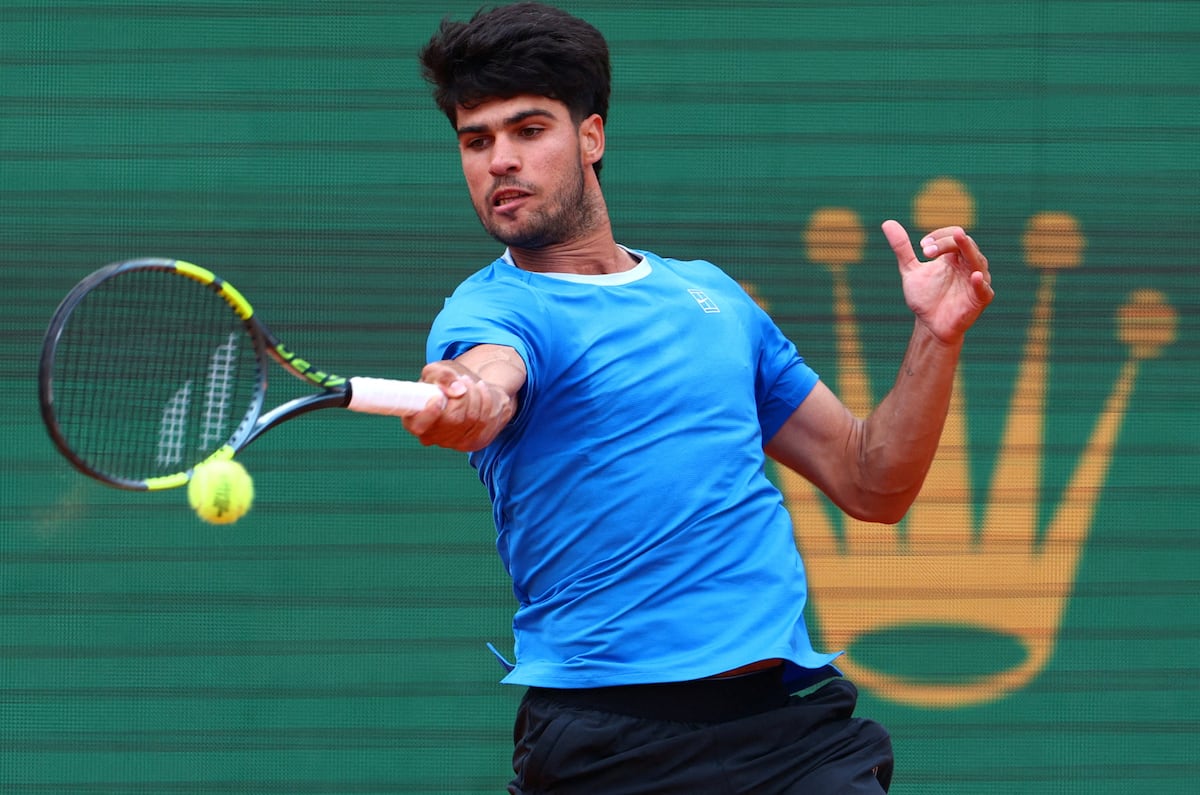
Carlos Alcaraz’s recent withdrawal from the Madrid Open due to a right arm injury has sparked widespread discussion in the tennis world, drawing comparisons to a magical wand breaking in the hands of a young wizard. The metaphor, evoked by Spanish media outlet EL PAÍS in a feature titled “Alcaraz o la varita mágica rota de Harry Potter,” reflects growing concern over the physical toll exacted on the 21-year-old Spaniard as he navigates a grueling schedule amid rising expectations. Even as the article uses a fictional analogy to highlight the fragility of even the most talismanic talent, verified reports confirm that Alcaraz’s absence stems from a recurring wrist issue that first surfaced during the Barcelona Open, forcing him to withdraw and hand a walkover to Tomas Machac in the second round.
This marks the second consecutive year that Alcaraz has withdrawn from the Madrid Open due to injury, a pattern that has raised questions about workload management and long-term sustainability in elite tennis. According to reports from La Voz de Galicia, the injury involves discomfort in the fibrocartilage or potential tenosynovitis — conditions affecting the tendons and connective tissue in the wrist — which Alcaraz himself described as better addressed by short-term rest than by risking long-term damage to his career. “It’s better to stop for a few weeks than to burden the rest of your career,” he reportedly said, underscoring a mature approach to physical preservation uncommon among players his age.
The timing of his withdrawal has had immediate ripple effects on the tournament draw. With Alcaraz absent, second-seeded Alexander Zverev advanced to the third round in Madrid after overcoming Mariano Navone in three sets. Speaking at a press conference following his win, Zverev expressed disappointment over Alcaraz’s absence, calling it “sad for tennis” while acknowledging the necessity of prioritizing health. “It’s sad. Sad for tennis. But as he said himself, he is very young and his career will be very long, and I think that is his priority,” Zverev stated, adding that the tour loses excitement when top players are sidelined. He also affirmed his belief in Jannik Sinner as a strong contender for the French Open title in Alcaraz’s stead.
Despite the setback, Alcaraz’s recent accomplishments remain among the most impressive in modern tennis history. Just months prior, on June 9, 2024, he captured his third Grand Slam title by defeating Alexander Zverev in a five-set Roland Garros final, winning 6-3, 2-6, 5-7, 6-1, 6-2. The victory, which lasted four hours and 19 minutes, made him the youngest man ever to win a major title on three different surfaces — hard, grass, and clay — surpassing even Rafael Nadal’s early achievements in this regard. Alcaraz had previously won the US Open (hard court) and Wimbledon (grass), completing the surface trifecta with his French Open triumph on the terre battue of Roland Garros.
His resilience during that final was particularly notable. After dropping the second and third sets, Alcaraz won 12 of the last 15 games to clinch the title, a feat last seen at Roland Garros when Rod Laver achieved it in 1962. He had also endured a grueling five-set semifinal win over Jannik Sinner, demonstrating remarkable mental fortitude despite arriving in Paris having not competed for three weeks due to the very arm injury that now plagues him again. “The last month we were struggling a lot with the injury,” Alcaraz told his team after the final. “Looking back to Madrid, I didn’t feel well. The next week there were a lot of doubts and then coming here and practising not too much. I am really grateful to have the team that I have and the people I have around.”
The physical demands of competing at the highest level have increasingly come under scrutiny, especially for young stars like Alcaraz who are expected to perform across all surfaces and throughout a near-yearlong season. His withdrawal from both the Italian Open and the upcoming French Open — announced via social media — was framed as a necessary step to recover fully before the grass-court swing, including Wimbledon. Medical experts note that wrist injuries in tennis players often stem from repetitive stress, particularly from the Western or semi-Western grips favored by modern baseliners, which place significant torque on the lead wrist during forehands and two-handed backhands.
While the exact diagnosis remains undisclosed by Alcaraz’s team, the conditions speculated in Spanish media — tenosynovitis and fibrocartilage lesions — are recognized as common overuse injuries in elite athletes. Tenosynovitis involves inflammation of the tendon sheath, often causing pain and restricted movement, while fibrocartilage damage can affect joint stability and load distribution. Both require careful management, including rest, targeted physiotherapy, and sometimes adjustments to technique or equipment. In Alcaraz’s case, the recurrence suggests a need for a deeper evaluation of his training load, recovery protocols, and scheduling.
Alexander Zverev, who has himself faced injury setbacks in recent seasons, echoed the sentiment that Alcaraz’s health must come first. Having won the Madrid Open in 2018 and 2021, Zverev is currently chasing a third title in the Spanish capital, a goal made more attainable by Alcaraz’s absence. Yet even as he benefits from the draw opening, Zverev has consistently praised Alcaraz’s character and competitive spirit, calling him a “Hall of Famer” already at 21 and lamenting that his rival’s absence diminishes the tournament’s prestige. “You won three different ones. It’s an amazing career already,” Zverev said after the Roland Garros final. “You’re already a Hall of Famer and you’ve already achieved so much.”
The broader implications of Alcaraz’s situation extend beyond individual tournaments. His case highlights the growing tension between commercial pressures — which favor constant visibility and participation — and the biological limits of adolescent athletes entering their physical prime. Tennis, unlike many team sports, offers no off-season in the traditional sense, with players expected to transition seamlessly from clay to grass to hard court with minimal recovery time. For a player of Alcaraz’s stature, whose game relies heavily on explosive movement, precise timing, and wrist-driven topspin, even minor discomfort can disrupt the kinetic chain essential to his performance.
As of now, there is no confirmed timeline for his return. Alcaraz has emphasized that he will not rush back, prioritizing long-term durability over short-term gains. His team has not released an official medical bulletin, and no tournament has listed him as an entry for upcoming events beyond the grass swing. Fans and analysts alike await updates, hoping that the young star will heed the advice implied by his own words: sometimes, the most powerful magic lies not in relentless force, but in knowing when to lower the wand and let it heal.
For ongoing developments regarding Carlos Alcaraz’s injury status and return to competition, readers are encouraged to consult official updates from the ATP Tour website and his verified social media channels, where any changes in his schedule or condition will be announced.
Related reading